
Search results: 449 results for “by Frantz Fanon”
Not finding what you're looking for? Check out our shop on bookshop.org to order and still support us ♥
449 results
-
Testimony Therapy: Decolonizing Mental Health for Black Therapists and Clients
![Testimony Therapy: Decolonizing Mental Health for Black Therapists and Clients cover image]()

Testimony Therapy: Decolonizing Mental Health for Black Therapists and Clients
$28.99Centering Black culture and community for liberating, anti-racist therapeutic practice.
This innovative book lays out the journey of family therapist Makungu Akinyela in developing testimony therapy―a healing practice rooted in Black cultural traditions of testifying and storytelling. This book argues that traditional Eurocentric approaches to therapy often perpetuate colonial oppression in the lives of Black clients, and that decolonizing mental health requires centering African American cultural knowledge, history, and community.
Drawing from thinkers from the Black radical critical tradition like Frantz Fanon and W. E. B. Du Bois, Dr. Akinyela frames testimony therapy as a narrative practice grounded in Ubuntu (the African communal self) and the oral traditions of African diasporic peoples. Testimony Therapy maps out theory, practices, and supervision approaches that help therapists support clients in resisting internalized racism, reclaiming self-definition, and nurturing liberated Black identities. Ultimately, this work is a call for Black therapists and clients to engage therapy as cultural resistance―a pathway to repair our souls and build collective freedom beyond Eurocentric limitations.
-
The Illusion of Power: Passion and Politics #1
![The Illusion of Power: Passion and Politics #1 cover image]()

The Illusion of Power: Passion and Politics #1
$26.99For fans of the New Camelot series by Sierra Simone and Kennedy Ryan’s All the King’s Men duet, comes The Illusion of Power. A spicy, contemporary romance that follows future First Lady, Selene Taylor, during the integral months of her husband's campaign for the Oval where she finds herself navigating the embarrassment of his infidelity, the dangers of being a Black woman in proximity to political power, and perhaps worst of all, falling for the two men tasked with protecting her.
-
Afropessimism
![Afropessimism]()
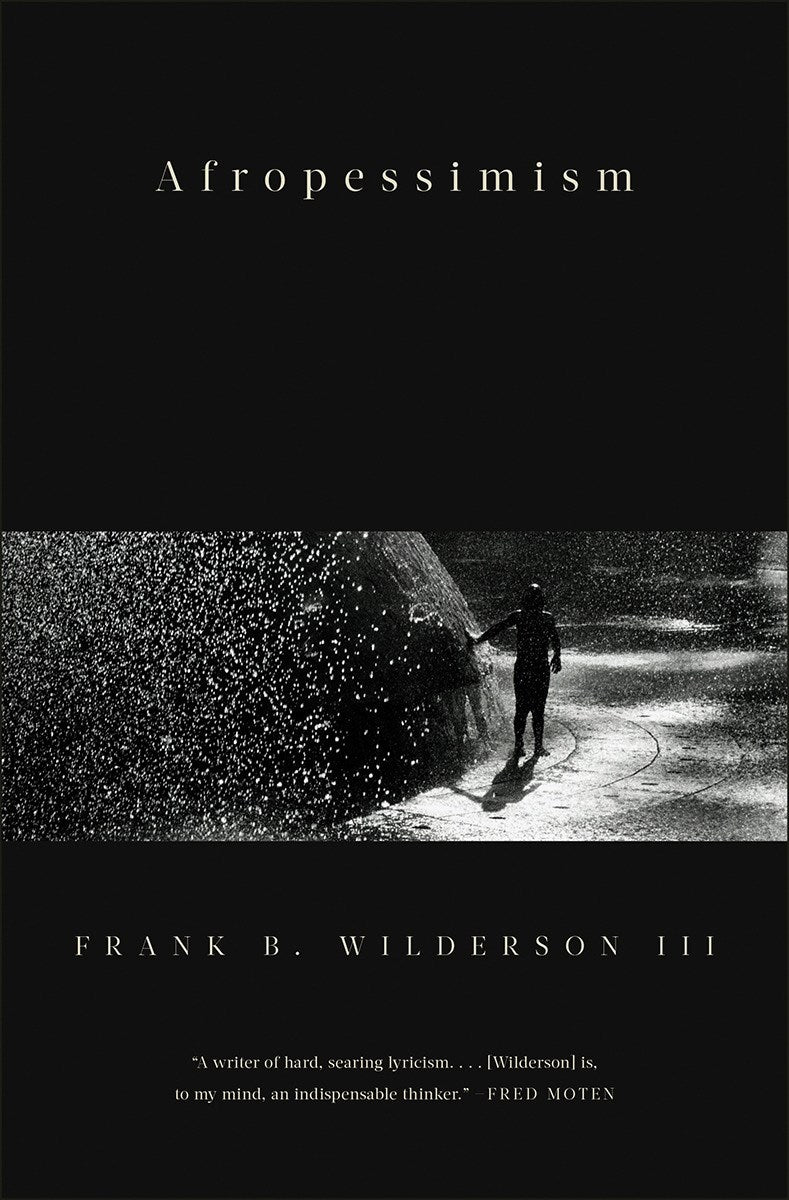
Afropessimism
by Frank B Wilderson III
from $18.95*ships in 7-10 business days
Longlisted • National Book Award (Nonfiction)
Combining trenchant philosophy with lyrical memoir, Afropessimism is an unparalleled account of Blackness.Why does race seem to color almost every feature of our moral and political universe? Why does a perpetual cycle of slavery—in all its political, intellectual, and cultural forms—continue to define the Black experience? And why is anti-Black violence such a predominant feature not only in the United States but around the world? These are just some of the compelling questions that animate Afropessimism, Frank B. Wilderson III’s seminal work on the philosophy of Blackness.
Combining precise philosophy with a torrent of memories, Wilderson presents the tenets of an increasingly prominent intellectual movement that sees Blackness through the lens of perpetual slavery. Drawing on works of philosophy, literature, film, and critical theory, he shows that the social construct of slavery, as seen through pervasive anti-Black subjugation and violence, is hardly a relic of the past but the very engine that powers our civilization, and that without this master-slave dynamic, the calculus bolstering world civilization would collapse. Unlike any other disenfranchised group, Wilderson argues, Blacks alone will remain essentially slaves in the larger Human world, where they can never be truly regarded as Human beings, where, “at every scale of abstraction, violence saturates Black life.”
And while Afropessimism delivers a formidable philosophical account of being Black, it is also interwoven with dramatic set pieces, autobiographical stories that juxtapose Wilderson’s seemingly idyllic upbringing in mid-century Minneapolis with the abject racism he later encounters—whether in late 1960s Berkeley or in apartheid South Africa, where he joins forces with the African National Congress. Afropessimism provides no restorative solution to the hatred that abounds; rather, Wilderson believes that acknowledging these historical and social conditions will result in personal enlightenment about the reality of our inherently racialized existence.
Radical in conception, remarkably poignant, and with soaring flights of lyrical prose, Afropessimism reverberates with wisdom and painful clarity in the fractured world we inhabit. It positions Wilderson as a paradigmatic thinker and as a twenty-first-century inheritor of many of the African American literary traditions established in centuries past.
-
Fences
![Fences]()
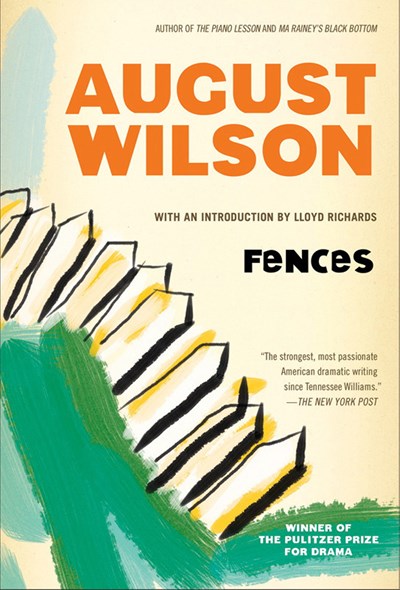
Fences
by August Wilson
$14.00*ships in 7-10 business days*Troy Maxson is a strong man, a hard man. He has had to be to survive. Troy Maxson has gone through life in an America where to be proud and black is to face pressures that could crush a man, body and soul. But the 1950s are yielding to the new spirit of liberation in the 1960s, a spirit that is changing the world Troy Maxson has learned to deal with the only way he can, a spirit that is making him a stranger, angry and afraid, in a world he never knew and to a wife and son he understands less and less. This is a modern classic, a book that deals with the impossibly difficult themes of race in America, set during the Civil Rights Movement of the 1950s and 60s.
Now an Academy Award-winning film directed by and starring Denzel Washington, along with Academy Award and Golden Globe winner Viola Davis. -
The Second Emancipation: Nkrumah, Pan-Africanism, and Global Blackness at High Tide
![The Second Emancipation: Nkrumah, Pan-Africanism, and Global Blackness at High Tide cover image]()

The Second Emancipation: Nkrumah, Pan-Africanism, and Global Blackness at High Tide
Howard W. French
$39.99Named one of the Most Anticipated Books of 2025 by Foreign Policy
“Howard French’s The Second Emancipation stands the second half of the last century on its geopolitical head.” ―David Levering Lewis, winner of the Pulitzer Prize
From the acclaimed author of Born in Blackness comes an extraordinary account of Africa’s liberation from colonial oppression, a work that fundamentally reshapes our understanding of modern history.
A work of epic dimension that recasts the liberation of twentieth-century Africa through the lens of revolutionary leader Kwame Nkrumah.
The Second Emancipation, the second work in a trilogy from best-selling author Howard W. French about Africa’s pivotal role in shaping world history, underscores Adam Hochschild’s contention that French is a “modern-day Copernicus.” The title―referring to a brief period beginning in 1957 when dozens of African colonies gained their freedom―positions this liberation at the center of a “movement of global Blackness,” with one charismatic leader, Kwame Nkrumah (1909–1972), at its head.
That so few people today know about Nkrumah is an omission that French demonstrates is “typical of our deliberate neglect of Africa’s enormous role in the birth of the modern world.” Determined to re-create Nkrumah’s life as “an epic twentieth-century story,” The Second Emancipation begins with his impoverished, unheralded birth in the far-western region of Ghana’s Gold Coast. But blessed with a deep curiosity, a young Nkrumah pursued an overseas education in the United States. Nowhere is French’s consummate style more vivid than in Nkrumah’s early years in Depression-era America, especially in his mesmerizing portrait of a culturally effervescent Harlem that Nkrumah encountered in 1935 before heading to college. During his student years in Pennsylvania and later as an activist in London, Nkrumah became steeped in a renowned international Black intellectual milieu―including Du Bois, Garvey, Fanon, Padmore, and C.L.R. James, who called him “one of the greatest political leaders of our century”―and formed an ideology that readied him for an extraordinarily swift and peaceful rise to power upon his return to Ghana in 1947.
Four years later, in a political landslide he engineered while imprisoned, Nkrumah stunned Britain by winning the first general election under universal franchise in Africa, becoming Ghana’s first independent prime minister in 1957. As leader of a sovereign nation, Nkrumah wielded his influence to promote the liberation of the entire continent, pushing unity as the only pathway to recover from the damages of enslavement and subjugation. By the time national military and police forces, aided by the CIA, overthrew him in 1966, Nkrumah’s radical belief in pan-African liberation had both galvanized dozens of nascent African states and fired a global agenda of Black power.
In its dramatic recasting of the American civil rights story and in its tragic depiction of a continent that once exuded all the promise of a newly won freedom, The Second Emancipation becomes a generational work that positions Africa at the forefront of modern-day history.
16 pages of illustrations; 3 maps
-
On Witness and Respair: Essays
![On Witness and Respair: Essays cover image]()

On Witness and Respair: Essays
$29.00The collected creative nonfiction of a singular American writer, Jesmyn Ward, including widely shared classics, three never-before-published speeches, and an introductory essay.
Respair (noun, obsolete), fresh hope after despair.
From the two-time National Book Award winner and New York Times bestselling author Jesmyn Ward, this collection of essays documents more than a decade of work in the life of a singular writer often lauded as “the heir apparent to Toni Morrison” (LitHub). Beginning with her upbringing in a multigenerational household in rural Mississippi, the cradle of both her youth and her gift for storytelling, Ward brings her keen wisdom and hauntingly lyrical prose to a range of topics, following in her grandmother Dorothy’s footsteps when she promises always to “Tell it straight. Tell it all.”
True to her word, in these pages Ward contemplates the writers and novels of her youth and adulthood—the transformative power of discovering Octavia Butler as a twenty-something, the mirror that Richard Wright’s novels held up to her own childhood, and of course, her lifelong love for Toni Morrison. Ward ruminates on her approach to both fiction and life, reflecting on the power of the novel, how to raise a Black son in an era of rising divisiveness and cruelty, as well as her own personal tragedies—including the titular essay of the collection, which tells the story of her partner’s sudden death on the eve of the COVID-19 epidemic. Every bit as piercing and moving as her fiction, On Witness and Respair is a testament to Ward’s powers as “one of America’s finest living writers” (San Francisco Chronicle) and is a monument to hope, beauty, and personal and collective resilience.
-
A Map to the Door of No Return: Notes to Belonging
![A Map to the Door of No Return: Notes to Belonging cover image]()

A Map to the Door of No Return: Notes to Belonging
$19.00Now in its first American edition, Dionne Brand's groundbreaking A Map to the Door of No Return has emerged as a modern classic, a highly influential exploration of "being" in the Black Diaspora.
Since its first publication in 2001, Dionne Brand's groundbreaking exploration of being in the Black Diaspora, A Map to the Door of No Return, has emerged as a modern classic. The door, in Brand's iconic schema, represents the point of rupture where the ancestors of the Black Diaspora departed one world for another: the place where all names were forgotten, and all beginnings recast. "This door," writes Brand, "is not mere physicality. It is a spiritual location . . . Since leaving was never voluntary, return was, and still may be, an intention, however deeply buried. There is as it says no way in; no return."
Through shards of history, memoir, lyrical investigation, and the unwritten experience of so many descendants of those who passed through the door, Brand constructs a map of this indelible region, culminating in an enduring expression, both definitive and seeking, of what it is to live, think, and create in the wake of colonization.
With a new preface by the author, and an afterword by Saidiya Hartman.
-
See Me: Prison Theater Workshops and Love
![See Me: Prison Theater Workshops and Love]()

See Me: Prison Theater Workshops and Love
by Jan Cohen-Cruz
$25.95See Me is a collection of intimate dialogues about collective experiences in the context of prison theater workshops. Each essay is a collaboration between two or three people who connected profoundly in the temporary community that a workshop can create. Part I is an exchange grounded in the prison theater workshop between the author and one of the incarcerated participants. They alternately tell the story of what they found in the workshop, each other, the future they imagined together, and the social turmoil and utopian aspirations of the times. Part II consists of essays jointly written by eight other people impacted by close relationships spawned in diverse in-prison and re-entry theater workshops.
-
salvation
![salvation]()

salvation
by bell hooks
$18.99“A manual for fixing our culture…In writing that is elegant and penetratingly simple, [hooks] gives voice to some things we may know in our hearts but need an interpreter like her to process.”—Black Issues Book Review Written from both historical and cultural perspectives, Salvation takes an incisive look at the transformative power of love in the lives of African Americans. Whether talking about the legacy of slavery, relationships and marriage in Black life, the prose and poetry of Martin Luther King, Jr., James Baldwin, and Maya Angelou, the liberation movements of the 1950s, 60s, and 70s, or hip hop and gangsta rap culture, hooks lets us know what love’s got to do with it.
Combining the passionate politics of W.E.B. DuBois with fresh, contemporary insights, hooks brilliantly offers new visions that will heal our nation’s wounds from a culture of lovelessness. Her writings on love and its impact on race, class, family, history, and popular culture raise all the relevant issues. This is work that helps us heal. Salvation shows us how to create beloved American communities.
-
Chain of Ideas: The Origins of Our Authoritarian Age
![Chain of Ideas: The Origins of Our Authoritarian Age cover image]()

Chain of Ideas: The Origins of Our Authoritarian Age
Ibram X. Kendi
$35.00The National Book Award-winning historian of Stamped from the Beginning charts how “great replacement theory” has moved from the margins to become the most dominant political theory of our time—and what we can do to safeguard democracy from this insidious threat.
Recall the words chanted in Charlottesville, Virginia, but heard around the world: “You will not replace us!” Recall the string of mass shooters around the world—in Oslo and Christchurch, Buffalo, El Paso, and Pittsburgh—who claimed their crimes were a defense against “White genocide.” Recall business and media figures cultivating anxiety and furor over demographic change. These incidents only scratch the surface of this ascendant idea: Popular and ruling politicians in every region of the world have been expressing some version of great replacement theory, eroding democratic norms in the name of preventing demographic change and restoring national greatness.
What is great replacement theory? Variations on the theory have existed for centuries, but it was given this name by a French novelist in 2011 who believed Black and Brown immigrants were “invading” Europe, brought by shadowy elites to “replace” Europe’s White population. From there, politicians and theorists—whether in the United States or the United Kingdom, Germany or Chile, Hungary or Australia—repackaged the conspiracy as a story of “globalists” welcoming “migrant criminals” and diversity initiatives to take away the jobs, cultures, electoral power, and the very lives of White people. Over time, great replacement theory has expanded the threat to include citizens, men, Jews, Christians, heterosexuals, and ethnic majorities in countries as distinct as Russia, El Salvador, Brazil, Italy, and India. All are targeted with the message that they are under an existential attack that only a strongman can prevent.
In our fast-shifting political landscape, most people are unfamiliar with this theory’s origins and its spread, which isn’t a coincidence. In Chain of Ideas, international bestselling author Ibram X. Kendi uses exacting and clear prose to uncover the roots of great replacement theory and its various mutations around the world. It is an unsettling but indispensable global history of how great replacement theory brought humanity into this authoritarian age—and how we can free ourselves from it. -
Perfect Peace: A Novel
![Perfect Peace: A Novel cover image]()

Perfect Peace: A Novel
Daniel Black
$19.00As seen on TikTok, Daniel Black’s Perfect Peace is the heartbreaking portrait of a large, rural southern family’s attempt to grapple with their mother’s desperate decision to make her newborn son into the daughter she will never have―“a complex, imaginative story of one unforgettable black family in mid-twentieth century Arkansas” (Atlanta Magazine).
When the seventh child of the Peace family, named Perfect, turns eight, her mother Emma Jean tells her bewildered daughter, “You was born a boy. I made you a girl. But that ain’t what you was supposed to be. So, from now on, you gon’ be a boy. It’ll be a little strange at first, but you’ll get used to it, and this’ll be over after while.”
From this point forward, Perfect’s life becomes a bizarre kaleidoscope of events―while the rest of his family is forced to question everything they thought they knew about gender, sexuality, unconditional love, and fulfillment.
“A morality tale of the consequences of letting our selfish needs trap the ones we love into roles they weren’t born to play. The characters here are as flawed, their sins numerous, as any living human being held under the lens, but the author brings a compassion and understanding to their plights.”―Mat Johnson, award-winning author of Invisible Things
“Part cautionary tale, part folk tale, part fable, Daniel Black’s Perfect Peace is a complete triumph…In Emma Jean Peace, Dr. Black has created a character as complex, equivocal and unforgettable as Scarlett O'Hara.”―Larry Duplechan, Lambda Literary Award-winning author of Got ’Til It’s Gone
-
My Bondage and My Freedom: The Givens Collection
![My Bondage and My Freedom: The Givens Collection cover image]()

My Bondage and My Freedom: The Givens Collection
Frederick Douglass
$26.95My Bondage and My Freedom is the second of three published autobiographies from one of the most brilliant and eloquent abolitionists and human rights activists in American history. The Narrative of the Life of Frederick Douglass, an American Slave was published ten years before in 1845, while The Life and Times of Frederick Douglass was published twenty-five years later.


Stay Informed. We're building a community committed to celebrating Black authors + artisans. Subscribe to keep up with all things Kindred Stories.