
Search results: 1000 results for “by Frantz Fanon”
Not finding what you're looking for? Check out our shop on bookshop.org to order and still support us ♥
1000 results
-
Working Cures: Healing, Health, and Power on Southern Slave Plantations
![Working Cures: Healing, Health, and Power on Southern Slave Plantations]()

Working Cures: Healing, Health, and Power on Southern Slave Plantations
by Sharla M. Fett
$44.95Exploring the charged topic of black health under slavery, Sharla Fett reveals how herbalism, conjuring, midwifery, and other African American healing practices became arts of resistance in the antebellum South.
Working Cures : Healing, Health, and Power on Southern Slave Plantations
Exploring the charged topic of black health under slavery, Sharla Fett reveals how herbalism, conjuring, midwifery, and other African American healing practices became arts of resistance in the antebellum South.
Fett shows how enslaved men and women drew on African precedents to develop a view of health and healing that was distinctly at odds with slaveholders' property concerns. While white slaveowners narrowly defined slave health in terms of "soundness" for labor, slaves embraced a relational view of health that was intimately tied to religion and community. African American healing practices thus not only restored the body but also provided a formidable weapon against white objectification of black health.
Enslaved women played a particularly important role in plantation health culture: they made medicines, cared for the sick, and served as midwives in both black and white households. Their labor as health workers not only proved essential to plantation production but also gave them a basis of authority within enslaved communities. Not surprisingly, conflicts frequently arose between slave doctoring women and the whites who attempted to supervise their work, as did conflicts related to feigned illness, poisoning threats, and African-based religious practices. By examining the deeply contentious dynamics of plantation healing, Fett sheds new light on the broader power relations of antebellum American slavery. -
Keeper of Lost Children
![Keeper of Lost Children cover image]()

Keeper of Lost Children
from $20.00*Paperback Release Date - 2/2/2027*
In this new novel from the New York Times bestselling author of The House of Eve, one American woman’s vision in post WWII Germany will tie together three people in an unexpected way.
Ethel Gathers, the proud wife of an American Officer, is living in Occupied Germany in the 1950s. After discovering a local orphanage filled with the abandoned mixed-race children of German women and Black American GI’s, Ethel feels compelled to help find these children homes.
Philadelphia born Ozzie Phillips volunteers for the recently desegregated army in 1948, eager to make his mark in the world. While serving in Manheim, Germany, he meets a local woman, Jelka, and the two embark on a relationship that will impact their lives forever.
In 1965 Maryland, Sophia Clark is given an opportunity to attend a prestigious all white boarding school and escape her heartless parents. While at the school, she discovers a secret that upends her world and sends her on a quest to unravel her own identity.
Toggling between the lives of these three individuals, Keeper of Lost Children explores how one woman’s vision will change the course of countless lives, and demonstrates that love in its myriad of forms—familial, parental, and forbidden, even love of self—can be transcendent. -
Everything We Thought Was Beautiful: Interviews with Radical Palestinian Women
![Everything We Thought Was Beautiful: Interviews with Radical Palestinian Women cover image]()

Everything We Thought Was Beautiful: Interviews with Radical Palestinian Women
Shoal Collective
$19.95Palestinian women are an essential—often silenced—part of global struggles for freedom. They are at the forefront of the anti-colonial struggle against Israel’s occupation of their lands, as well as being comrades in intersecting movements worldwide.
This series of interviews with Palestinian women living across Palestine and in the diaspora include a journalist on the front line of resistance against settlers and the Israeli army in the West Bank, a BDS activist, a doctor exposing Israel’s deliberate targeting of medical infrastructure as part of its genocidal assault on Gaza, an organiser who critiques the Palestinian Authority’s repression of social media and those making their voices heard in the diaspora, and others.
Everything We Thought Was Beautiful: Interviews with Radical Palestinian Women broadcasts these women’s struggles in their own words and on all fronts—against colonialism, white supremacy, conservatism, patriarchy, state control—and Israel’s occupation. They discuss their politics, the fight for freedom, and their hope for the future.
Complied by Shoal Collective, a co-operative of independent writers and researchers writing for social justice and a world beyond capitalism, the voices include Ayah Al-Ghazzawi, Lina Nabulsy, Samah Fadil, Diana Khwaelid, Shahd Abusalama, Sireen Khudairy, Lama Suleiman, Shrouq Aila, Rana Abu Rahmah, Shatha Abu Srour, Ghada Hamdan, Mona Al-Farra, and Faiza Abu Shamsiyah with a Foreword by Huwaida Arraf.
-
Africanamerican't
![Africanamerican't]()

Africanamerican't
by Ayokunle Falomo
$16.00If the question is America-and by extension, who is and what does it mean to be American? -AFRICANAMERICAN'T offers no answers. The CAN'T in the title suggests impossibility and that is precisely what the book is interested in. Even in the so-called land of opportunity, some things remain impossible for its speaker(s). In a way, AFRICANAMERICAN'T is a document of attempted refusals: assimilation, forgetting, and allegiance to any one country. However valid despair might be as a response to the continued failings of his two countries, Ayokunle Falomo traverses the distance between betrayal and love in an attempt to find poetry-and perhaps, something like hope-in all the places it can't be found.
-
PRE-ORDER: Tending to Our Wounds: A Diasporic Memoir
![Tending to Our Wounds: A Diasporic Memoir cover image]()

PRE-ORDER: Tending to Our Wounds: A Diasporic Memoir
$24.95A profound and poetic memoir, tracing the wounds that racism and colonialism have left on Black people across borders.
With astute insight and immersive prose, Bonhomme outlines a personal and political history of life in the United States, Haiti, and Germany, discovering what it means to be Black at home and abroad. She unlearns the lies that she was told about slavery and colonialism and explores how communities are resisting the weight of centuries of history.
Whether examining debt, medical racism, art, or reparations, Tending to Our Wounds cuts a breathtaking course between the past and the present, the individual and the collective―identifying the tendrils of history in the everyday and outlining a path to real freedom.
-
Afro-Decolonial Manifesto (Quilombola)
![Afro-Decolonial Manifesto (Quilombola) cover image]()

Afro-Decolonial Manifesto (Quilombola)
Norman Ajari
$21.00Offering a compelling call to arms while challenging the pervasive grip of colonialism on the Black psyche, this manifesto charts a course toward a future defined by autonomy, dignity, and radical liberation.
Delving into the historical currents of resistance—from Negritude to Black nationalism to pan-Africanism—this manifesto unapologetically confronts the insidious nature of modern colonialism. In a world where the very presence of the Black body incites fear and insecurity among white supremacists, Afro-Decolonial Manifesto exposes the fallacy of equating Black existence with reverse colonialism. It challenges the prevailing narratives of gratitude and guilt, asserting the right of the Black diaspora to reclaim its autonomy and dignity, and also examines the effectiveness of movements like Black Lives Matter, advocating for a renewed Black internationalism rooted in Africa’s unity and autonomy.
In a stirring call to arms, Afro-Decolonial Manifesto heralds a new era of resistance, where reparation becomes not just a demand for restitution, but a catalyst for radical change. This volume emboldens Black people to reclaim their narrative, their agency, and their future. It is a testament to the enduring spirit of liberation and the indomitable resilience of Black lives.
-
The New Book: A Powerful Collection from Nikki Giovanni, America's Celebrated Poet and Indispensable Radical Orator
![The New Book: A Powerful Collection from Nikki Giovanni, America's Celebrated Poet and Indispensable Radical Orator cover image]()

The New Book: A Powerful Collection from Nikki Giovanni, America's Celebrated Poet and Indispensable Radical Orator
Nikki Giovanni
from $19.99*Paperback Release Date - 3/2/2027*
Nikki Giovanni’s extraordinary final collection—a landmark of American literature—speaks to the fury of our current political moment while reflecting on the tragedies and triumphs of her early life.
For decades, Nikki Giovanni’s poetry has been at the forefront of American culture. The New Book is a towering work of protest against the divisions of our time, leavened with moments of joy and reflection about her indelible legacy, her family history, and the small pleasures of her richly lived life.
In The New Book, Nikki Giovanni slashes at the ridiculousness of our cultural and political climate: “We have no secrets/since the world shrunk/and the icebergs melted/and all the year books/are digitized./… and we press Like/or No Like/as if it mattered.”
She remembers 2020 and its cataclysmic reckoning with police brutality and white supremacy: “I do understand that republicans/Are cowards and so are those nazis/Cheering/And those kkk we now call police killing/Not to mention father and sons chasing unarmed Black men/and running their cars into crowds/Pretending they are brave or something/They are not only cowards/And nazis but evil fools/And who go to bed white/Wake up American/And hate themselves for having/To share this earth/They will not overcome/And we will not love them.”
But also in the same poem: “But what does 2020 mean to me/A chance to learn to open oysters/Talk to my friends/Catch up on my reading/Tell myself I am going to dust the house/Lie about it/...Enjoy my own company not to mention football/And remember there will be tomorrow/Because there will be/And evil will go and good will come/I am Black/We have seen much worse.”
With this collection, which includes brief letters and short prose from her life as well as poetry, Giovanni reaffirms her place as a giant of literature, a canny truth-teller, an indispensable radical orator, and one of America’s preeminent cultural critics. It is a book to be savored, and shared.
"If there was a need for poetry that galvanized and inspired, there was also a demand for poetry that comforted and unified — and Ms. Giovanni provided on both counts." — The Washington Post
-
Without Terminus: untraining an archive
![Without Terminus: untraining an archive cover image]()

Without Terminus: untraining an archive
$18.00A dazzlingly inventive account of kinship and dispossession by a two-time Minnesota Book Award–winning author
In his first work of nonfiction, poet chaun webster blends memoir, archival research, visual poetics, and cultural criticism to trace the ways structural anti-Black violence has shaped his inheritance, and grapples with the question of how to know―and mourn―the kin he was never able to meet.
webster is particularly drawn to his grandfather Reginald, who worked for years as a Pullman porter, who was denied rest while his labor enabled rest for others, and who died without receiving a pension before webster was born. Returning to the figures of Reginald and the train, webster explores the relationship between comportment and confinement, speaking in tongues in the Pentecostal church, the ancestral meeting place of dreams, his fraught relationship with his mother, and moments with his own child. Throughout, webster also reflects on nonbiological kinship, tethering his and his predecessors’ lives to those of several historical Black figures―Harriet Jacobs, John Henry, Henry “Box” Brown, and Henry Dumas, a writer who was killed by New York City police while riding the subway.
Attempting to exhaust the possibilities of the sentence and the grammar of anti-Blackness, webster riffs and rails on the debris within reach. Part elegy, part archival detective story, and part visual poem, Without Terminus is a philosophically rigorous and deeply moving text that takes us beyond the archive of loss.
-
Born in Blackness: Africa, Africans, and the Making of the Modern World, 1471 to the Second World War
![Born in Blackness: Africa, Africans, and the Making of the Modern World, 1471 to the Second World War]()
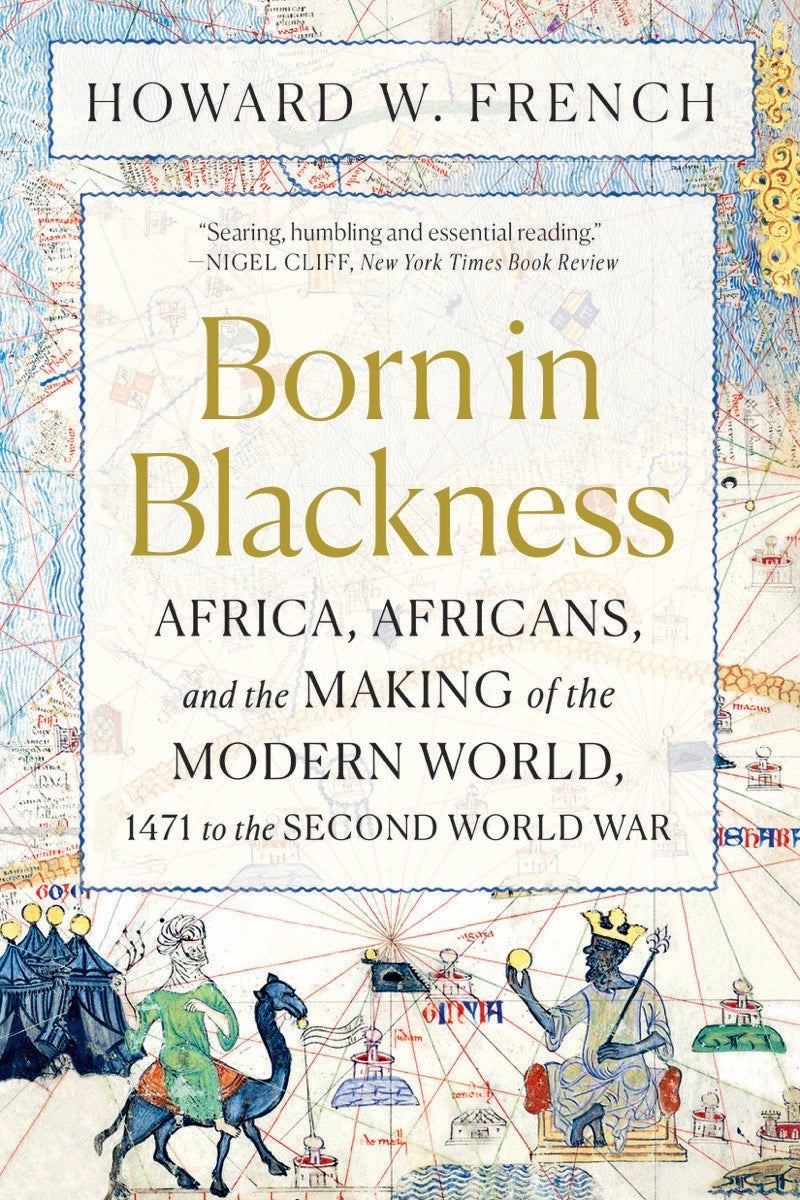
Born in Blackness: Africa, Africans, and the Making of the Modern World, 1471 to the Second World War
by Howard W. French
$19.95Revealing the central yet intentionally obliterated role of Africa in the creation of modernity, Born in Blackness vitally reframes our understanding of world history. Traditional accounts of the making of the modern world afford a place of primacy to European history. Some credit the fifteenth-century Age of Discovery and the maritime connection it established between West and East; others the accidental unearthing of the “New World.” Still others point to the development of the scientific method, or the spread of Judeo-Christian beliefs; and so on, ad infinitum. The history of Africa, by contrast, has long been relegated to the remote outskirts of our global story. What if, instead, we put Africa and Africans at the very center of our thinking about the origins of modernity?
In a sweeping narrative spanning more than six centuries, Howard W. French does just that, for Born in Blackness vitally reframes the story of medieval and emerging Africa, demonstrating how the economic ascendancy of Europe, the anchoring of democracy in the West, and the fulfillment of so-called Enlightenment ideals all grew out of Europe’s dehumanizing engagement with the “dark” continent. In fact, French reveals, the first impetus for the Age of Discovery was not—as we are so often told, even today—Europe’s yearning for ties with Asia, but rather its centuries-old desire to forge a trade in gold with legendarily rich Black societies sequestered away in the heart of West Africa.
Creating a historical narrative that begins with the commencement of commercial relations between Portugal and Africa in the fifteenth century and ends with the onset of World War II, Born in Blackness interweaves precise historical detail with poignant, personal reportage. In so doing, it dramatically retrieves the lives of major African historical figures, from the unimaginably rich medieval emperors who traded with the Near East and beyond, to the Kongo sovereigns who heroically battled seventeenth-century European powers, to the ex-slaves who liberated Haitians from bondage and profoundly altered the course of American history.
While French cogently demonstrates the centrality of Africa to the rise of the modern world, Born in Blackness becomes, at the same time, a far more significant narrative, one that reveals a long-concealed history of trivialization and, more often, elision in depictions of African history throughout the last five hundred years. As French shows, the achievements of sovereign African nations and their now-far-flung peoples have time and again been etiolated and deliberately erased from modern history. As the West ascended, their stories—siloed and piecemeal—were swept into secluded corners, thus setting the stage for the hagiographic “rise of the West” theories that have endured to this day.
“Capacious and compelling” (Laurent Dubois), Born in Blackness is epic history on the grand scale. In the lofty tradition of bold, revisionist narratives, it reframes the story of gold and tobacco, sugar and cotton—and of the greatest “commodity” of them all, the twelve million people who were brought in chains from Africa to the “New World,” whose reclaimed lives shed a harsh light on our present world.
-
The Autobiography of Malcolm X (As Told to Alex Haley)
![The Autobiography of Malcolm X (As Told to Alex Haley) cover image]()

The Autobiography of Malcolm X (As Told to Alex Haley)
$22.00ONE OF TIME’S TEN MOST IMPORTANT NONFICTION BOOKS OF THE TWENTIETH CENTURY
In the searing pages of this classic autobiography, originally published in 1965, Malcolm X, the Muslim leader, firebrand, and anti-integrationist, tells the extraordinary story of his life and the growth of the Black Muslim movement. His fascinating perspective on the lies and limitations of the American Dream, and the inherent racism in a society that denies its nonwhite citizens the opportunity to dream, gives extraordinary insight into the most urgent issues of our own time. The Autobiography of Malcolm X stands as the definitive statement of a movement and a man whose work was never completed but whose message is timeless. It is essential reading for anyone who wants to understand America.
Praise for The Autobiography of Malcolm X
“Extraordinary . . . a brilliant, painful, important book.”—The New York Times
“This book will have a permanent place in the literature of the Afro-American struggle.”—I. F. Stone
-
Until the Last Yoke Is Broken: The Constitutional Vision of Frederick Douglass
![Until the Last Yoke Is Broken: The Constitutional Vision of Frederick Douglass cover image]()

Until the Last Yoke Is Broken: The Constitutional Vision of Frederick Douglass
$29.95A groundbreaking analysis of Frederick Douglass as constitutional theorist, showing how his vision, which prefigured today’s originalism, melded history and natural rights to address the evil of slavery.
In his celebrated address “What to the Slave is the Fourth of July?” Frederick Douglass denounced America’s hypocritical celebration of freedom. But he did not blame the nation’s founding document for enabling the evil of slavery. Rather, he proclaimed that “interpreted as it ought to be interpreted, the Constitution is a Glorious Liberty Document.”
This was no mere rhetorical flourish. Examining Douglass not just as an activist but as a legal and political theorist, Until the Last Yoke Is Broken reveals that his abolitionism was guided by rigorous constitutional interpretation. Reconstructing Douglass’s method from his speeches and writings, Bradley Rebeiro shows that his approach both anticipated and challenged aspects of contemporary originalism. Like today’s originalists, Douglass saw historical meaning as central to constitutional analysis. But unlike today’s originalism, Douglass’s goes beyond simply asking how the Constitution was understood at its ratification. Instead, Douglass insisted that whenever a constitutional provision is ambiguous, the interpreter must adopt whatever meaning best agrees with the natural rights affirmed in the Declaration of Independence.
Rebeiro also shows how Douglass balanced this constitutional vision with pragmatism during Reconstruction. When political tensions pitted the fate of black suffrage against women’s suffrage, Douglass set aside the theoretically pure for the politically possible; as soon as black suffrage was secured, he returned to advocating for universal voting rights. “It was mine to stand for the freedom of people of all colors,” Douglass wrote near the end of his life, “until in our land the last yoke was broken and the last bondsman was set free.”
-
Honeypot
![Honeypot]()

Honeypot
by E. Patrick Johnson
$26.95E. Patrick Johnson's Honeypot opens with the fictional trickster character Miss B. barging into the home of Dr. EPJ, informing him that he has been chosen to collect and share the stories of her people. With little explanation, she whisks the reluctant Dr. EPJ away to the women-only world of Hymen, where she serves as his tour guide as he bears witness to the real-life stories of queer Black women throughout the American South. The women he meets come from all walks of life and recount their experiences on topics ranging from coming out and falling in love to mother/daughter relationships, religion, and political activism. As Dr. EPJ hears these stories, he must grapple with his privilege as a man and as an academic, and in the process he gains insights into patriarchy, class, sex, gender, and the challenges these women face. Combining oral history with magical realism and poetry, Honeypot is an engaging and moving book that reveals the complexity of identity while offering a creative method for scholarship to represent the lives of other people in a rich and dynamic way.


Stay Informed. We're building a community committed to celebrating Black authors + artisans. Subscribe to keep up with all things Kindred Stories.