
Search results: 14 results for “by Gordon Parks”
Not finding what you're looking for? Check out our shop on bookshop.org to order and still support us ♥
14 results
-
Gordon Parks: How the Photographer Captured Black and White America
![Gordon Parks: How the Photographer Captured Black and White America]()
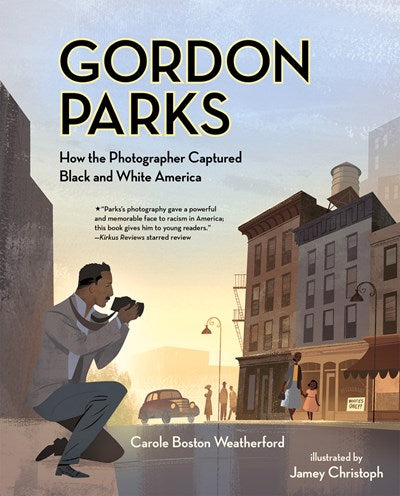
Gordon Parks: How the Photographer Captured Black and White America
by Carole Boston Weatherford
$16.99*Ships in 7-10 Business Days*
His white teacher tells her all-black class, You'll all wind up porters and waiters. What did she know? Gordon Parks is most famous for being the first black director in Hollywood. But before he made movies and wrote books, he was a poor African American looking for work. When he bought a camera, his life changed forever. He taught himself how to take pictures and before long, people noticed. His success as a fashion photographer landed him a job working for the government. In Washington DC, Gordon went looking for a subject, but what he found was segregation. He and others were treated differently because of the color of their skin. Gordon wanted to take a stand against the racism he observed. With his camera in hand, he found a way. Told through lyrical verse and atmospheric art, this is the story of how, with a single photograph, a self-taught artist got America to take notice.
-
A Choice of Weapons
![A Choice of Weapons]()
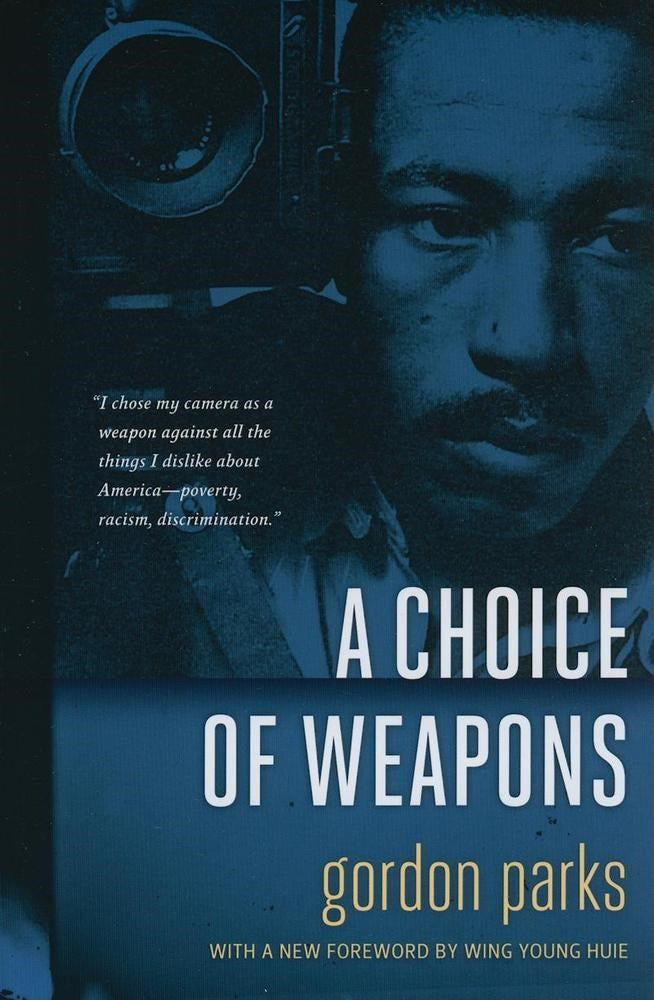
A Choice of Weapons
by Gordon Parks
$18.95*This item will ship or be ready for pick up in 7-10 business days
Gordon Parks (1912–2006)—the groundbreaking photographer, writer, composer, activist, and filmmaker—was only sixteen in 1928 when he moved from Kansas to St. Paul, Minnesota, after his mother's death. There, homeless and hungry, he began his fight to survive, to educate himself, and to fulfill his potential dream.
This compelling autobiography, first published in 1966, now back in print by popular demand and with a new foreword by Wing Young Huie, tells how Parks managed to escape the poverty and bigotry around him and to launch his distinguished career by choosing the weapons given him by "a mother who placed love, dignity, and hard work over hatred." Parks, the first African American to work at Life magazine and the first to write, direct, and score a Hollywood film, told an interviewer in 1999, "I saw that the camera could be a weapon against poverty, against racism, against all sorts of social wrongs. I knew at that point I had to have a camera."
Praise for A Choice of Weapons
"A perceptive narrative of one man's struggle to realize the values (defined as democratic and especially American) he has been taught to respect." —New York Times Book Review
"A lean, well-written memoir."—Time -
PRE-ORDER: Diary of a Harlem Family, 1967/1968
![Diary of a Harlem Family, 1967/1968 cover image]()

PRE-ORDER: Diary of a Harlem Family, 1967/1968
$75.00On 8 March 1968, Life magazine published “A Harlem Family” by Gordon Parks, a searing portrait of poverty in the United States, told through images and text about a single family residing in Harlem, the Fontenelles. On the twentieth anniversary of The Gordon Parks Foundation, this new, expanded study considers this story as a pivotal moment in Parks’ life, and one that launched his career in film. Since the publication in 2012 of a book devoted to Parks’ photo essay, additional images belonging to the series have been discovered, and research has been conducted on the accompanying film, Diary of a Harlem Family (1968). The present volume tells the story of Parks’ project through this updated lens. This material is accompanied by previously unpublished texts and ephemera related to the project, including correspondence and other documents Parks amassed over the years while he kept in touch with the Fontenelles, letters written by Life readers showing an outpouring of support for the family, and the transcript of a conversation between Parks and Michael Torosian about the making of the story. Essays by Studio Museum of Harlem director and chief curator Thelma Golden, Oscar-winning author Cord Jefferson, and noted scholars Leigh Raiford and Michael Boyce Gillespie offer enlightening commentary on this seminal body of work. Co-published with The Gordon Parks Foundation
-
Born Black: A Personal Report on the Decade of Black Revolt 1960-1970
![Born Black: A Personal Report on the Decade of Black Revolt 1960-1970 cover image]()

Born Black: A Personal Report on the Decade of Black Revolt 1960-1970
Gordon Parks
$65.00*Ships/ready for pick up in 5-8 business days*
Originally published in 1971, Gordon Parks’ Born Black was the first book to unite his writing and his photography. It was also the first to provide a focused survey of Parks’ documentation of a crucial time for the civil rights and Black Power movements. Today, more than 50 years later, this expanded edition of Born Black illuminates Parks’ vision for the book and offers deeper insight into the series within it. The original publication featured nine articles commissioned by Life magazine from 1963 to 1970―some never-before published―supplemented with later commentary by Parks and presented as his personal account of these important historical moments. Born Black includes the original text and images, as well as additional photographs from each series, spreads from the 1971 book, early correspondence, reproductions of related Life articles, and new scholarly essays. The nine series selected by Parks for Born Black―a rare glimpse inside San Quentin State Prison; extensive documentation of the Black Muslim movement and the Black Panthers; his commentaries on the deaths of civil rights leaders Malcolm X and Martin Luther King, Jr.; intimate portrait studies of Stokely Carmichael, Muhammad Ali and Eldridge Cleaver; and a narrative of the daily life of the impoverished Fontenelle family in Harlem―have come to define his legendary career as a photographer and activist. This reimagined, comprehensive edition of Born Black highlights the lasting legacy of these projects and their importance to our understanding of critical years in American history. Co-published with The Gordon Parks Foundation
-
PRE-ORDER: New City, Old Blues: The Gordon Parks Foundation / Steidl Book Prize
![New City, Old Blues: The Gordon Parks Foundation / Steidl Book Prize cover image]()

PRE-ORDER: New City, Old Blues: The Gordon Parks Foundation / Steidl Book Prize
$45.00For more than a decade, Andre D. Wagner has explored and documented New York City street life, with a particular focus on the changing landscape of Bushwick, Brooklyn, where he has lived and worked since 2011. His work offers an intimate portrait of city life shaped by connection, responsibility and care. Born in Omaha, Nebraska, Wagner came to New York to pursue a degree in social work, but ultimately found his voice through the camera. He is also deeply committed to photographic processes, developing his own black-and-white negatives and making gelatin silver prints in his own darkroom. Wagner’s work belongs to a lineage of American street photography that investigates the social landscape and addresses questions of race, class and identity. His photographs capture the joys and hardships of Black life in the city: moments of tenderness and distance, humor and melancholy, solitude and communion. This publication, representing the 2025 Gordon Parks Foundation / Steidl Book Prize, features work made between 2014 and 2024, much of it never published before. The book also includes an essay by the acclaimed writer Hanif Abdurraqib. Co-published with The Gordon Parks Foundation
-
If Emmett Till Lived: A Creative Monument
![If Emmett Till Lived: A Creative Monument cover image]()

If Emmett Till Lived: A Creative Monument
$49.95Meditating on the legacies of racial injustice in America: a photographic reimagining of Emmett Till’s life had it not been cut short
Published with Museum of Contemporary Photography at Columbia College Chicago.
This book honors the life, death and legacy of Emmett Till through a kaleidoscope of 20th- and 21st-century photography. Both a reckoning with the past and a probing investigation into the current state of American life, If Emmett Till Lived presents a fictionalized narrative of the life Emmett Till might have lived had he returned home in 1955, rather than being murdered at the age of 14 while visiting family in Mississippi, a victim of the racial terror of Jim Crow rule. Curated by writer and scholar Sarah Lewis, the more than 100 photographs from dozens of artists are drawn from the permanent collection of the Museum of Contemporary Photography. Her selection of works recalls small but not insignificant moments in Till’s childhood as well as larger themes from his life’s unfulfilled promise. Collectively, Lewis’ selections present a poetic and profound photographic account of quotidian moments from a childhood and adulthood unrealized. These photographs speak to the absence of images of Till’s life beyond the age of 14. In filling that void, the exhibition more broadly addresses the lasting impact of racialized violence in the United States across generations, ultimately offering a framework for considering how freedom is secured on American ground.
Photographers include: Dawoud Bey, Keith Carter, Teju Cole, Bruce Davidson, An-My Lê, Danny Lyon, Sally Mann, Diana Matar, Gordon Parks, Walter Rosenblum, Carrie Mae Weems. -
Black Photojournalism
![Black Photojournalism cover image]()

Black Photojournalism
Charlene Foggie-Barnett
$65.00A landmark survey of Black American photojournalism spanning 1945 to 1984, chronicling a critical period in the civil rights movements in the United States
This volume presents work by 57 Black photographers and contributions from scholars such as Joy Bivins, Tina M. Campt and Gerald Horne, chronicling historic events and daily life in the United States from the conclusion of World War II in 1945 to the presidential campaigns of 1984, including the civil rights movements through the 1950s, '60s and '70s. Drawn from archives and collections in the care of journalists, libraries, museums, newspapers, photographers and universities, the photographs in the catalog were circulated and reviewed in publishing offices across the country.
Responding to a dearth of stories about Black lives told from the perspectives of Black people, Black publishers and their staff created groundbreaking editorial and photojournalistic methods and news networks. During a period of urgent social change and civil rights advocacy, newspapers and magazines, including the Afro American News, Atlanta Daily World, Pittsburgh Courier, Chicago Defender and Ebony, transformed how people were able to access seeing themselves and their communities. Their impact on the media landscape continues into the digital present.
The catalog is published on the occasion of the exhibition of the same name at Carnegie Museum of Art. The exhibition and catalog are both designed by artist David Hartt, and organized and edited by Charlene Foggie-Barnett, Charles ""Teenie"" Harris, community archivist, and Dan Leers, curator of photography, in dialogue with an expanded network of archivists, curators, historians and scholars.
Photographers include: Harry Adams, Anthony Barboza, Kwame Brathwaite, Don Hogan Charles, Adger Cowans, Guy Crowder, Roy DeCarava, Doris Derby, Bob Douglas, Louis Draper, Theodore Gaffney, Charles "Teenie" Harris, Chester Higgins, Kojo Kamau, Jeanne Moutoussamy-Ashe, Marilyn Nance, Gordon Parks, Ming Smith, Bruce Talamon, Deborah Willis-Ryan. -
Meaning Matter Memory: Selections from the Studio Museum in Harlem Collection
![Meaning Matter Memory: Selections from the Studio Museum in Harlem Collection cover image]()

Meaning Matter Memory: Selections from the Studio Museum in Harlem Collection
Thelma Golden
$34.95Selections from the extraordinary Studio Museum in Harlem Collection, accompanying the highly anticipated opening of the institution’s first-ever purpose-built museum
Meaning Matter Memory is a keepsake extension of the Studio Museum’s collection of artwork by artists of African descent. Beautiful illustrations of significant works by more than 250 artists are accompanied by original texts from more than 100 voices in the art world, including writers, scholars, artists, and critics.
Celebrating myriad voices and artistic media, styles, and eras, this handbook glimpses into the profound and manifold artistic achievements made by Black artists for over 200 years. The book exhibits and carries forward a principal tenet of the Studio Museum’s mission: to serve as the stewards of the work – old, new, and still to be created – by artists of African descent.
Featuring work by: Derrick Adams, Emma Amos, Jean-Michel Basquiat, Romare Bearden, Jordan Casteel, Elizabeth Catlett, Nick Cave, Samuel Fosso, Theaster Gates, Cy Gavin, Barkley L. Hendricks, Arthur Jafa, Rashid Johnson, Simone Leigh, Glenn Ligon, Julie Mehretu, Wangechi Mutu, Gordon Parks, Martin Puryear, Faith Ringgold, Betye Saar, Augusta Savage, Tschabalala Self, Lorna Simpson, Mickalene Thomas, Kara Walker, and Carrie Mae Weems, among many more.
-
Gordon Parks: Stokely Carmichael and Black Power
![Gordon Parks: Stokely Carmichael and Black Power]()
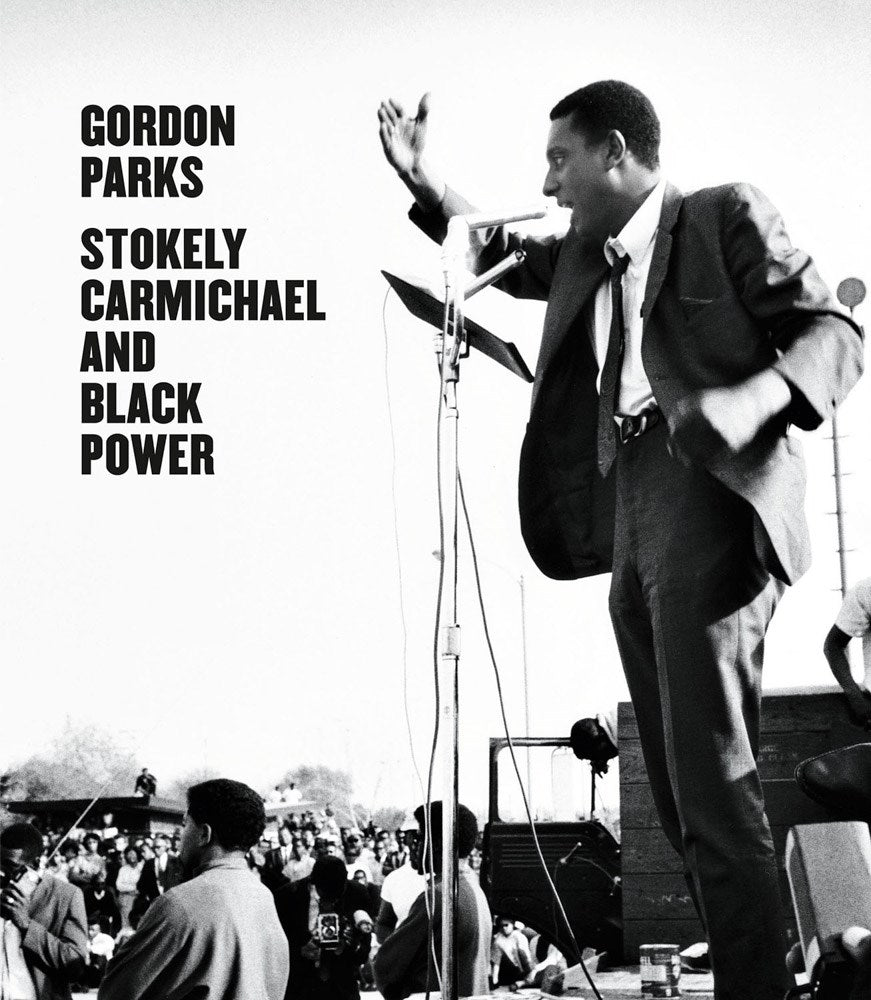
Gordon Parks: Stokely Carmichael and Black Power
Sold outA nuanced profile, in image and text, of the great Black Power leader at the exhilarating moment of the movement’s ascendancy
Gordon Parks’ 1967 Life magazine essay “Whip of Black Power” is a nuanced profile of the young, controversial civil rights leader Stokely Carmichael. As chairman of the Student Nonviolent Coordinating Committee, Carmichael gained national attention and inspired media backlash when he issued the call for Black Power in Greenwood, Mississippi, in June 1966. Parks shadowed him from the fall of 1966 to the spring of 1967, as Carmichael gave speeches, headed meetings and promoted the growing Black Power movement. Parks’ photos and writing addressed Carmichael’s intelligence and humor, presenting the whole man behind the headline-making speeches and revealing his own advocacy of Black Power and its message of self-determination and love.
Stokely Carmichael and Black Power delves into Parks’ groundbreaking presentation of Carmichael, with analysis of his images and accompanying text about the charismatic leader. Lisa Volpe explores Parks’ complex understanding of the movement and its leader, and Cedric Johnson frames Black Power within the heightened political moment of the late 1960s. Carmichael’s own voice is represented through a reprint of his important 1966 essay “What We Want.”
Gordon Parks (1912–2006) was a photographer, filmmaker, musician and author whose 50-year career focused on American culture, social justice, the civil rights movement and the Black American experience. Born into poverty and segregation in Fort Scott, Kansas, Parks was awarded the Julius Rosenwald Fellowship in 1942, which led to a position with the Farm Security Administration. In 1969 he became the first Black American to write and direct a major feature film, The Learning Tree, and his next directorial endeavor, Shaft (1971), helped define a film genre. -
Gordon Parks: Segregation Story
![Gordon Parks: Segregation Story]()
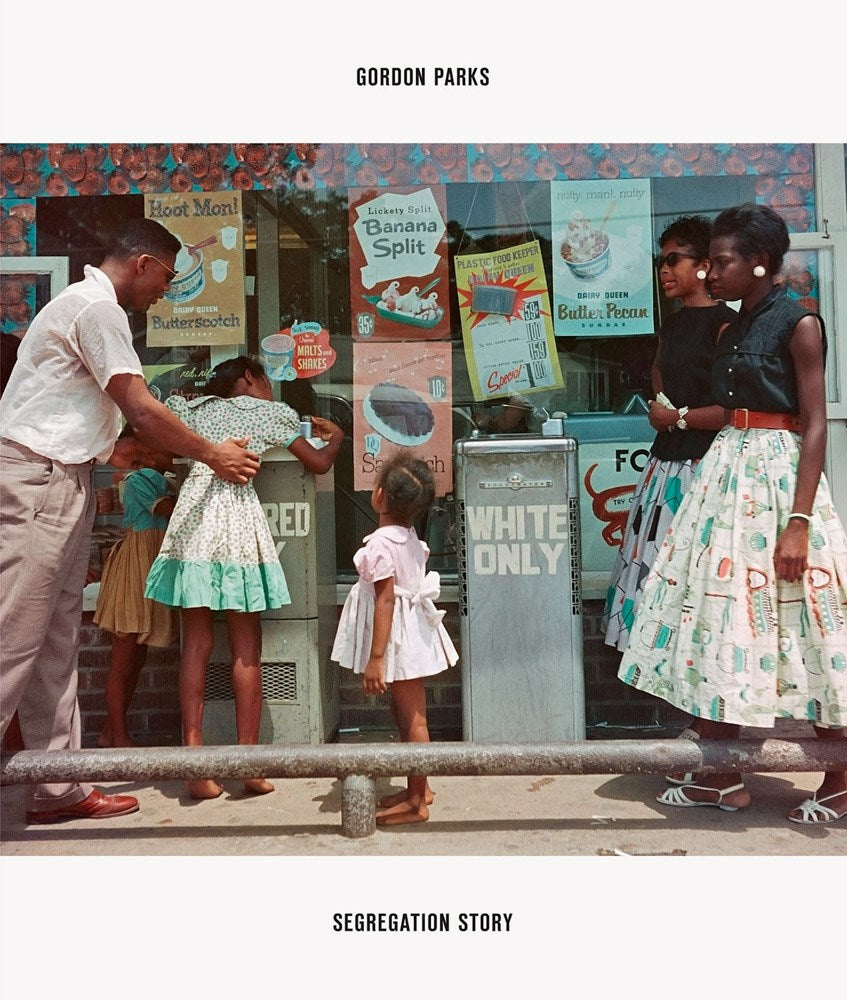
Gordon Parks: Segregation Story
Sold outAn expanded edition of Parks’ classic account of race relations in America, with previously unpublished images and texts
This expanded edition of Gordon Parks: Segregation Story includes around 30 previously unpublished photographs, as well as enhanced reproductions created from Parks’ original color transparencies; newly discovered descriptions Parks wrote for the photographs; a manuscript of film-developing instructions and captions Parks authored with Samuel F. Yette; previously published texts by the late art historian Maurice Berger and the esteemed journalist and civil rights activist Charlayne Hunter-Gault; and a new essay by artist Dawoud Bey.
After the photographs were first presented in a 1956 issue of Life magazine, the bulk of Parks’ assignment was thought to be lost. In 2011, five years after Parks’ death, the Gordon Parks Foundation found more than 200 color transparencies belonging to the series. In 2014 the series was first published as a book, and since then new photographs have been uncovered.
In the summer of 1956, Life magazine sent Gordon Parks to Alabama to document the daily realities of African Americans living under Jim Crow laws in the rural South. The resulting color photographs are among Parks’ most powerful images, and, in the decades since, have become emblematic representations of race relations in America. Pursued at grave danger to the photographer himself, the project was an important chapter in Parks’ career-long endeavor to use the camera as a weapon for social change.
Gordon Parks (1912–2006) was born into poverty and segregation in Fort Scott, Kansas, in 1912. An itinerant laborer, he worked as a brothel pianist and railcar porter, among other jobs, before buying a camera at a pawnshop, training himself and becoming a photographer. He evolved into a modern-day Renaissance man, finding success as a film director, writer and composer. The first African American director to helm a major motion picture, he helped launch the blaxploitation genre with his film Shaft (1971). Parks died in 2006. -
Pastor E. F. Ledbetter and The Metropolitan Missionary Baptist Church, 1953
![Pastor E. F. Ledbetter and The Metropolitan Missionary Baptist Church, 1953 cover image]()

Pastor E. F. Ledbetter and The Metropolitan Missionary Baptist Church, 1953
Gordon Parks
Sold outIn 1953, Gordon Parks returned to Chicago on assignment for Life magazine to photograph the Metropolitan Missionary Baptist Church for a series on American religious life. After the success of his recent work for Life, Parks approached the Near West Side church with a decisive eye toward composing compelling images that conveyed simultaneously the universal humanity and local specificity of the religious community. This would be the first assignment for which he was both writer as well as photographer. His photographs and essay were never published by Life, yet as this book demonstrates, Parks’ visual and textual representation of Black religious life powerfully documents the dynamism of a community shaped by the Great Migration and Chicago’s industrial landscape. Parks embarked on a significant chapter of his aesthetic and conceptual development through his engagement with the pastor, the Reverend Ernest F. Ledbetter, Sr., and the members of his church. This publication features more than 65 previously unpublished photographs and contact sheets, complemented by Parks’ unseen manuscript and ephemeral material from the private collection of the Ledbetter family. A range of scholarly essays provides further insight and contextual analysis in art history, cultural geography, Black religious studies, and creative writing. Co-published with The Gordon Parks Foundation and Howard University, Washington DC
-
Photography and the Black Arts Movement, 1955-1985
![Photography and the Black Arts Movement, 1955-1985 cover image]()

Photography and the Black Arts Movement, 1955-1985
Philip Brookman
Sold outFeaturing more than 100 artists, this landmark book charts the intricate connections between photography and the Black Arts Movement
The Black Arts Movement brought together writers, filmmakers, and visual artists who were exploring ways of using art to advance civil rights and Black self-determination. This book examines the vital role of photography in the evolution of the Black Arts Movement, revealing how photographs operated across art, community building, journalism, and political messaging to contribute to the development of a distinctly Black art and culture.
Works by Romare Bearden, Dawoud Bey, Kwame Brathwaite, Samuel Fosso, Jeanne Moutoussamy-Ashe, Gordon Parks, Juan Sánchez, Robert A. Sengstacke, Lorna Simpson, Ming Smith, and Carrie Mae Weems, among dozens of other celebrated and underappreciated artists, span documentary and fashion photography, portraiture, collage, installation, performance, and video. Pictured luminaries include Miles Davis, Mahalia Jackson, Martin Luther King, Jr., Bob Marley, Nina Simone, Malcolm X, and many more. The book’s essays by distinguished scholars focus on topics such as women and the movement, community, activism, and Black photojournalism. Taking an expansive approach, the authors consider the complex connections between American artists and the African diaspora and the dynamic interchange of pan-African ideas that propelled the movement. Authoritative and beautifully illustrated, this is the definitive volume on photography and the Black Arts Movement.
Published in association with the National Gallery of Art, Washington
Exhibition Schedule:
National Gallery of Art, Washington, DC
(September 21, 2025–January 4, 2026)
J. Paul Getty Museum, Los Angeles, CA
(February 24–May 24, 2026)
Mississippi Museum of Art, Jackson, MS
(July 25–November 1, 2026)


Stay Informed. We're building a community committed to celebrating Black authors + artisans. Subscribe to keep up with all things Kindred Stories.