
Search results: 27 results for “Toni Morrison and Claudia Brodsky”
Not finding what you're looking for? Check out our shop on bookshop.org to order and still support us ♥
27 results
-
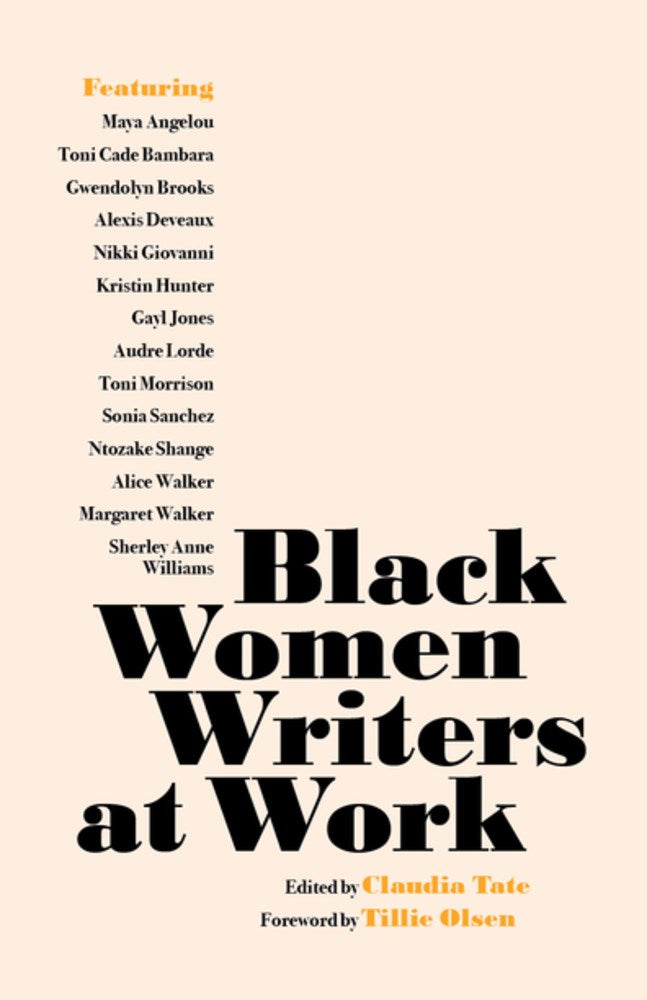
Black Women Writers at Work
![Black Women Writers at Work]()
Black Women Writers at Work
by Claudia Tate
$24.95A critical collection of conversations with Toni Morrison, Alice Walker, Gayl Jones and other Black women writers that changed the scope of Black literature in the 20th century and beyond.
“Black women writers and critics are acting on the old adage that one must speak for oneself if one wishes to be heard.” —Claudia Tate, from the introduction
Long out of print, Black Women Writers at Work is a vital contribution to Black literature in the 20th century.Through candid interviews with Maya Angelou, Toni Cade Bambara, Gwendolyn Brooks, Alexis De Veaux, Nikki Giovanni, Kristin Hunter, Gayl Jones, Audre Lorde, Toni Morrison, Sonia Sanchez, Ntozake Shange, Alice Walker, Margaret Walker, and Sherley Anne Williams, the book highlights the practices and critical linkages between the work and lived experiences of Black women writers whose work laid the foundation for many who have come after.
Responding to questions about why and for whom they write, and how they perceive their responsibility to their work, to others, and to society, the featured playwrights, poets, novelists, and essayists provide a window into the connections between their lives and their art.
Finally available for a new generation, this classic work has an urgent message for readers and writers today. -
Selected Poems American Classics Edition (HarperCollins American Classics)
![Selected Poems American Classics Edition (HarperCollins American Classics) cover image]()

Selected Poems American Classics Edition (HarperCollins American Classics)
$20.00“When Miss Brooks. . . writes out of her heart, out of her rich and living background, out of her very real talent, then she induces almost unbearable excitement.” — New York Times
In celebration of the 250th anniversary of the United States, HarperCollins is proud to present this library of American classics drawn from our storied catalog. Selected Poems is the classic volume by the distinguished and celebrated poet Gwendolyn Brooks, winner of the 1950 Pulitzer Prize, and recipient of the National Book Foundation Medal for Distinguished Contribution to American Letters. This compelling collection showcases Brooks's technical mastery, her warm humanity, and her compassionate and illuminating response to a complex world.
By 1963 the civil rights movement was in full swing across the United States, and more and more African American writers were increasingly outspoken in attacking American racism and insisting on full political, economic, and social equality for all. In that memorable year of the March on Washington, Harper & Row released Brooks’s Selected Poems, which incorporated poems from her first three collections, as well as a selection of new poems.
This edition of Selected Poems includes A Street in Bronzeville, Brooks's first published volume of poetry for which she became nationally known and which led to successive Guggenheim fellowships; Annie Allen, published one year before she became the first African American author to win the Pulitzer Prize in any category; and The Bean Eaters, her fifth publication which expanded her focus from studies of the lives of mainly poor urban black Americans to the heroism of early civil rights workers and events of particular outrage—including the 1955 Emmett Till lynching and the 1957 school desegregation crisis in Little Rock, Arkansas.
-
Language as Liberation: Reflections on the American Canon
![Language as Liberation: Reflections on the American Canon cover image]()

Language as Liberation: Reflections on the American Canon
Sold outNobel Laureate and Pulitzer Prize-winning author of Beloved, Toni Morrison, investigates Black characters in the American literary canon and the way they shaped the nation’s collective unconscious
In a dazzling series of lectures from her tenure as a professor at Princeton University, Toni Morrison interrogates America’s most famous works and authors, drawing a direct line from the Black bodies that built the nation to the Black characters that many of the country’s canonical white writers imagined in their work. Morrison sees these fictions as a form of creation and projection, arguing that they helped manufacture American racial identity – these “Africanist” presences are “the shadow that makes light possible,” as Morrison writes, and the reflections of the authors’ own deepest fears, insecurities, and longings.
With profound erudition and wit, Morrison breaks wide open the American conception of race with energetic, enlivening readings of the nation’s canon, revealing that our liberation from these diminishing notions comes through language. “How,” Morrison wonders, “could one speak of profit, of economy, of labor, or progress, of suffragism, or Christianity, of the frontier, of the formation of new states, the acquisition of new lands … of practically anything a new nation concerns itself with – without having as a referent, at the heart of the discourse or defining its edges, the presence of Africans and/or their descendants?”
To read these lectures, collected here for the first time, is to encounter Morrison, not just the writer but also the teacher, in the most profound and subversive way yet. With a foreword from her son, Ford Morrison, and an introduction from her Princeton comparative literature colleague, Claudia Brodsky, Language as Liberation is a revelatory collection that promises to redefine the American canon.
-
Tar Baby
![Tar Baby]()

Tar Baby
by Toni Morrison
Sold outThe author of Song of Solomon now sets her extraordinary novelistic powers on a striking new course. Tar Baby, audacious and hypnotic, is masterful in its mingling of tones—of longing and alarm, of urbanity and a primal, mythic force in which the landscape itself becomes animate, alive with a wild, dark complicity in the fates of the people whose drama unfolds. It is a novel suffused with a tense and passionate inquiry, revealing a whole spectrum of emotions underlying the relationships between black men and women, white men and women, and black and white people.
The place is a Caribbean island. In their mansion overlooking the sea, the cultivated millionaire Valerian Street, now retired, and his pretty, younger wife, Margaret, go through rituals of living, as if in a trance. It is the black servant couple, who have been with the Streets for years—the fastidious butler, Sydney, and his strong yet remote wife—who have arranged every detail of existence to create a surface calm broken only by sudden bursts of verbal sparring between Valerian and his wife. And there is a visitor among them—a beautiful young black woman, Jadine, who is not only the servant’s dazzling niece, but the protegée and friend of the Streets themselves; Jadine, who has been educated at the Sorbonne at Valerian’s expense and is home now for a respite from her Paris world of fashion, film and art.
Through a season of untroubled ease, the lives of these five move with a ritualized grace until, one night, a ragged, starving black American street man breaks into the house. And, in a single moment, with Valerian’s perverse decision not to call for help but instead to invite the man to sit with them and eat, everything changes. Valerian moves toward a larger abdication. Margaret’s delicate and enduring deception is shattered. The butler and his wife are forced into acknowledging their illusions. And Jadine, who at first is repelled by the intruder, finds herself moving inexorably toward him—he calls himself Son; he is a kind of black man she has dreaded since childhood; uneducated, violent, contemptuous of her privilege.
As Jadine and Son come together in the loving collision they have both welcomed and feared, the novel moves outward—to the Florida backwater town Son was raised in, fled from, yet cherishes; to her sleek New York; then back to the island people and their protective and entangling legends. As the lovers strive to hold and understand each other, as they experience the awful weight of the separate worlds that have formed them—she perceiving his vision of reality and of love as inimical to her freedom, he perceiving her as the classic lure, the tar baby set out to entrap him—all the mysterious elements, all the highly charged threads of the story converge. Everything that is at risk is made clear: how the conflicts and dramas wrought by social and cultural circumstances must ultimately be played out in the realm of the heart.
Once again, Toni Morrison has given us a novel of daring, fascination, and power. -
Jazz
![Jazz]()

Jazz
by Toni Morrison
Sold outFrom the acclaimed Nobel Prize winner, a passionate, profound story of love and obsession that brings us back and forth in time, as a narrative is assembled from the emotions, hopes, fears, and deep realities of Black urban life. With a foreword by the author.
“As rich in themes and poetic images as her Pulitzer Prize–winning Beloved.... Morrison conjures up the hand of slavery on Harlem’s jazz generation. The more you listen, the more you crave to hear.” —Glamour
In the winter of 1926, when everybody everywhere sees nothing but good things ahead, Joe Trace, middle-aged door-to-door salesman of Cleopatra beauty products, shoots his teenage lover to death. At the funeral, Joe’s wife, Violet, attacks the girl’s corpse. This novel “transforms a familiar refrain of jilted love into a bold, sustaining time of self-knowledge and discovery. Its rhythms are infectious” (People). -
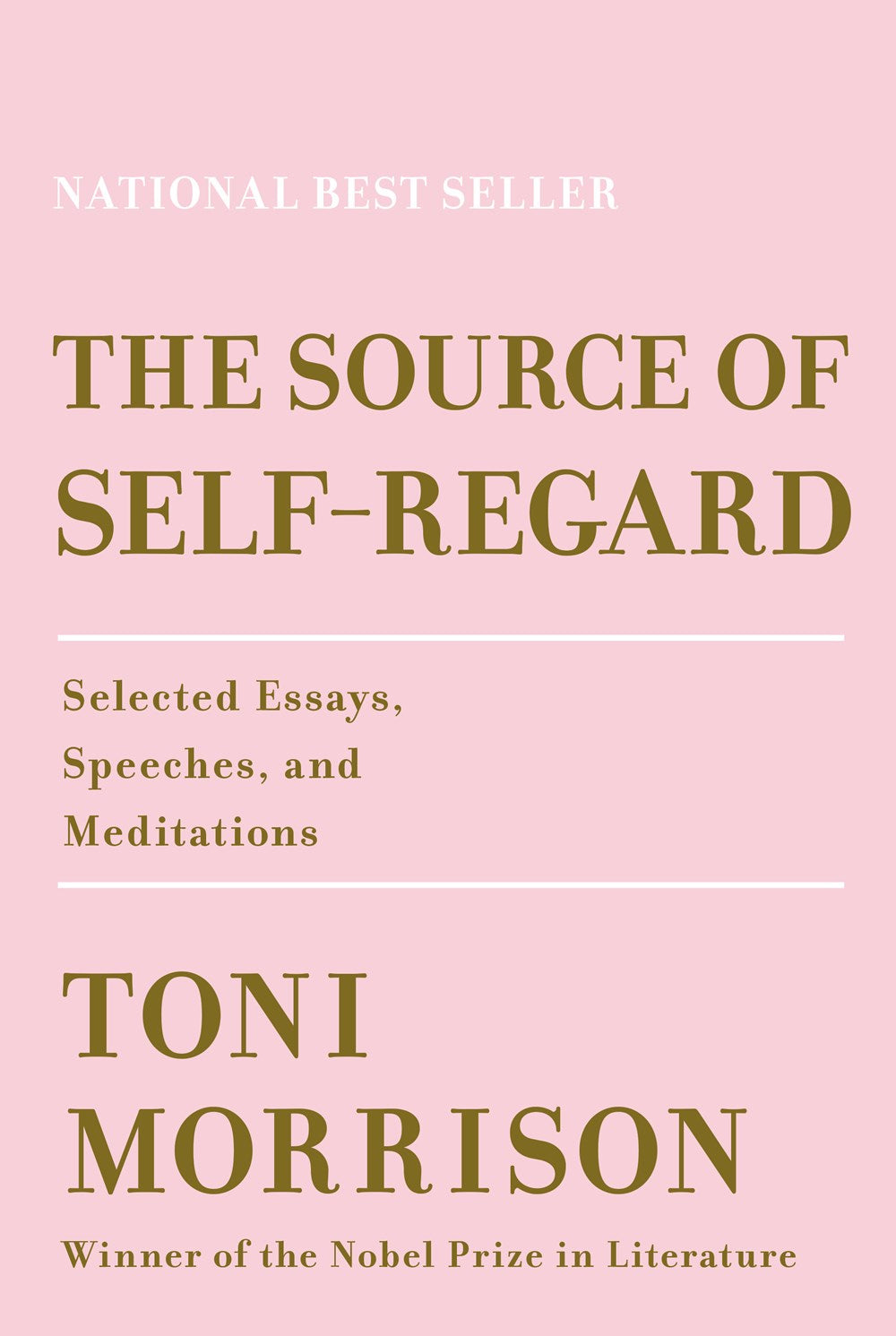
The Source of Self-Regard: Selected Essays, Speeches, and Meditations
![The Source of Self-Regard: Selected Essays, Speeches, and Meditations]()
The Source of Self-Regard: Selected Essays, Speeches, and Meditations
by Toni Morrison
Sold outNATIONAL BESTSELLER • Here is the Nobel Prize winner in her own words: a rich gathering of her most important essays and speeches, spanning four decades that "speaks to today’s social and political moment as directly as this morning’s headlines” (NPR).
These pages give us her searing prayer for the dead of 9/11, her Nobel lecture on the power of language, her searching meditation on Martin Luther King Jr., her heart-wrenching eulogy for James Baldwin. She looks deeply into the fault lines of culture and freedom: the foreigner, female empowerment, the press, money, “black matter(s),” human rights, the artist in society, the Afro-American presence in American literature. And she turns her incisive critical eye to her own work (The Bluest Eye, Sula, Tar Baby, Jazz, Beloved,Paradise) and that of others.
An essential collection from an essential writer, The Source of Self-Regard shines with the literary elegance, intellectual prowess, spiritual depth, and moral compass that have made Toni Morrison our most cherished and enduring voice. -
Beloved
![Beloved]()

Beloved
by Toni Morrison
Sold outThe magnificent Pulitzer Prize–winning work that brought the wrenching experience of slavery into the literature of our time, enlarging our comprehension of America’s original sin.
Upon the original publication of Beloved in 1987, John Leonard wrote in the Los Angeles Times: “I can’t imagine American literature without it.” Nearly two decades later, The New York Times chose Beloved as the best American novel of the previous fifty years.
Set in post–Civil War Ohio, it is the story of Sethe, an escaped slave who has lost a husband and buried a child; who has withstood savagery and not gone mad. Sethe, who now lives in a small house on the edge of town with her daughter, Denver, her mother-in-law, Baby Suggs, and a disturbing, mesmerizing apparition who calls herself Beloved.
Sethe works at “beating back the past,” but it makes itself heard and felt incessantly: in her memory; in Denver’s fear of the world outside the house; in the sadness that consumes Baby Suggs; in the arrival of Paul D, a fellow former slave; and, most powerfully, in Beloved, whose childhood belongs to the hideous logic of slavery and who has now come from the “place over there” to claim retribution for what she lost and for what was taken from her.
Sethe’s struggle to keep Beloved from gaining possession of the present—and to throw off the long-dark legacy of the past—is at the center of this spellbinding novel. But it also moves beyond its particulars, combining imagination and the vision of legend with the unassailable truths of history. -
Paradise
![Paradise]()

Paradise
by Toni Morrison
Sold outParadise opens with one of Morrison’s most raw and Faulknerian scenes: early one morning in 1976, nine men from the town of Ruby, Oklahoma—population 360, all black—unleash an assault upon a convent seventeen miles away. The misfortunes suffered in Ruby, the men believe, come from the convent women, who are rumored to engage in witchcraft and abortion. From this fateful moment of collision, Morrison takes us back to the town’s origins in 1890, when it was founded by former slaves. She then guides us through Ruby’s tumultuous journey through the twentieth century, as generations are born and lost, as racial turmoil shakes the nation. As time wears on, the residents of Ruby become ever more convinced that they must isolate themselves in order to preserve their freedom and dignity. Richly imagined and elegantly composed, Paradise is a deeply resonant allegory, one of Morrison’s most ambitious works.
-
Home
![Home]()

Home
Toni Morrison
Sold outNATIONAL BESTSELLER • A New York Times Notable Book • From the acclaimed Nobel Prize winner: an emotional powerhouse of a novel about a modern Odysseus returning to a 1950s America mined with lethal pitfalls for an unwary Black man
When Frank Money joined the army to escape his too-small world, he left behind his cherished and fragile little sister, Cee. After the war, he journeys to his native Georgia with a renewed sense of purpose in search of his sister, but it becomes clear that their troubles began well before their wartime separation. Together, they return to their rural hometown of Lotus, where buried secrets are unearthed and where Frank learns at last what it means to be a man, what it takes to heal, and—above all—what it means to come home.
-
Song of Solomon
![Song of Solomon]()

Song of Solomon
by Toni Morrison
Sold outNEW YORK TIMES BESTSELLER • An official Oprah Winfrey’s “The Books That Help Me Through” selection • With this brilliantly imagined novel, the acclaimed Nobel Prize winner transfigures the coming-of-age story as audaciously as Saul Bellow or Gabriel García Márquez.
Milkman Dead was born shortly after a neighborhood eccentric hurled himself off a rooftop in a vain attempt at flight. For the rest of his life he, too, will be trying to fly. As Morrison follows Milkman from his rustbelt city to the place of his family’s origins, she introduces an entire cast of strivers and seeresses, liars and assassins, the inhabitants of a fully realized Black world. -
Otherworldly Mothering: The Maternal Grammar of Black Women’s Writing, 1970–1990
![Otherworldly Mothering: The Maternal Grammar of Black Women’s Writing, 1970–1990 cover image]()

Otherworldly Mothering: The Maternal Grammar of Black Women’s Writing, 1970–1990
Marika Ceschia
Sold outOtherworldly Mothering argues that literary works by Toni Morrison, Gloria Naylor, Paule Marshall, Audre Lorde, and Toni Cade Bambara reimagine subjectivity in processual and relational terms through a rewriting of maternal praxis, a technique that unveils the historical continuities between antebellum and neoliberal America. By refiguring materials drawn from the tradition of slave narratives, Black women’s literature of the 1970s and 1980s often conjures maternal otherworlds where it is possible to engage alternative modes of being.
In conversation with the work of Hortense Spillers, Sylvia Wynter, and Saidiya Hartman, Marika Ceschia analyzes how Black women writers find in the maternal a means of creatively reenvisioning the figure of the human. Morrison’s Song of Solomon, Naylor’s Linden Hills, Marshall’s Praisesong for the Widow, Lorde’s Zami, and Bambara’s The Salt Eaters each change the strictures that dictate how the human is performed. As these texts show, maternal praxis can have a transformative ontological effect: confronting the toll exerted by centuries of racial violence, these writers reclaim the maternal as a site of subject formation.
Otherworldly Mothering reassesses canonical works of twentieth-century Black women’s literature alongside theoretical debates around the ontology of the human, antiblackness, and Black motherhood. Ceschia proposes a reappraisal of maternal praxis that challenges neoliberal discourse and questions recent critical turns toward Afropessimism and posthumanism.
-
Sula (Contemporánea)
![Sula (Contemporánea) cover image]()

Sula (Contemporánea)
Toni Morrison
Sold outUna obra maestra de la ganadora del Premio Nobel de Literatura 1993.
Esta es la historia de Sula y Nel, dos niñas que crecen juntas en un barrio de negros, compartiendo sus sueños e ilusiones. Ambas son precoces y curiosas, hijas de familias pobres. Pero el tiempo pasa y, cuando Nel se casa, Sula se marcha del suburbio para ir a la universidad y viajar por el país. Diez años después, Sula regresa e involuntariamente destruye la familia y la felicidad de Nel. A partir de entonces, los pintorescos habitantes del suburbio la consideran una bruja malvada...
Ambientada en los EE.UU. en el período de entreguerras, Sula es un portentoso retrato del poder de lo femenino en una comunidad pobre y rural de negros, donde las mujeres reinan como madres, hechiceras y depositarias de la tradición oral.
Reseña:
«Un aullido de amor y rabia, travieso y divertido, duro y amargo.»
The New York Times


- ← Previous
- page 1
- page 2
- page 3
- Next →
Stay Informed. We're building a community committed to celebrating Black authors + artisans. Subscribe to keep up with all things Kindred Stories.