
Search results: 60 results for “Little Feminist, Dolisha Mitchell, and Ashley Jefferson”
Not finding what you're looking for? Check out our shop on bookshop.org to order and still support us ♥
60 results
-
The Seven Daughters of Dupree
![The Seven Daughters of Dupree cover image]()

The Seven Daughters of Dupree
$30.00From the two-time Emmy Award–winning producer and host of the Black and Published podcast comes a sweeping multi-generational epic following seven generations of Dupree women as they navigate love, loss, and the unyielding ties of family in the tradition of Homegoing and The Love Songs of W.E.B. DuBois.
It’s 1995, and fourteen-year-old Tati is determined to uncover the identity of her father. But her mother, Nadia, keeps her secrets close, while her grandmother Gladys remains silent about the family’s past, including why she left Land’s End, Alabama, in 1953. As Tati digs deeper, she uncovers a legacy of family secrets, where every generation of Dupree women has posed more questions than answers.
From Jubi in 1917, whose attempt to pass for white ends when she gives birth to Ruby; to Ruby’s fiery lust for Sampson in 1934 that leads to a baby of her own; to the night in 1980 that changed Nadia’s future forever, the Dupree women carry the weight of their heritage. Bound by a mysterious malediction that means they will only give birth to daughters, the Dupree women confront a legacy of pain, resilience, and survival that began with an enslaved ancestor who risked everything for freedom.
The Seven Daughters of Dupree masterfully weaves together themes of generational trauma, Black women’s resilience, and unbreakable familial bonds. Echoing the literary power of The Twelve Tribes of Hattie by Ayana Mathis, Nikesha Elise Williams delivers a feminist literary fiction that explores the ripple effects of actions, secrets, and love through seven generations of Black women.
-
Misbehaving at the Crossroads: Essays & Writings
![Misbehaving at the Crossroads: Essays & Writings cover image]()

Misbehaving at the Crossroads: Essays & Writings
Honoree Fanonne Jeffers
$19.99*Paperback Release Date - 6/23/2026*
The New York Times-bestselling, National Book Award-nominated author of The Love Songs of W.E.B. Du Bois and The Age of Phillis makes her nonfiction debut with this personal and thought-provoking work that explores the journeys and possibilities of Black women throughout American history and in contemporary times.
Honorée Fanonne Jeffers is at a crossroads.
Traditional African/Black American cultures present the crossroads as a place of simultaneous difficulty and possibility. In contemporary times, Kimberlé Crenshaw coined the phrase “intersectionality” to explain the unique position of Black women in America. In many ways, they are at a third crossroads: attempting to fit into notions of femininity and respectability primarily assigned to White women, while inventing improvisational strategies to combat oppression.
In Misbehaving at the Crossroads, Jeffers explores the emotional and historical tensions in Black women’s public lives and her own private life. She charts voyages of Black girlhood to womanhood and the currents buffeting these journeys, including the difficulties of racially gendered oppression, the challenges of documenting Black women’s ancestry; the adultification of Black girls; the irony of Black female respectability politics; the origins of Womanism/Black feminism; and resistance to White supremacy and patriarchy. As Jeffers shows with empathy and wisdom, naming difficult historical truths represents both Blues and transcendence, a crossroads that speaks.
Necessary and sharply observed, provocative and humane, and full of the insight and brilliance that has characterized her poetry and fiction, Misbehaving at the Crossroads illustrates the life of one extraordinary Black woman—and her extraordinary foremothers.
-
Good Woman: A Reckoning
![Good Woman: A Reckoning cover image]()

Good Woman: A Reckoning
$28.99A raw and lyrical exploration of the confining expectations of womanhood and, if we dare, what lies beyond those limitations--from a writer Roxane Gay calls "vibrant and thoughtful."
Gorgeous, badass, and practically waiting to pounce, Good Woman: A Reckoning is acclaimed essayist Savala Nolan's follow-up to her "standout collection" (New York Times Book Review) Don't Let It Get You Down.
A lifetime of playing by the rules of female social conditioning is not what it's cracked up to be for Nolan. The years of making herself smaller (literally and metaphorically); the sexual advances that led to more than she wanted; the bad marriage she fought like hell to keep; all the ways others questioned her identity or choices and she let it slide to keep the peace; her silence when requested; her body when desired--none of it worked. None of it protected her the way it was advertised to.
Nolan noticed the same was true for the women around her and the women in history she read about. Across time and location, they were raised to be agreeable and "good." Hyper-visible as sexual objects but invisible as full people. Living in a physical world created by men for men. Taking on the ultimate role of birth-giver and caretaker, yet seeing it remain an unsung act, even as it's a God-like endeavor. Only in midlife did Nolan begin to realize she was capable of living outside these cages of conditioning so slyly insidious that they're nearly invisible.
Good Woman elegantly probes the knotty conditions themselves, the costs of adhering to them, and what happens when one refuses to comply. The twelve stunning and unforgettable essays blend memoir, reportage, and history to create a collection that is alternately bold, brash, and explosive ... and ravishingly tender, sensual, and joyous. Nolan takes aim at big and old ideas, and she does not miss. Hers is a testimony to witness and to savor.
-
Freedom Fire: Black Girl Power: 15 Stories Celebrating Black Girlhood
![Freedom Fire: Black Girl Power: 15 Stories Celebrating Black Girlhood cover image]()

Freedom Fire: Black Girl Power: 15 Stories Celebrating Black Girlhood
Leah Johnson
$18.99A vibrant, heartwarming collection of 15 middle grade stories and poems that celebrates the joy, strength, and experience of Black girlhood, including stories from Ibi Zoboi, Sharon M. Draper, and Leah Johnson, as well as cover art from Caldecott winner Vashti Harrison.
Black girl power is…
Bringing your favorite stuffed animal to your first real sleepover. . .
Escaping an eerie dollhouse that’s got you trapped inside. . .
Making new friends one magical baked good at a time. . .
Finding the courage to dance to the beat of your own drum. . .And more! From 15 legendary Black women authors comes a dazzling collection of stories and poems about the power we find in the everyday and the beauty of Black girlhood.
Contributors include: Amerie, Kalynn Bayron, Roseanne A. Brown, Elise Bryant, Dhonielle Clayton, Natasha Diaz, Sharon M. Draper, Sharon Flake, Leah Johnson, Kekla Magoon, Janae Marks, Tolá Okogwu, Karen Strong, Renée Watson, and Ibi Zoboi
-
I Love Myself When I Am Laughing... And Then Again When I Am Looking Mean and Impressive
![I Love Myself When I Am Laughing... And Then Again When I Am Looking Mean and Impressive]()
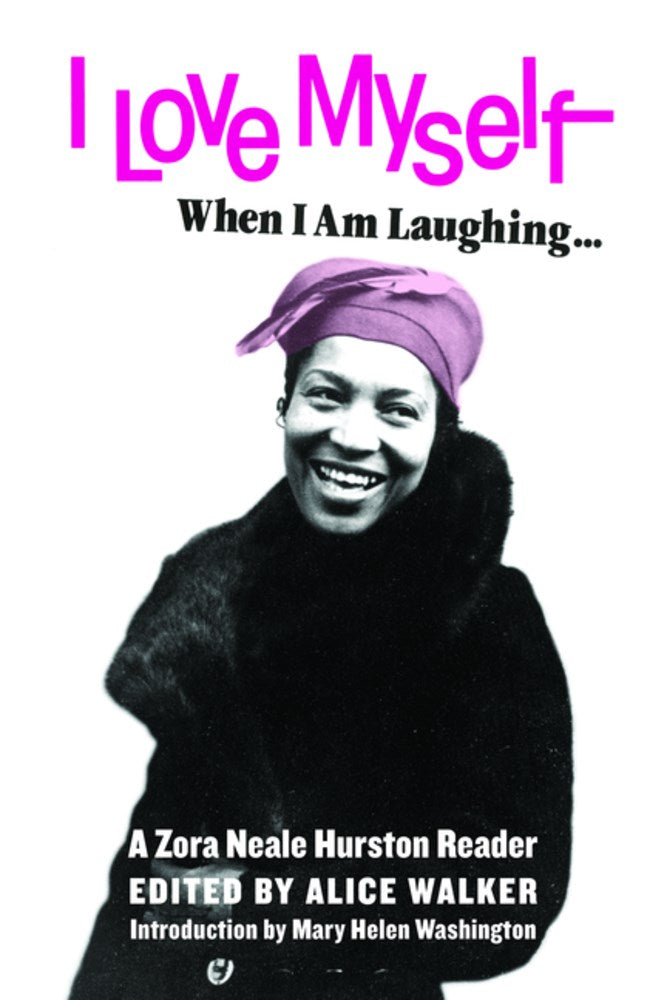
I Love Myself When I Am Laughing... And Then Again When I Am Looking Mean and Impressive
by Zora Neale Hurston
$19.95A collection of essays, fiction, journalism, folklore, and autobiography, preserving the legacy of one of the Harlem Renaissance’s greatest writers.
The foundational, classic anthology that revived interest in the author of Their Eyes Were Watching God—"one of the greatest writers of our time"—and made her work widely available for a new generation of readers (Toni Morrison).
During her lifetime, Zora Neale Hurston was praised for her writing but condemned for her independence and audacity. Her work fell into obscurity until the 1970s, when Alice Walker rediscovered Hurston's unmarked grave and anthologized her writing in this groundbreaking collection for the Feminist Press.
I Love Myself When I Am Laughing... And Then Again When I Am Looking Mean and Impressive established Hurston as an intellectual leader for future generations of black writers. A testament to the power and breadth of Hurston's oeuvre, this edition—newly reissued for the Feminist Press's fiftieth anniversary—features a new preface by Walker.
"Through Hurston, the soul of the black South gained one of its most articulate interpreters." —The New York Times
-
A Terrible Strength: The Hidden Crisis of the Black Womb and Your Survival Guide to Healing
![A Terrible Strength: The Hidden Crisis of the Black Womb and Your Survival Guide to Healing cover image]()

A Terrible Strength: The Hidden Crisis of the Black Womb and Your Survival Guide to Healing
$28.99Black women are facing a systemic gynecological health crisis. This book gives them the tools needed to unlearn the medical normalization of their suffering and offers a path forward to healing—by a foremost physician, surgeon, researcher, and gynecological cancer expert.
When Dr. Kemi Doll first began training to be a gynecologic cancer surgeon, she quickly noticed that the level of care being offered to women was rarely equal. She started to ask herself: Whose pain was believed? Who was “high maintenance” vs. “angry and non-compliant”? Who died? White women’s pain was doubted, but Black women’s pain was often outright denied. And the locus of this crisis was the womb. Day by day, fibroids, bleeding, inflammation, and cancer struck Black women the hardest, yet the medical field cared very little about their fate. When student physicians would explicitly bring up these alarming disparities, Dr. Doll's teachers would reply: “Black women just don’t do well with this,” followed by, “We don’t really know why.”
Since then, Dr. Doll has made it her goal to give Black women the tools they need to unlearn what she calls “womb suffering.” For all women navigating gynecologic care, and the medical professionals who care for them, this comprehensive, authoritative book of science-backed information and lived experience covers:
* The mechanisms behind the four primary conditions that affect the womb—often with fatal consequences—including Endometriosis, Fibroids, Heavy Bleeding, and Endometrial cancer.
* An overview of the research conducted on reproductive health outside pregnancy—the lack of which has caused healthcare inequity and obstructed access to care
* Gripping stories of smart, successful women struggling with and overcoming Womb Suffering
* What good gynecologic health looks like and why it is vital to reclaiming a full, healthy life; how to feel and respond to your body’s signals; and the tools and vocabulary needed to help advocate and prepare for medical visits.A Terrible Strength links women’s health care to timely conversations on racial justice and healthcare inequity, arming women with the power to secure vibrant health and well-being for the rest of their lives.
-
Insurgent Visions: Feminism, Justice, Solidarity (a John Hope Franklin Center Book)
![Insurgent Visions: Feminism, Justice, Solidarity (a John Hope Franklin Center Book) cover image]()

Insurgent Visions: Feminism, Justice, Solidarity (a John Hope Franklin Center Book)
$28.95In a current era marked by carceral logics, authoritarianism, and white supremacy, there has never been a greater need for the tools and inspiration that radical feminism provides. In Insurgent Visions, Chandra Talpade Mohanty explores methods of anticapitalist resistance to radically transform everyday life. She presents insurgent feminism—a theory and praxis with which to contest and replace the practices of violence grounded in racialized gender relations. Insurgent feminism unsettles existing power structures in order to enact new relationships and forge new subjectivities, epistemologies, and communities. Drawing on organizing efforts in the US-Mexico borderlands, Palestine/Israel, and Kashmir, as well as on abolitionist and Dalit feminisms, Mohanty contends that the knowledge that emerges from the experiences of marginalized groups who are struggling for economic, racial, and social justice is key for imagining feminist futures. She also turns to the neoliberal landscape of higher education in the United States and the difficulties of instituting transformative antiracist and anti-imperialist feminist knowledge building. Mapping new challenges for radical praxis, Mohanty reconfigures feminist studies while offering a model for decolonial cross-border organizing and solidarity.
-
Black Chameleon: Memory, Womanhood, and Myth
![Black Chameleon: Memory, Womanhood, and Myth]()
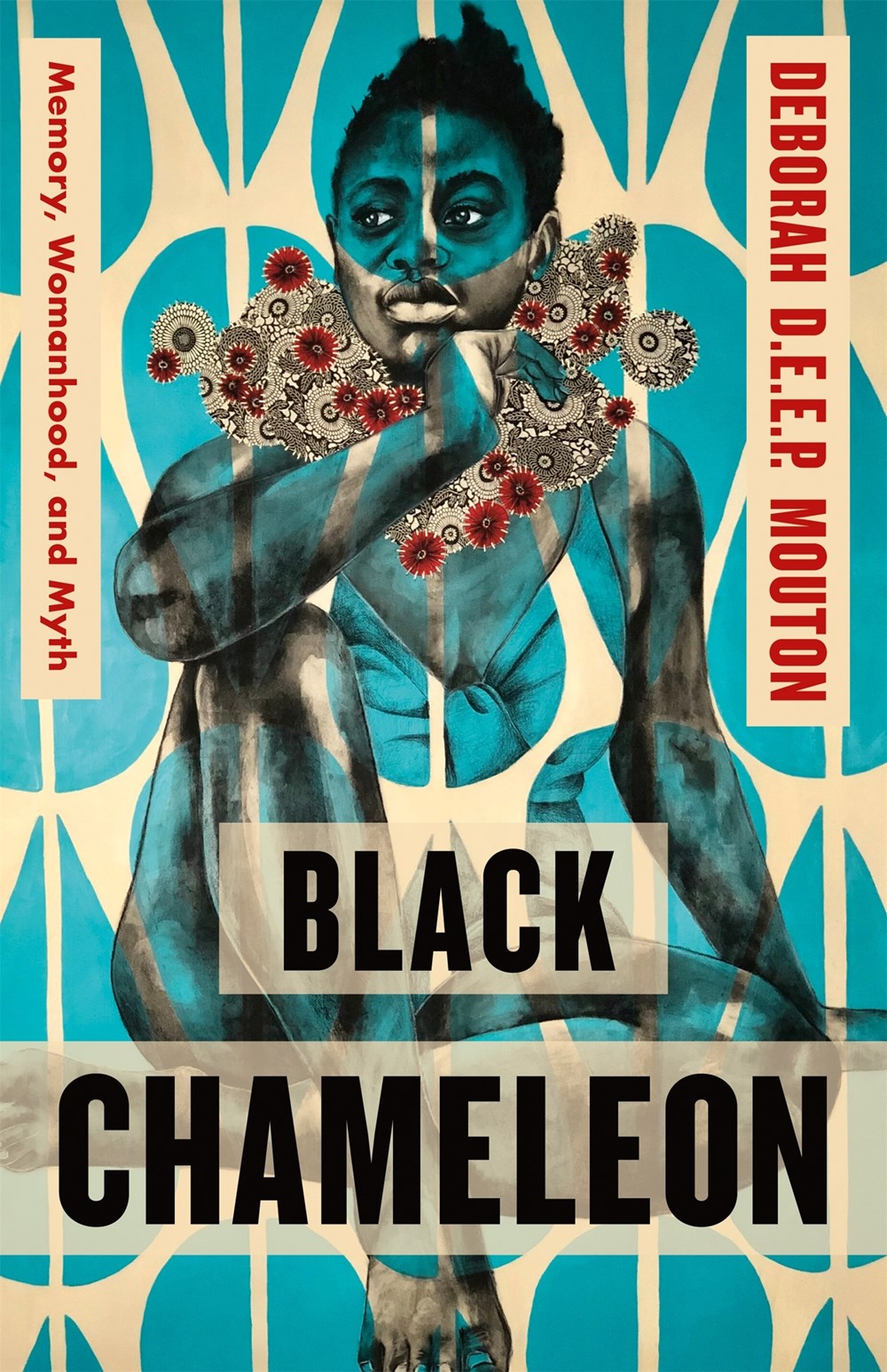
Black Chameleon: Memory, Womanhood, and Myth
by Deborah D.E.E.P. Mouton
$19.99In the literary tradition of Carmen Maria Machado’s In the Dream House, Maxine Hong Kingston’s The Woman Warrior, and Jesmyn Ward’s Men We Reaped, this debut memoir confronts both the challenges and joys of growing up Black and making your own truth.
Growing up as a Black girl in America, Deborah Mouton felt alienated from the stories she learned in class. She yearned for stories she felt connected to—true ones of course—but also fables and mythologies that could help explain both the world and her place in it. What she encountered was almost always written by white writers who prospered in a time when human beings were treated as chattel, such as the Greek and Roman myths, which felt as dusty and foreign as ancient ruins. When she sought myths written by Black authors, they were rooted too far in the past, a continent away.
Mouton writes, “The phrases of my mother and grandmother began to seem less colloquial and more tied to stories that had been lost along the way. . . . Mythmaking isn’t a lie. It is our moment to take the privilege of our own creativity to fill in the gaps that colonization has stolen from us. It is us choosing to write the tales that our children pull strength from. It is hijacking history for the ignorance in its closets. This, a truth that must start with the women.”
Mouton’s memoir is a song of praise and an elegy for Black womanhood. With a poet’s gift for lyricism and poignancy, Mouton reflects on her childhood as the daughter of a preacher and a harsh but loving mother, living in the world as a Black woman whose love is all too often coupled with danger, and finally learning to be a mother to another Black girl in America. Of the moment yet timeless, playful but incendiary, Mouton has staked out new territory in the memoir form. -
Little Leaders: Bold Women in Black History
![Little Leaders: Bold Women in Black History]()
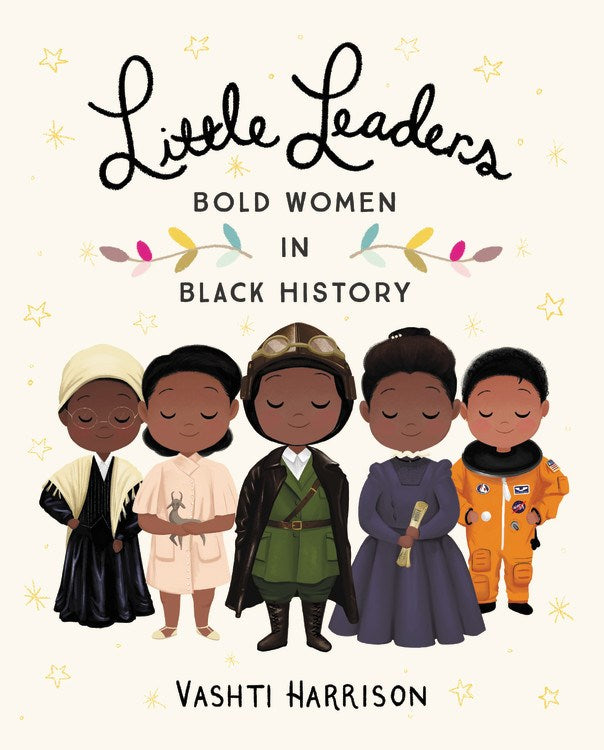
Little Leaders: Bold Women in Black History
by Vashti Harrison
$16.99Featuring 18 trailblazing black women in American history, Dream Big, Little One is the irresistible board book adaptation of Little Leaders: Bold Women in Black History.
Among these women, you’ll find heroes, role models, and everyday women who did extraordinary things – bold women whose actions and beliefs contributed to making the world better for generations of girls and women to come. Whether they were putting pen to paper, soaring through the air or speaking up for the rights of others, the women profiled in these pages were all taking a stand against a world that didn’t always accept them.
The leaders in this book may be little, but they all did something big and amazing, inspiring generations to come. -
Black Trans Feminism
![Black Trans Feminism]()
Black Trans Feminism
by Marquis Bey
$28.95Marquis Bey offers a meditation on blackness and gender nonnormativity in ways that recalibrate traditional understandings of each, conceiving of black trans feminism as a politics grounded in fugitivity and the subversion of power.
In Black Trans Feminism Marquis Bey offers a meditation on blackness and gender nonnormativity in ways that recalibrate traditional understandings of each. Theorizing black trans feminism from the vantages of abolition and gender radicality, Bey articulates blackness as a mutiny against racializing categorizations; transness as a nonpredetermined, wayward, and deregulated movement that works toward gender’s destruction; and black feminism as an epistemological method to fracture hegemonic modes of racialized gender. In readings of the essays, interviews, and poems of Alexis Pauline Gumbs, jayy dodd, and Venus Di’Khadijah Selenite, Bey turns black trans feminism away from a politics of gendered embodiment and toward a conception of it as a politics grounded in fugitivity and the subversion of power. Together, blackness and transness actualize themselves as on the run from gender. In this way, Bey presents black trans feminism as a mode of enacting the wholesale dismantling of the world we have been given. -
Undesirability and Her Sisters: Black Women's Visual Work and the Ethics of Representation (Minoritarian Aesthetics)
![Undesirability and Her Sisters: Black Women's Visual Work and the Ethics of Representation (Minoritarian Aesthetics) cover image]()

Undesirability and Her Sisters: Black Women's Visual Work and the Ethics of Representation (Minoritarian Aesthetics)
$30.00How Black women’s visual work functions in an era of new racial and gender meaning
In the wake of contemporary art’s post-Black turn and the mainstreaming of intersectionality, Undesirability and Her Sisters charts a new genealogy of Black women’s art that exposes the unfinished project of racial and gender empowerment in the twenty-first century. Tiffany Barber argues that Black women’s social positions at the intersection of race, gender, sexuality, and class are inherently queer, thus spurring unexpected aesthetic strategies that throw into high relief the ethical terrain of what it means to be Black and a woman now.
Undesirability and Her Sisters collates what Barber terms “undesirable” representations of Black female bodies in recent American sculpture, collage, photography, and dance-based performance art by Kara Walker, Wangechi Mutu, Xaviera Simmons, and Narcissister. These works not only engage the visual senses but also incorporate olfactory, haptic, and sonic experiences that challenge traditional interpretations of Blackness and womanhood in art history, Black Studies, feminist and gender studies, dance and performance studies, and queer studies. Instead of transcendental beauty, wholeness, and individual and collective becoming, the perverse Black female figures profiled here eschew sublimation and synthesis as necessary responses to racial and gender subjugation in the past, present, and future.
Through its unique, groundbreaking analysis, this book contributes to the ongoing discussions on the ethics of representation―the capacity to speak and act for oneself, to have significance and impact, and ultimately, to reject acknowledgment.
-
Killing the Black Body: Race, Reproduction, and the Meaning of Liberty
![Killing the Black Body: Race, Reproduction, and the Meaning of Liberty]()
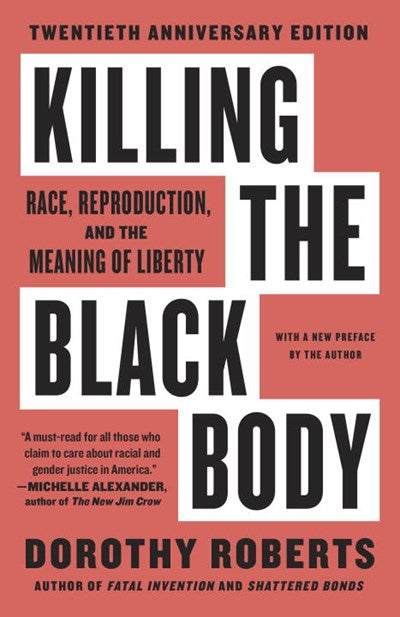
Killing the Black Body: Race, Reproduction, and the Meaning of Liberty
by Dorothy Roberts
$18.00*ships in 7-10 business days*
In 1997, the image of the “Welfare Queen” dominated white America’s perceptions of Black women. Legislation was being proposed to deny benefits to children born to welfare mothers and to require insertion of birth-control implants as a condition of receiving aid. Meanwhile, a booming fertility industry was catering primarily to infertile white couples.
Dorothy Roberts’s landmark book, Killing the Black Body, made a powerful entrance into the national conversation of the era, exposing America’s systemic abuse of Black women’s bodies, from slave masters’ economic stake in bonded women’s fertility to government programs that coerced thousands of poor Black women into being sterilized as late as the 1970s. These abuses point not only to the degradation of Black motherhood, but to the exclusion of Black women’s reproductive needs from the feminist agenda. Killing the Black Body turns twenty next year and is as relevant today as it was upon publication. In our current moment of Black Lives Matter, Between the World and Me, and authors like Chimamanda Ngozi Adichie and Roxane Gay speaking out about feminism and race, Killing the Black Body offers a vision of reproductive freedom that respects each and every American.


Stay Informed. We're building a community committed to celebrating Black authors + artisans. Subscribe to keep up with all things Kindred Stories.