Search results: 57 results for “Frederick Douglass”
Not finding what you're looking for? Check out our shop on bookshop.org to order and still support us ♥
57 results
-
Afropessimism
Afropessimism
by Frank B Wilderson III
from $18.95*ships in 7-10 business days
Longlisted • National Book Award (Nonfiction)
Combining trenchant philosophy with lyrical memoir, Afropessimism is an unparalleled account of Blackness.Why does race seem to color almost every feature of our moral and political universe? Why does a perpetual cycle of slavery—in all its political, intellectual, and cultural forms—continue to define the Black experience? And why is anti-Black violence such a predominant feature not only in the United States but around the world? These are just some of the compelling questions that animate Afropessimism, Frank B. Wilderson III’s seminal work on the philosophy of Blackness.
Combining precise philosophy with a torrent of memories, Wilderson presents the tenets of an increasingly prominent intellectual movement that sees Blackness through the lens of perpetual slavery. Drawing on works of philosophy, literature, film, and critical theory, he shows that the social construct of slavery, as seen through pervasive anti-Black subjugation and violence, is hardly a relic of the past but the very engine that powers our civilization, and that without this master-slave dynamic, the calculus bolstering world civilization would collapse. Unlike any other disenfranchised group, Wilderson argues, Blacks alone will remain essentially slaves in the larger Human world, where they can never be truly regarded as Human beings, where, “at every scale of abstraction, violence saturates Black life.”
And while Afropessimism delivers a formidable philosophical account of being Black, it is also interwoven with dramatic set pieces, autobiographical stories that juxtapose Wilderson’s seemingly idyllic upbringing in mid-century Minneapolis with the abject racism he later encounters—whether in late 1960s Berkeley or in apartheid South Africa, where he joins forces with the African National Congress. Afropessimism provides no restorative solution to the hatred that abounds; rather, Wilderson believes that acknowledging these historical and social conditions will result in personal enlightenment about the reality of our inherently racialized existence.
Radical in conception, remarkably poignant, and with soaring flights of lyrical prose, Afropessimism reverberates with wisdom and painful clarity in the fractured world we inhabit. It positions Wilderson as a paradigmatic thinker and as a twenty-first-century inheritor of many of the African American literary traditions established in centuries past.
-
Toward the African Revolution
Frantz Fanon
$17.00This powerful collection of articles, essays, and letters spans the period between Black Skin, White Masks (1952) and The Wretched of the Earth (1961), Fanon’s landmark manifesto on the psychology of the colonized and the means of empowerment necessary for their liberation. These pieces display the genesis of some of Fanon’s greatest ideas ideas that became so vital to the leaders of the American civil rights movement.
-
The New Negro: A History in Documents, 1887–1937
Martha H. Patterson
$39.95An authoritative anthology tracing the history of one of the most important concepts Black people drew on to challenge the brutal, totalizing system of Jim Crow racism
This book brings together a wealth of readings on the metaphor of the “New Negro,” charting how generations of thinkers debated its meaning and seized on its potency to stake out an astonishingly broad and sometimes contradictory range of ideological positions. It features dozens of newly unearthed pieces by major figures such as W. E. B. Du Bois, Charles S. Johnson, and Drusilla Dunjee Houston as well as writings from Cuba, the US Virgin Islands, Dominica, France, Sierra Leone, South Africa, colonial Zimbabwe, and the United States. Demonstrating how this evocative and supremely protean concept predates its popularization in Alain Locke’s 1925 anthology of the same name, The New Negro takes readers from its beginnings as a response to Henry Grady’s famous “New South” address in 1886 through the Harlem Renaissance and the New Deal.
Opening a fascinating window into a largely unexplored chapter in African American, Afro-Latin American, and African intellectual history, this groundbreaking anthology includes writings by Gwendolyn Bennett, Marita Bonner, John Edward Bruce (“Bruce Grit”), Nannie Helen Burroughs, Charles W. Chesnutt, James Bertram Clarke (“José Clarana,” “Jaime Gil”), Anna Julia Cooper, Alexander Crummell, Countee Cullen, Alice Dunbar-Nelson, Marcus Garvey, Hubert Harrison, Langston Hughes, Zora Neale Hurston, D. Hamilton Jackson, Fenton Johnson, Claude McKay, Oscar Micheaux, Jeanne “Jane” Nardal, Jean Toomer, Gustavo Urrutia, Booker T. Washington, Dorothy West, Ruth Whitehead Whaley, Fannie Barrier Williams, Carter G. Woodson, and a host of others.
-
The South by Adolph L. Reed
$24.95A historical account of growing up Black in the Jim Crow South
The last generation of Americans with a living memory of Jim Crow will soon disappear. They leave behind a collective memory of segregation shaped increasingly by its horrors and heroic defeat but not a nuanced understanding of everyday life in Jim Crow America. In The South, Adolph L. Reed Jr. — New Orleanian, political scientist, and according to Cornel West, “the greatest democratic theorist of his generation” — takes up the urgent task of recounting the granular realities of life in the last decades of the Jim Crow South.
Reed illuminates the multifaceted structures of the segregationist order. Through his personal history and political acumen, we see America’s apartheid system from the ground up, not just its legal framework or systems of power, but the way these systems structured the day-to-day interactions, lives, and ambitions of ordinary working people.
The South unravels the personal and political dimensions of the Jim Crow order, revealing the sources and objectives of this unstable regime, its contradictions and precarity, and the social order that would replace it. -
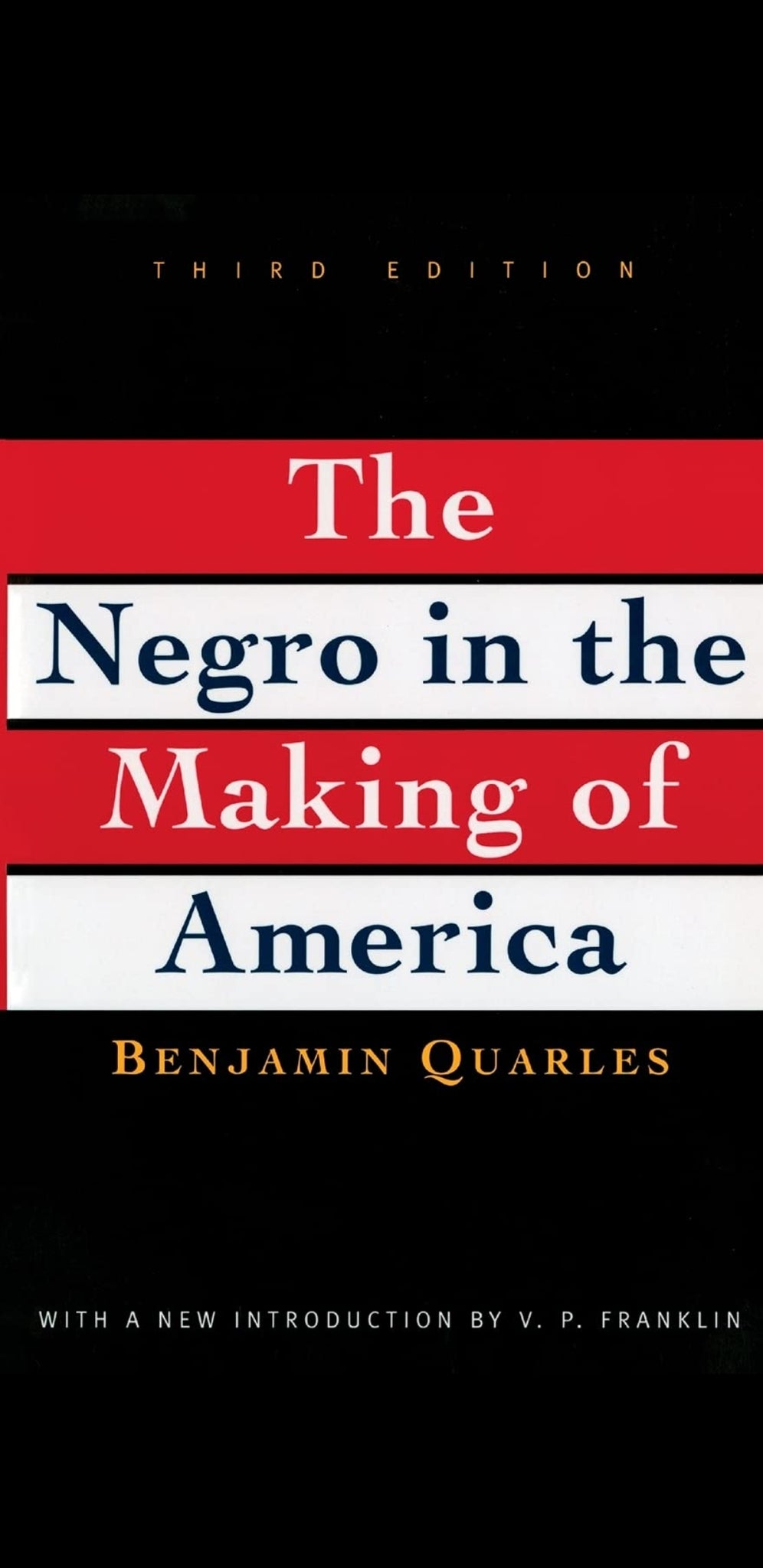
The Negro in the Making of America by Benjamin Quarles
$24.99The bestselling, definitive study of African Americans throughout American history, now with a new introduction by noted scholar V. P. Franklin.
In The Negro in the Making of America, eminent historian Benjamin Quarles provides one of the most comprehensive and readable accounts ever gathered in one volume of the role that African Americans have played in shaping the destiny of America. Starting with the arrival of the slave ships in the early 1600s and moving through the Colonial period, the Revolutionary and Civil Wars, and into the last half of the twentieth century, Quarles chronicles the sweep of events that have brought blacks and their struggle for social and economic equality to the forefront of American life.
Through compelling portraits of central political, historical, and artistic figures such as Nat Turner, Frederick Douglass, Duke Ellington, Malcolm X, and the Reverend Martin Luther King, Jr., Quarles illuminates the African American contributions that have enriched the cultural heritage of America. This classic history also covers black participation in politics, the rise of a black business class, and the forms of discrimination experienced by blacks in housing, employment, and the media.
Quarles's groundbreaking work not only surveys the role of black Americans as they engaged in the dual, simultaneous processes of assimilating into and transforming the culture of their country, but also, in a portrait of the white response to blacks, holds a mirror up to the deeper moral complexion of our nation's history. The restoration of this history holds a redemptive quality—one that can be used, in the author's words, as a "vehicle for present enlightenment, guidance, and enrichment." -
History Teaches Us to Resist: How Progressive Movements Have Succeeded in Challenging Times
Mary Frances Berry
$18.00Historian and civil rights activist proves how progressive movements can flourish even in conservative times.
Despair and mourning after the election of an antagonistic or polarizing president, such as Donald Trump, is part of the push-pull of American politics. But in this incisive book, historian Mary Frances Berry shows that resistance to presidential administrations has led to positive change and the defeat of outrageous proposals, even in challenging times. Noting that all presidents, including ones considered progressive, sometimes require massive organization to affect policy decisions, Berry cites Indigenous peoples’ protests against the Dakota pipeline during Barack Obama’s administration as a modern example of successful resistance built on earlier actions.
Beginning with Franklin D. Roosevelt, Berry discusses that president’s refusal to prevent race discrimination in the defense industry during World War II and the subsequent March on Washington movement. She analyzes Lyndon Johnson, the war in Vietnam, and the antiwar movement and then examines Ronald Reagan’s two terms, which offer stories of opposition to reactionary policies, such as ignoring the AIDS crisis and retreating on racial progress, to show how resistance can succeed.
The prochoice protests during the George H. W. Bush administration and the opposition to Bill Clinton’s “Don’t Ask, Don’t Tell” policy, as well as his budget cuts and welfare reform, are also discussed, as are protests against the war in Iraq and the Patriot Act during George W. Bush’s presidency. Throughout these varied examples, Berry underscores that even when resistance doesn’t achieve all the goals of a particular movement, it often plants a seed that comes to fruition later.
Berry also shares experiences from her six decades as an activist in various movements, including protesting the Vietnam War and advocating for the Free South Africa and civil rights movements, which provides an additional layer of insight from someone who was there. And as a result of having served in five presidential administrations, Berry brings an insider’s knowledge of government.
History Teaches Us to Resist is an essential book for our times which attests to the power of resistance. It proves to us through myriad historical examples that protest is an essential ingredient of politics, and that progressive movements can and will flourish, even in perilous times.
-
American Dark Age: Racial Feudalism and the Rise of Black Liberalism
Keidrick Roy
$35.00How medieval-inspired racial feudalism reigned in early America and was challenged by Black liberal thinkers
Though the United States has been heralded as a beacon of democracy, many nineteenth-century Americans viewed their nation through the prism of the Old World. What they saw was a racially stratified country that reflected not the ideals of a modern republic but rather the remnants of feudalism. American Dark Age reveals how defenders of racial hierarchy embraced America’s resemblance to medieval Europe and tells the stories of the abolitionists who exposed it as a glaring blemish on the national conscience.
Against those seeking to maintain what Frederick Douglass called an “aristocracy of the skin,” Keidrick Roy shows how a group of Black thinkers, including Frances Ellen Watkins Harper, Hosea Easton, and Harriet Jacobs, challenged the medievalism in their midst—and transformed the nation’s founding liberal tradition. He demonstrates how they drew on spiritual insight, Enlightenment thought, and a homegrown political philosophy that gave expression to their experiences at the bottom of the American social order. Roy sheds new light on how Black abolitionist writers and activists worked to eradicate the pernicious ideology of racial feudalism from American liberalism and renew the country’s commitment to values such as individual liberty, social progress, and egalitarianism.
American Dark Age reveals how the antebellum Black liberal tradition holds vital lessons for us today as hate groups continue to align themselves with fantasies of a medieval past and openly call for a return of all-powerful monarchs, aristocrats, and nobles who rule by virtue of their race.
-
Middle Passage
Middle Passage
Charles Johnson
$18.00A twenty-fifth anniversary edition of Charles Johnson’s National Book Award-winning masterpiece—"a novel in the tradition of Billy Budd and Moby-Dick…heroic in proportion…fiction that hooks the mind" (The New York Times Book Review)—now with a new introduction from Stanley Crouch.
Rutherford Calhoun, a newly freed slave and irrepressible rogue, is lost in the underworld of 1830s New Orleans. Desperate to escape the city’s unscrupulous bill collectors and the pawing hands of a schoolteacher hellbent on marrying him, he jumps aboard the Republic, a slave ship en route to collect members of a legendary African tribe, the Allmuseri. Thus begins a voyage of metaphysical horror and human atrocity, a journey which challenges our notions of freedom, fate and how we live together. Peopled with vivid and unforgettable characters, nimble in its interplay of comedy and serious ideas, this dazzling modern classic is a perfect blend of the picaresque tale, historical romance, sea yarn, slave narrative and philosophical allegory.
Now with a new introduction from renowned writer and critic Stanley Crouch, this twenty-fifth anniversary edition of Middle Passage celebrates a cornerstone of the American canon and the masterwork of one of its most important writers. "Long after we’d stopped believe in the great American novel, along comes a spellbinding adventure story that may be just that" (Chicago Tribune).
-
Black Nature: Four Centuries of African American Nature Poetry
edited by Camille T. Dungy
$38.95Black Nature is the first anthology to focus on nature writing by African American poets, a genre that until now has not commonly been counted as one in which African American poets have participated.
Black poets have a long tradition of incorporating treatments of the natural world into their work, but it is often read as political, historical, or protest poetry―anything but nature poetry. This is particularly true when the definition of what constitutes nature writing is limited to work about the pastoral or the wild.
Camille T. Dungy has selected 180 poems from 93 poets that provide unique perspectives on American social and literary history to broaden our concept of nature poetry and African American poetics. This collection features major writers such as Phillis Wheatley, Rita Dove, Yusef Komunyakaa, Gwendolyn Brooks, Sterling Brown, Robert Hayden, Wanda Coleman, Natasha Trethewey, and Melvin B. Tolson as well as newer talents such as Douglas Kearney, Major Jackson, and Janice Harrington. Included are poets writing out of slavery, Reconstruction, the Harlem Renaissance, the Black Arts Movement, and late twentieth- and early twenty-first-century African American poetic movements.
Black Nature brings to the fore a neglected and vital means of considering poetry by African Americans and nature-related poetry as a whole.
A Friends Fund Publication. -
Emmett J. Scott: Power Broker of the Tuskegee Machine (Afro-Texans)
Maceo C. Dailey Jr.
$45.00Reared in Houston (Freedmen’s Town), Texas, Emmett J. Scott was a journalist, newspaper editor, government official, author, and chief of staff, adviser, and ghostwriter to Booker T. Washington. Called “the power broker of the Tuskegee Machine,” Scott was a Renaissance man, scholar, and political fixer. However, his life has not received a full examination until now.
Built upon fifty years of research, Maceo C. Dailey’s Emmett J. Scott offers fascinating detail by describing Scott’s role in promoting the Tuskegee Institute. Before his 2015 death, Dailey had nearly singular access to the Scott papers at Morgan State University, which have been officially closed for decades. Readers will finally be exposed to Scott’s behind-the-scenes contributions to racial uplift and will see his influential role in advancing not only the Tuskegee Institute but also the Booker T. Washington agenda.
Editors Will Guzmán and David H. Jackson Jr. lend their own expertise in bringing Dailey’s lifetime project to fruition. Two-time Pulitzer Prize–winning historian David Levering Lewis, a close friend of Dailey’s, provides a timely foreword. Former Black Panther Party chairwoman Elaine Brown, Scott’s granddaughter, reflects on his impact and her relationship with the Scott family in the afterword.
Taken together, this work of biography is an impressive reference and an essential endeavor of recovery, one that restores to prominence the life and legacy of Emmett J. Scott.
-
The Great Disillusionment of Nick and Jay
$19.99From New York Times bestselling author Ryan Douglass comes a gripping and tender reimagining of The Great Gatsby about the pursuit of happiness—and love—in a society built on cruelty and secrets.
Seventeen-year-old Nick Carrington wants nothing more than to leave Greenwood, Oklahoma, behind and make a name for himself in the papers. But when tragedy strikes, dreams turn into a twisted reality. Forced to start anew in Harlem, only a letter of acceptance from the prestigious West Egg Academy is able to pull him back into the world.
But the supposedly integrated private boys’ school is more of a catchy headline than a fact, with the same prejudices Nick left behind back home. And his secret but growing feelings for the founder’s wickedly charismatic son, Jay Gatsby Jr.— who dances past society’s conventions with practiced ease—only add more complications.
When Nick’s cutting pen exposes dangerous truths about West Egg and leads to perilous consequences, he and Jay must decide whether to spend a lifetime outrunning trouble or be the ones to light the match. Can they not only fight back but triumph? Or will the powers that be win yet again?
-
Freedom Is a Constant Struggle: Ferguson, Palestine, and the Foundations of a Movement
by Angela Y. Davis
$15.95Activist, teacher, author and icon of the Black Power movement Angela Davis talks Ferguson, Palestine, and prison abolition.
In these newly collected essays, interviews, and speeches, world-renowned activist and scholar Angela Y. Davis illuminates the connections between struggles against state violence and oppression throughout history and around the world.
Reflecting on the importance of black feminism, intersectionality, and prison abolitionism for today's struggles, Davis discusses the legacies of previous liberation struggles, from the Black Freedom Movement to the South African anti-Apartheid movement. She highlights connections and analyzes today's struggles against state terror, from Ferguson to Palestine.
Facing a world of outrageous injustice, Davis challenges us to imagine and build the movement for human liberation. And in doing so, she reminds us that "Freedom is a constant struggle."
Stay Informed. We're building a community committed to celebrating Black authors + artisans. Subscribe to keep up with all things Kindred Stories.