
Search results: 18 results for “edited by Walter Hood”
Not finding what you're looking for? Check out our shop on bookshop.org to order and still support us ♥
18 results
-
Black Landscapes Matter
![Black Landscapes Matter]()
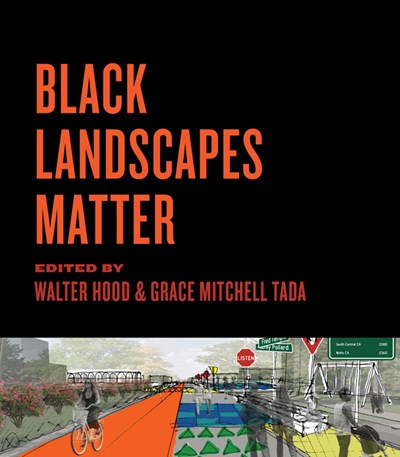
Black Landscapes Matter
edited by Walter Hood & Grace Mitchell Tada
$43.50The question "Do black landscapes matter?" cuts deep to the core of American history. From the plantations of slavery to contemporary segregated cities, from freedman villages to northern migrations for freedom, the nation’s landscape bears the detritus of diverse origins. Black landscapes matter because they tell the truth. In this vital new collection, acclaimed landscape designer and public artist Walter Hood assembles a group of notable landscape architecture and planning professionals and scholars to probe how race, memory, and meaning intersect in the American landscape.
Essayists examine a variety of U.S. places—ranging from New Orleans and Charlotte to Milwaukee and Detroit—exposing racism endemic in the built environment and acknowledging the widespread erasure of black geographies and cultural landscapes. Through a combination of case studies, critiques, and calls to action, contributors reveal the deficient, normative portrayals of landscape that affect communities of color and question how public design and preservation efforts can support people in these places. In a culture in which historical omissions and specious narratives routinely provoke disinvestment in minority communities, creative solutions by designers, planners, artists, and residents are necessary to activate them in novel ways. Black people have built and shaped the American landscape in ways that can never be fully known. Black Landscapes Matter is a timely and necessary reminder that without recognizing and reconciling these histories and spaces, America’s past and future cannot be understood.
-
The African Ancestors Garden: History and Memory at the International African American Museum
![The African Ancestors Garden: History and Memory at the International African American Museum cover image]()

The African Ancestors Garden: History and Memory at the International African American Museum
$59.95‘[Walter Hood is] one of the great American landscape artists.’ – Former President Joseph R. Biden
The first publication to document the International African American Museum’s landscape design by Hood Design Studio, illuminating its mission and historic site
The African Ancestors Garden is the first book to be published in conjunction with the International African American Museum (IAAM) in Charleston, South Carolina. The museum’s landscape design by Hood Design Studio, led by award-winning Walter Hood, exemplifies the museum’s mission to reflect on its location at Gadsden’s Wharf, the point at which nearly half of all enslaved Africans arrived in North America.
With contributions by figures critical to the realization of the International African American Museum, this significant book presents the intensive site research and concepts that went into the distinct spaces at the museum, including an infinity reflecting pool and an ethnobotanical showcase of African plants brought to North America though that landing. Hood’s design response to these historic grounds addresses memory, tragedy, and culture, a moving homage to the living Charleston community and the African diaspora at large.
Hood Design Studio, led by MacArthur ‘Genius’ Grant-winner Walter Hood, is at the forefront of the expanding field of social activism through design, and this book allows us a detailed overview of the conceptualization and creation of a remarkable and deeply meaningful landscape, proposing a way of designing public spaces and cultural institutions that embody the African American experience.
-
The Groundings With My Brothers
![The Groundings With My Brothers cover image]()

The Groundings With My Brothers
$21.95A striking book on the international operations of racism and the global meaning of Black Power
In his short life, the Guyanese intellectual Walter Rodney emerged as one of the leading thinkers and activists of the anticolonial revolution, leading movements in North America, South America, the African continent, and the Caribbean. In each locale, Rodney found himself a lightning rod for working class Black Power. His deportation catalyzed 20th century Jamaica's most significant rebellion, the 1968 Rodney riots, and his scholarship trained a generation how to think politics at an international scale. In 1980, shortly after founding of the Working People's Alliance in Guyana, the 38-year-old Rodney would be assassinated.
In this classic work published in the heady days of anti-colonial revolution, Groundings with My Brothers follows the global circulation of emancipatory ideas, from the black students of North America to the Rasta counter-culture of Jamaica and beyond. The book is striking in its simultaneous ability to survey the wide and heterogenous international context while remaining anchored in grassroots politics, as Rodney offers us first-hand accounts of mass movement organizing. Having inspired a generation of revolutionaries, this new edition will re-introduce the book to a new political landscape that it helped shape, with reflections from leading scholar-activists such as Carole Boyce Davies -
Houston Noir
![Houston Noir]()

Houston Noir
by Gwendolyn Zepeda
$15.95From the introduction by Gwendolyn Zepeda:
In a 2004 essay, Hunter S. Thompson described Houston as a "cruel, crazy town on a filthy river in East Texas with no zoning laws and a culture of sex, money and violence. It's a shabby, sprawling metropolis ruled by brazen women, crooked cops and super-rich pansexual cowboys who live by the code of the West--which can mean just about anything you need it to mean, in a pinch." For what it's worth, that quote is now posted on a banner somewhere downtown and regularly, gleefully repeated by our local feature writers.
Houston is a port city on top of a swamp and, yes, it has no zoning laws. And that means it's culturally diverse, internally incongruous, and ever-changing. At any intersection here, I might look out my car window and see a horse idly munching St. Augustine grass. And, within spitting distance of that horse, I might see a "spa" that's an obvious brothel, a house turned drug den, or a swiftly rising bayou that might overtake a car if the rain doesn't let up...Overall, this collection represents the very worst our city has to offer, for residents and visitors alike. But it also presents some of our best voices, veteran and emerging, to any reader lucky enough to pick up this book.
-
Devil in a Blue Dress (30th Anniversary Edition): An Easy Rawlins Novel
![Devil in a Blue Dress (30th Anniversary Edition): An Easy Rawlins Novel]()

Devil in a Blue Dress (30th Anniversary Edition): An Easy Rawlins Novel
by Walter Mosley
$18.99The first novel by “master of mystery” (The New York Times) Walter Mosley, featuring Easy Rawlins, the most iconic African American detective in all of fiction. Named one of the “best 100 mystery novels of all time” by the Mystery Writers of America, this special thirtieth anniversary edition features an all new introduction from the author.
The year is 1948, the town is Los Angeles.
Easy Rawlins, a black war veteran, has just been fired from his job at a defense factory plant. Drinking in his friend’s bar, he’s wondering how he’ll manage to make ends meet, when a white man in a linen suit approaches him and offers him good money if Easy will simply locate Miss Daphne Money, a missing blonde beauty known to frequent black jazz clubs.
Easy has no idea that by taking this job, his life is about to change forever.
“More than simply a detective novel…[Mosley is] a talented author with something vital to say about the distance between the black and white worlds, and with a dramatic way to say it” (The New York Times). -
PRE-ORDER: Bold and Brilliant: The Rise of Black American Magazines, 1930-1970
![Bold and Brilliant: The Rise of Black American Magazines, 1930-1970 cover image]()

PRE-ORDER: Bold and Brilliant: The Rise of Black American Magazines, 1930-1970
$60.00A landmark study of twentieth-century Black picture magazines and their impact on Black American life
From the late 1930s through the early 1970s, national publications such as Our World, Sepia, Color, Elegant, Flash, Brown, and Ebony framed emerging definitions of success for Black middle-class audiences. These magazines featured dynamic photo essays, sometimes by photographers as renowned as Gordon Parks and Moneta Sleet Jr., that shaped perspectives on Black cultural life and influenced the way millions of Americans understood the world through photography.
This history of Black picture magazines and their contribution to American photography, journalism, and cultural production is the first to consider these publications through a visual and scholarly lens. It features more than 250 illustrations, essays by prominent curators and thinkers, and thematic contributions by celebrity experts, including
• Tina Beyoncé Knowles, businesswoman and House of Deréon fashion designer, on beauty culture
• Doug Glanville, sports journalist and former MLB player, on sports
• Carla J. Williams, photographer and 2025 Guggenheim fellow, on pulp pinups
• Jason Moran, jazz musician and MacArthur “genius” award-winner, on music
• TAYLOR ALXNDR, activist and performer, on drag and queer/trans representationWith a comprehensive list of Black picture magazines and the photographers whose work appeared in them, this volume will serve as both a foundational reference and a compelling visual history that reveals the profound role these publications played in defining and circulating images of Black life, achievement, and aspiration in the United States.
Published in association with the Museum of Fine Arts, Houston
Exhibition Schedule:
Museum of Fine Arts, Houston
(February 28 to May 31, 2027)Portland Museum of Art, Maine
(October 8, 2027, to January 9, 2028)New Orleans Museum of Art
(May 11 to August 6, 2028) -
Race and the Houston Police Department, 1930–1990: A Change Did Come (Volume 102) (Centennial Series of the Association of Former Students, Texas A&M University)
![Race and the Houston Police Department, 1930–1990: A Change Did Come (Volume 102) (Centennial Series of the Association of Former Students, Texas A&M University) cover image]()

Race and the Houston Police Department, 1930–1990: A Change Did Come (Volume 102) (Centennial Series of the Association of Former Students, Texas A&M University)
Dwight D. Watson
$44.00In Houston, as in the rest of the American South up until the 1950s, the police force reflected and enforced the segregation of the larger society. When the nation began to change in the 1950s and 1960s, this guardian of the status quo had to change, too. It was not designed to do so easily.
Dwight Watson traces how the Houston Police Department reacted to social, political, and institutional change over a fifty-year period—and specifically, how it responded to and in turn influenced racial change.
Using police records as well as contemporary accounts, Watson astutely analyzes the escalating strains between the police and segments of the city’s black population in the 1967 police riot at Texas Southern University and the 1971 violence that became known as the Dowling Street Shoot-Out. The police reacted to these events and to daily challenges by hardening its resolve to impose its will on the minority community.
By 1977, the events surrounding the beating and drowning of Jose Campos Torres while in police custody prompted one writer to label the HPD the “meanest police in America.” This event encouraged Houston’s growing Mexican American community to unite with blacks in seeking to curb police autonomy and brutality.
Watson’s study demonstrates vividly how race complicated the internal impulses for change and gave way through time to external pressures—including the Civil Rights Movement, modernization, annexations, and court-ordered redistricting—for institutional changes within the department. His work illuminates not only the role of a southern police department in racial change but also the internal dynamics of change in an organization designed to protect the status quo.
-
PRE-ORDER: The Jungles: Thelonious Monk and the Lost Cradle of Modern Jazz
![The Jungles: Thelonious Monk and the Lost Cradle of Modern Jazz cover image]()

PRE-ORDER: The Jungles: Thelonious Monk and the Lost Cradle of Modern Jazz
$31.99A hidden history of twentieth-century American modernity that re-examines a mere twelve-block area on Manhattan’s Upper West Side with Thelonious Monk as its guiding star.
The Jungles reclaims the largely forgotten world of San Juan Hill, a predominantly Black neighborhood on Manhattan’s West Side, was one of the most fertile centers of American cultural life in the twentieth century.
At once a biography, an urban history, and a cultural reckoning, Howard W. French’s The Jungles reveals how the neighborhood that would encompass Lincoln Center, previously known as the Jungles, fostered numerous pathbreaking Black artists, among them a young Thelonious Sphere Monk (1917–1982).
The story opens in Cuba in 1898, where we watch as Teddy Roosevelt’s forces triumph on San Juan Hill, with close to one-fifth of the overall invading force consisting of Black soldiers whose valor went largely unrecognized. After returning to the US, these veterans joined a broader wave of Black migrants moving northward, eventually settling in a Manhattan -neighborhood that would take the battle’s name. San Juan Hill became a lively, artistic Black community that preceded the Harlem Renaissance and inspired some of the highest twentieth- century creative triumphs―giving rise to the stride piano style and nurturing the genius of Monk, whose mold-breaking artistry struggled to gain traction in an industry then dominated by white producers.
As Robert Moses began tearing down the neighborhood under the guise of “urban renewal,” Monk became its most famous holdout, staying put in his cramped apartment in the Phipps Houses at 243 West 63rd Street, his upright piano protruding from his bedroom into the kitchen as he continued to make his iconic music.
By the late 1950s, Monk’s genius had finally been recognized, but the erasure already felt irreversible, extending even to the musical West Side Story, which reimagined the neighborhood’s streets as Latino gang territory, whitewashing the predominantly Black and Caribbean community that had actually lived there.
A compelling history from one of our finest American historians, The Jungles ultimately emerges as a new way of telling the history of music, of New York, and of America. The cradle of jazz was not only in New Orleans but also in San Juan Hill, and French’s magnificent recreation of that vanished world, and of the miraculous life of Thelonious Monk, restores to American cultural memory what erasure nearly stole for good.
12 illustrations
-
PRE-ORDER: The Hood Bird Guide: It's Not Just Pigeons
![PRE-ORDER: The Hood Bird Guide: It's Not Just Pigeons]()

PRE-ORDER: The Hood Bird Guide: It's Not Just Pigeons
$19.99Most bird books weren't made for us. This one is. This is your guide. These are your birds.
The Hood Bird Guide is ornithology for the streets. It's a love letter to the ends and a call to reconnect with nature - right where you are.
Built for city youth, council-estate dreamers and suited professionals who hike on weekends, this is a bold, witty and culturally fluent take on birds as you've never seen them before. It looks at pigeons, magpies and kestrels with the same reverence usually reserved for rare species, proving the magic is already flying above our heads - if you know how to look up.
With sharp writing, serious style and undeniable cultural credibility, The Hood Bird Guide remixes the classic field guide into something fresh and accessible through slang-coded anatomy.
Perfect for:
* Urban explorers, creatives and first-time birdwatchers
* Anyone bored of beige nature books
* Readers who want culture, humour and style alongside real knowledge -
PRE-ORDER: For the Villain (Deluxe Edition) (Hunt the Red Hood, 2)
![For the Villain (Standard Edition) (Hunt the Red Hood, 2) cover image]()

PRE-ORDER: For the Villain (Deluxe Edition) (Hunt the Red Hood, 2)
$19.99The second book in the Hunt the Red Hood duology from bestselling author B.B. Reid.
While caring for her grandmother, a young woman is caught between a sly wolf hellbent on seducing her and an enigmatic stranger with a heart of tarnished gold.
-
PRE-ORDER: The Best of The Crisis Magazine: Over 100 Years of Excellence in Black Literature from 1910 to Today
![The Best of The Crisis Magazine: Over 100 Years of Excellence in Black Literature from 1910 to Today cover image]()

PRE-ORDER: The Best of The Crisis Magazine: Over 100 Years of Excellence in Black Literature from 1910 to Today
$26.99The iconic NAACP magazine’s most dynamic and daring African American voices gathered together for the first time in a groundbreaking literary collection, from founding editor W. E. B. DuBois and Jessie Fauset to today's modern day cultural critics, including June Shagaloff and Michael A. Lawrence.
The Crisis magazine is the official publication of NAACP. It was created in 1910 by renowned historian, civil rights activist, and NAACP co-founder W. E. B. DuBois. The magazine appeared three years before Conde Nast launched an American version of Vanity Fair and fifteen years before Harold W. Ross introduced The New Yorker to readers.
Du Bois started The Crisis in one room of the New York Evening Post building in New York City and edited the publication until 1934. A group of NAACP leaders adapted the name from James Russell Lowell's poem The Present Crisis, written at the height of the Civil War.
In the premier issue Du Bois made clear of the publication’s goals: "The Crisis will record important happenings and movements in the world which bear on the great problem of inter-racial relations, and especially those which affect the Negro-American. Secondly, it will be a review of opinion and literature, recording briefly books, articles, and important expressions of opinion in the white and colored press on the race problem. Thirdly, it will publish a few short articles. Finally, its editorial page will stand for the rights of men, irrespective of color or race, for the highest ideals of American democracy."
At the time, Du Bois noted, "it was the rule of most white papers never to publish a picture of a colored person except as a criminal and the colored papers published mostly pictures of celebrities who sometimes paid for the honor. In general, the Negro race was just a little afraid to see itself in plain ink." Everything changed with the advent of The Crisis.
Now, for the first time ever The Best of the Crisis will bring together the magazine’s previously published most dynamic and daring voices and stories from its founding until today in one extraordinary collection, including W. E. B. Du Bois, Thurgood Marshall, Bayard Rustin, Francis Grimke, J.A. Rogers, Stetson Kennedy, E. Franklin Frazier, Oswald Garrison Villard, Jessie Fauset and Arna Bontemps.
This edition will spotlight the first section devoted to Negro children, the first presentation of Negro artwork, the first feature stories about successful Negroes, the first full-fledged drive for Pan-Africanism, the first special numbers devoted to Negro educational advancement, the first articles on consumers cooperation all tied together with contemporary voices on where we stand on these issues today.
-
PRE-ORDER: For the Villain (Standard Edition) (Hunt the Red Hood, 2)
![For the Villain (Standard Edition) (Hunt the Red Hood, 2) cover image]()
PRE-ORDER: For the Villain (Standard Edition) (Hunt the Red Hood, 2)
$19.99The second book in the Hunt the Red Hood duology from bestselling author B.B. Reid.
While caring for her grandmother, a young woman is caught between a sly wolf hellbent on seducing her and an enigmatic stranger with a heart of tarnished gold.


Stay Informed. We're building a community committed to celebrating Black authors + artisans. Subscribe to keep up with all things Kindred Stories.