
Search results: 13 results for “by the education for liberation network”
Not finding what you're looking for? Check out our shop on bookshop.org to order and still support us ♥
13 results
-
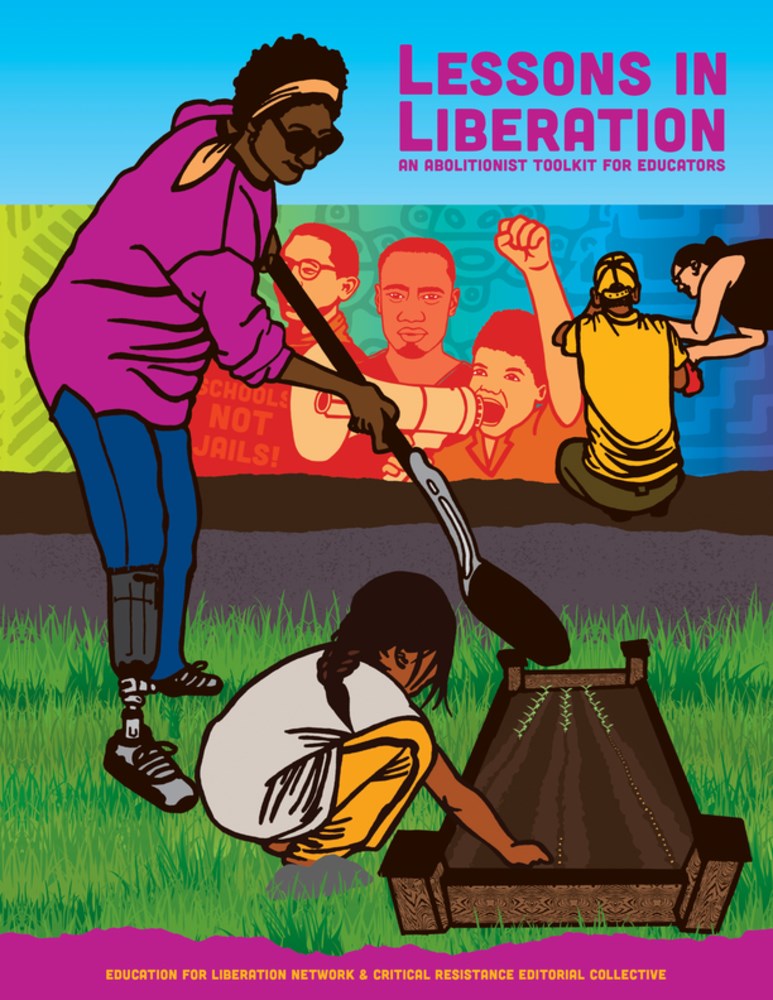
Lessons in Liberation: An Abolitionist Toolkit for Educators
![Lessons in Liberation: An Abolitionist Toolkit for Educators]()
Lessons in Liberation: An Abolitionist Toolkit for Educators
by The Education for Liberation Network & Critical Resistance Editorial Collective
$25.00A political vision for a future ripe with alternatives to imprisonment and punishment.
Born from sustained organizing, and rooted in Black and women of color feminisms, disability justice, and other movements, abolition calls for an end to our reliance on imprisonment, policing and surveillance, and to imagine a safer future for our communities.
Lessons in Liberation: An Abolitionist Toolkit for Educators offers entry points to build critical and intentional bridges between educational practice and the growing movement for abolition. Designed for educators, parents, and young people, this toolkit shines a light on innovative abolitionist projects, particularly in pre-K–12 learning contexts.
Sections are dedicated to entry points into Prison Industrial Complex abolition and education; the application of the lessons and principles of abolition; and stories about growing abolition outside of school settings. Topics addressed throughout include student organizing, immigrant justice in the face of ICE, approaches to sex education, arts-based curriculum, and building abolitionist skills and thinking in lesson plans.
The result of patient and urgent work, and more than five years in the making, Lessons in Liberation invites educators into the work of abolition.
Contributors include Black Organizing Project, Chicago Women’s Health Center, Mariame Kaba and Project NIA, Bettina L. Love, the MILPA Collective, and artists from the Justseeds Collective, among others.
-
Toward Liberation: Educational Practices Rooted in Activism, Healing and Love
![Toward Liberation: Educational Practices Rooted in Activism, Healing and Love]()
Toward Liberation: Educational Practices Rooted in Activism, Healing and Love
by Jamilah Pitts
$21.95*Ships in 7-10 business days*
An essential guide for frontline educators to address systemic racial oppression, repair harm, and foster safe, inclusive learning spaces for their students
For educators and readers of Bettina Love’s We Want to Do More Than Survive, with a foreword by Leigh Patel, author of No Study Without Struggle
Toward Liberation is the timely and practical guide that pioneers new pathways for educators to repair harm and foster transformative learning spaces. This road map for liberatory pedagogy is replete with resources, tools, and strategies drawn from Jamilah Pitts's experiences as a young Black girl, a Black student, a teacher, a former school leader, and a consultant with schools across the country.
Educators will want to mark up and keep their copy of Toward Liberation at their desks for easy reference. In its pages, they will find- Real-life examples and student writing from Pitts’s classroom
- Explorative questions for teachers to consider in their equity work
- Constructive charts that map out manifestations of harm
- Activities to engage students in liberatory learning
- Healing and self-care strategies for teachers—particularly Black women educators
Pitts infuses her writing with an extensive knowledge base of the education system, honed over years as a teacher, a coach, a dean, an assistant principal, and a national education consultant. The tenets of this book—rooted in truthtelling, activism, healing, wellness, self-care, and, ultimately, love— both inform and are inspired by the healing work Pitts does with educators to this day. In doing this work, she helps to reimagine the role of the critical teacher.
Toward Liberation equips teachers with the tools they need to carve a path toward liberatory educational practices, ensuring that students are afforded the full range of their humanity and their experience, in and out of the classroom. -
We Want to Do More Than Survive: Abolitionist Teaching and the Pursuit of Educational Freedom by Bettina L. Love
![We Want to Do More Than Survive: Abolitionist Teaching and the Pursuit of Educational Freedom by Bettina L. Love]()
We Want to Do More Than Survive: Abolitionist Teaching and the Pursuit of Educational Freedom by Bettina L. Love
$17.95Drawing on personal stories, research, and historical events, an esteemed educator offers a vision of educational justice inspired by the rebellious spirit and methods of abolitionists.
Drawing on her life’s work of teaching and researching in urban schools, Bettina Love persuasively argues that educators must teach students about racial violence, oppression, and how to make sustainable change in their communities through radical civic initiatives and movements. She argues that the US educational system is maintained by and profits from the suffering of children of color. Instead of trying to repair a flawed system, educational reformers offer survival tactics in the forms of test-taking skills, acronyms, grit labs, and character education, which Love calls the educational survival complex.
To dismantle the educational survival complex and to achieve educational freedom—not merely reform—teachers, parents, and community leaders must approach education with the imagination, determination, boldness, and urgency of an abolitionist. Following in the tradition of activists like Ella Baker, Bayard Rustin, and Fannie Lou Hamer, We Want to Do More Than Survive introduces an alternative to traditional modes of educational reform and expands our ideas of civic engagement and intersectional justice. -
Freedom Is a Constant Struggle: Ferguson, Palestine, and the Foundations of a Movement
![Freedom Is a Constant Struggle: Ferguson, Palestine, and the Foundations of a Movement]()
Freedom Is a Constant Struggle: Ferguson, Palestine, and the Foundations of a Movement
by Angela Y. Davis
$15.95Activist, teacher, author and icon of the Black Power movement Angela Davis talks Ferguson, Palestine, and prison abolition.
In these newly collected essays, interviews, and speeches, world-renowned activist and scholar Angela Y. Davis illuminates the connections between struggles against state violence and oppression throughout history and around the world.
Reflecting on the importance of black feminism, intersectionality, and prison abolitionism for today's struggles, Davis discusses the legacies of previous liberation struggles, from the Black Freedom Movement to the South African anti-Apartheid movement. She highlights connections and analyzes today's struggles against state terror, from Ferguson to Palestine.
Facing a world of outrageous injustice, Davis challenges us to imagine and build the movement for human liberation. And in doing so, she reminds us that "Freedom is a constant struggle." -
Pedagogy of the Oppressed : 50th Anniversary Edition (4th Edition)
![Pedagogy of the Oppressed : 50th Anniversary Edition (4th Edition)]()

Pedagogy of the Oppressed : 50th Anniversary Edition (4th Edition)
Paulo Freire
$28.95Paulo Freire outlines the revolutionary principles behind the educational methods that made him one of the 20th century's most influential education theorists.First published in Portuguese in 1968, Pedagogy of the Oppressed was translated and published in English in 1970. Paulo Freire's work has helped to empower countless people throughout the world and has taken on special urgency in the United States and Western Europe, where the creation of a permanent underclass among the underprivileged and minorities in cities and urban centers is ongoing.
This 50th anniversary edition includes an updated introduction by Donaldo Macedo, a new afterword by Ira Shor and interviews with Marina Aparicio Barberán, Noam Chomsky, Ramón Flecha, Gustavo Fischman, Ronald David Glass, Valerie Kinloch, Peter Mayo, Peter McLaren and Margo Okazawa-Rey to inspire a new generation of educators, students, and general readers for years to come. -
The Education of Black People: Ten Critiques, 1906-1960
![The Education of Black People: Ten Critiques, 1906-1960]()
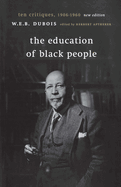
The Education of Black People: Ten Critiques, 1906-1960
$18.00Undoubtedly the most influential black intellectual of the twentieth century and one of America's finest historians, W.E.B. DuBois knew that the liberation of the African American people required liberal education and not vocational training. He saw education as a process of teaching certain timeless values: moderation, an avoidance of luxury, a concern for courtesy, a capacity to endure, a nurturing love for beauty. At the same time, DuBois saw education as fundamentally subversive. This was as much a function of the well-established role of educationfrom Plato forwardas the realities of the social order under which he lived. He insistently calls for great energy and initiative; for African Americans controlling their own lives and for continued experimentation and innovation, while keeping education's fundamentally radical nature in view.
Though containing speeches written nearly one-hundred years ago, and on a subject that has seen more stormy debate and demagoguery than almost any other in recent history, The Education of Black People approaches education with a timelessness and timeliness, at once rooted in classical thought that reflects a remarkably fresh and contemporary relevance. -
Education for the Revolution: The Legacy of the Black Panther Party's Oakland Community School (Black Power)
![Education for the Revolution: The Legacy of the Black Panther Party's Oakland Community School (Black Power) cover image]()

Education for the Revolution: The Legacy of the Black Panther Party's Oakland Community School (Black Power)
$30.00Traces the history of the Oakland Community School, the last Community Survival Program of the Black Panther Party
Education for the Revolution offers the first comprehensive historical account of the last standing survival program of the Black Panther Party, the Oakland Community School. First established as the Children’s House in 1970 and operational until 1982, the Oakland Community School provided grade school children with holistic educational and communal practices that oriented them to the Black Panther Party’s political consciousness. Drawing from newspapers, oral histories, and archives, historian Robert P. Robinson links the history of the school to the Black historical tradition of resistance via education, framing the school as a union of Black self-determination and education history.
Robinson situates the Oakland Community School within the Black Panther Party’s longstanding commitment to using education as a tool to achieve liberation. Long before terms like restorative justice, gender inclusion, and culturally relevant pedagogy were popular in classrooms, Robinson explores how students of the Oakland Community School were regarded as co-creators of knowledge alongside their teachers, local activists, and parents. Combining personal reflections from parents, students, and former faculty with an analysis of the school’s concrete teaching practices, the book asserts that their histories are vital to present-day educational efforts.
Whereas popular narratives of the Black Panther Party argue that their political activism ceased by the early 1970s, this history of the Oakland Community School illuminates Black Panther women’s continued efforts to grow power through education. At once compelling and revelatory, Education for the Revolution cements the Oakland Community School’s legacy as one of the most enduring Black independent education projects for social justice, as well as a fascinating precursor to critical forms of education seen today.
-
The Second Emancipation: Nkrumah, Pan-Africanism, and Global Blackness at High Tide
![The Second Emancipation: Nkrumah, Pan-Africanism, and Global Blackness at High Tide cover image]()

The Second Emancipation: Nkrumah, Pan-Africanism, and Global Blackness at High Tide
Howard W. French
from $22.99*Paperback Release Date - 10/6/2026*
Named one of the Most Anticipated Books of 2025 by Foreign Policy
“Howard French’s The Second Emancipation stands the second half of the last century on its geopolitical head.” ―David Levering Lewis, winner of the Pulitzer Prize
From the acclaimed author of Born in Blackness comes an extraordinary account of Africa’s liberation from colonial oppression, a work that fundamentally reshapes our understanding of modern history.
A work of epic dimension that recasts the liberation of twentieth-century Africa through the lens of revolutionary leader Kwame Nkrumah.
The Second Emancipation, the second work in a trilogy from best-selling author Howard W. French about Africa’s pivotal role in shaping world history, underscores Adam Hochschild’s contention that French is a “modern-day Copernicus.” The title―referring to a brief period beginning in 1957 when dozens of African colonies gained their freedom―positions this liberation at the center of a “movement of global Blackness,” with one charismatic leader, Kwame Nkrumah (1909–1972), at its head.
That so few people today know about Nkrumah is an omission that French demonstrates is “typical of our deliberate neglect of Africa’s enormous role in the birth of the modern world.” Determined to re-create Nkrumah’s life as “an epic twentieth-century story,” The Second Emancipation begins with his impoverished, unheralded birth in the far-western region of Ghana’s Gold Coast. But blessed with a deep curiosity, a young Nkrumah pursued an overseas education in the United States. Nowhere is French’s consummate style more vivid than in Nkrumah’s early years in Depression-era America, especially in his mesmerizing portrait of a culturally effervescent Harlem that Nkrumah encountered in 1935 before heading to college. During his student years in Pennsylvania and later as an activist in London, Nkrumah became steeped in a renowned international Black intellectual milieu―including Du Bois, Garvey, Fanon, Padmore, and C.L.R. James, who called him “one of the greatest political leaders of our century”―and formed an ideology that readied him for an extraordinarily swift and peaceful rise to power upon his return to Ghana in 1947.
Four years later, in a political landslide he engineered while imprisoned, Nkrumah stunned Britain by winning the first general election under universal franchise in Africa, becoming Ghana’s first independent prime minister in 1957. As leader of a sovereign nation, Nkrumah wielded his influence to promote the liberation of the entire continent, pushing unity as the only pathway to recover from the damages of enslavement and subjugation. By the time national military and police forces, aided by the CIA, overthrew him in 1966, Nkrumah’s radical belief in pan-African liberation had both galvanized dozens of nascent African states and fired a global agenda of Black power.
In its dramatic recasting of the American civil rights story and in its tragic depiction of a continent that once exuded all the promise of a newly won freedom, The Second Emancipation becomes a generational work that positions Africa at the forefront of modern-day history.
16 pages of illustrations; 3 maps
-
Little Stories Club: Storytime at Kindred - September 26 @ 11 AM
![Little Stories Club: Storytime at Kindred - September 26 @ 11 AM]()

Little Stories Club: Storytime at Kindred - September 26 @ 11 AM
$0.00Join us for a montly children's storytime at Kindred Stories. Each Story time will celebrate a special book and be read by a wondertful community mementer. IT also includes a story time.
Featured Book: Daisy Helps With The Dress
Featured Reader: Antonia Adams
EVENT DEETS
When: Saturday, September 26 @ 11 AM CST
Where: Kindred Stories (2310 Elgin St. Houston, TX 77004)
How:
-
RSVP ONLY to reserve your spot and let us know you are coming.
ABOUT DAISY HELPS WITH THE DRESS
When Daisy tries to help with her cousin’s wedding, her misguided assists almost ruin the big day, until she finds a way to pull the dress—and her family—together in this charming picture book by award-winning author Olugbemisola Rhuday-Perkovich.
Daisy loves helping her family and she knows the best kind of helpers never wait to be asked. That’s why she doesn’t ask before adding finishing touches to her family’s special reused, re-tried, remixed things, like a leftover broccoli topping for Auntie Fontie’s cakes or a good bath for Nana DJ’s “back-in-the-day, rusty, dusty” vintage albums—much to their chagrin.
But what Daisy wants most is to help give her cousin Simone’s recycled wedding dress a little razzle dazzle. She knows just what the vintage dress needs: a little glitter here, a few stickers there to give the dress some flair.
But Daisy’s cousin Simone and the rest of the family are not so happy with her decorations. Can Daisy make things right and help find Simone a new re-lived, re-loved wedding dress?
-
-
Black Muslim Freedom Dreams: Islamic Education, Pan-Africanism, and Collective Care
![Black Muslim Freedom Dreams: Islamic Education, Pan-Africanism, and Collective Care cover image]()

Black Muslim Freedom Dreams: Islamic Education, Pan-Africanism, and Collective Care
Sold outExplores three generations of Black American Muslims pursuing education and liberation beyond the borders of the United States
Since the 1970s, hundreds of Black American Muslims in the Tijani Sufi order have sought refuge in a new world that would nurture their racial, religious and gendered identities away from anti-Black and anti-Muslim racism in the United States. This new world is in Medina Baye, a city in Senegal that is the headquarters of a pan-African Sufi movement with tens of millions of members in Africa alone.
Drawing on a decade and a half of ethnographic engagement, Black Muslim Freedom Dreams explores the Islamic educational opportunities created for and by Black American Muslims in Medina Baye, chronicling the dreams, sacrifices, struggles, and joys of young people and parents who live, learn, and strive for liberation between the United States and Senegal. The volume traces their journeys between these two worlds, zooming in to vividly portray everyday Black American and West African religious life, and zooming out to map the sociopolitical landscapes, educational conditions and Islamic and pan-African ideologies that shape believers' perspectives.
Black Muslim Freedom Dreams argues that Black Muslims’ experiences of Islamic education and pan-African exchange are oriented towards collective care – a radical way of being and belonging through which believers journey on the path towards Allah’s love by caring for one another and addressing the material inequities that constrain their communities. This notion disrupts narratives of religion that are limited to systems of personal belief, showcasing instead how their educational experiences foster a collective responsibility and solidarity. The book offers a compelling account of how Black Muslims engage with transnational religious and racial networks to build liberatory communities beyond the United States.
-
The Battle for the Black Mind
![The Battle for the Black Mind cover image]()

The Battle for the Black Mind
Karida L. Brown Ph.D
Sold outFrom a NAACP award-winning historian and Fulbright scholar, a history of education in the United States from the end of the Civil War to the historic ruling of Brown v. Board of Education.
In The Battle for the Black Mind, Dr. Karida Brown explores the struggle to define and control the education of African Americans amid shifting societal attitudes and forms of systemic exclusion. From the perspective of freed slaves seeking empowerment and liberation through education, to the white elites aiming to shape the future of the workforce and consolidate power, The Battle for the Black Mind explores the formation of segregated education systems and the influence of philanthropic organizations, religious institutions, and Black educators themselves in shaping these structures. It also examines the global reach of these education models, particularly their impact on African societies under colonial rule.
Ultimately, Dr. Brown presents a critical investigation of the foundational roots of racial inequality in American education, arguing that it wasn't just about the separation of institutions—but about controlling access to the ideals of American democracy.
-
Virtual Author Talk: The Sex Lives of African Women with Nana Darkoa Sekyiamah & Aja Monet - April 10 @ 1 PM CST
![Virtual Author Talk: The Sex Lives of African Women with Nana Darkoa Sekyiamah & Aja Monet - April 10 @ 1 PM CST]()

Virtual Author Talk: The Sex Lives of African Women with Nana Darkoa Sekyiamah & Aja Monet - April 10 @ 1 PM CST
Sold outEVENT DEETS:
When: Sunday, April 10 at 1 PM CST
Where: Virtual via Crowdcast
How: Register on this page or head over to register on Crowdcast directly using this link. If you register using our website (with or without purchasing the book) and not Crowdcast, you will receive a Crowdcast watch link at least 24 hours before the start of the event.
We hope you can join us!
ABOUT THE BOOK:
In these confessional pages, women control their own bodies and desires, work toward healing their painful pasts, and learn to assert their sexual power. Weaving a rich tapestry of experiences with a sex positive outlook, The Sex Lives of African Women is an empowering, subversive book that celebrates the liberation, individuality, and joy of African women’s multifaceted sexuality.
From a queer community in Egypt, to polyamorous life in Senegal, and a reflection on the intersection of religion and pleasure in Cameroon, feminist author Nana Darkoa Sekyiamah explores the many layers of love and desire, its expression, and how it defines who we are.
Sekyiamah has spent decades talking openly and intimately to African women around the world about sex for her blog, “Adventures from the Bedrooms of African Women.” For this book she spoke to over 30 African women across the globe while chronicling her own journey toward sexual freedom.ABOUT THE AUTHOR:
Nana Darkoa Sekyiamah is a feminist activist, writer and blogger. She is the co-founder of Adventures from the Bedrooms of African Women, an award-winning blog that focuses on African women, sex and sexualities, and she writes frequently for The Guardian, Open Democracy, and elsewhere. She works with the Association for Women’s Rights in Development (AWID) as director of communications and tactics. She lives in Accra, Ghana.
ABOUT THE MODERATOR
Aja Monet is a Caribbean-American poet, performer, and educator from Brooklyn. She has been awarded the Andrea Klein Willison Prize for Poetry and the Nuyorican Poet's Café Grand Slam title, as well as the New York City YWCA's "One to Watch Award." She is the author of The Black Unicorn Sings and the co-editor, with Saul Williams, of Chorus: A Literary Mixtape. She lives in Little Haiti, Miami, where she is a co-founder of Smoke Signals Studio and dedicates her time merging arts and culture in community organizing with the Dream Defenders and the Community Justice Project.


Stay Informed. We're building a community committed to celebrating Black authors + artisans. Subscribe to keep up with all things Kindred Stories.