
Search results: 12 results for “by Saidiya Hartman”
Not finding what you're looking for? Check out our shop on bookshop.org to order and still support us ♥
12 results
-
PRE-ORDER: Lose Your Mother: A Journey Along the Atlantic Slave Route (20th Anniversary Edition)
![Lose Your Mother: A Journey Along the Atlantic Slave Route (20th Anniversary Edition) cover image]()

PRE-ORDER: Lose Your Mother: A Journey Along the Atlantic Slave Route (20th Anniversary Edition)
$19.00An eloquent and original exploration of the Atlantic slave trade―now featuring the essay “Venus in Two Acts” and a new introduction by Dionne Brand.
A monumental work of first-person history, Lose Your Mother traces the legacy of the Atlantic slave trade by recounting a journey Saidiya Hartman took along a slave route in Ghana. Following the trail of captives from the hinterland to the Atlantic coast, she reckons with the blank slate of her own genealogy and the rippling effects of slavery on three centuries of African and African-American history.
The slave, Hartman observes, is a stranger―torn from family, home, and country. To lose your mother is to be severed from your kin, to be uprooted from your past, and to inhabit the world as an outsider. There are no known survivors of Hartman’s lineage, no relatives in Ghana whom she came hoping to find. Instead, she is a stranger in search of strangers, forging connections with others living in the wake of atrocity.
A rigorous and intimate reflection on the afterlife of slavery, Lose Your Mother is both a book of history and a book of grief. This 20th anniversary edition now includes Hartman’s landmark essay “Venus in Two Acts” and a new introduction by Dionne Brand―perfect for introducing new readers to Hartman’s lived-in way of contending with the past.
-
Wayward Lives, Beautiful Experiments
![Wayward Lives, Beautiful Experiments]()

Wayward Lives, Beautiful Experiments
by Saidiya Hartman
$17.95Beautifully written and deeply researched, Wayward Lives, Beautiful Experiments examines the revolution of black intimate life that unfolded in Philadelphia and New York at the beginning of the twentieth century. In wrestling with the question of what a free life is, many young black women created forms of intimacy and kinship indifferent to the dictates of respectability and outside the bounds of law. They cleaved to and cast off lovers, exchanged sex to subsist, and revised the meaning of marriage. Longing and desire fueled their experiments in how to live. They refused to labor like slaves or to accept degrading conditions of work. Here, for the first time, these women are credited with shaping a cultural movement that transformed the urban landscape. Through a melding of history and literary imagination, Wayward Lives, Beautiful Experiments recovers these women’s radical aspirations and insurgent desires.
-
Zong!: As told to the author by Setaey Adamu Boateng
![Zong!: As told to the author by Setaey Adamu Boateng cover image]()

Zong!: As told to the author by Setaey Adamu Boateng
$20.00A new and expanded edition of one of the essential works of twenty-first-century literature
Zong! is a haunting lifeline between archive and memory, law and poetry.
In November 1781, the captain of the slave ship Zong ordered that some 150 Africans be murdered by drowning so that the ship’s owners could collect insurance monies. Relying entirely on the words of the legal decision Gregson v. Gilbert―the only extant public document related to the massacre―Zong! tells the story that cannot be told yet must be told. Equal parts song, moan, shout, oath, ululation, curse, and chant, Zong! excavates the legal text. Memory, history, and law collide and metamorphose into the poetics of the fragment. Through the innovative use of fugal and counterpointed repetition, Zong! becomes an anti-narrative lament that stretches the boundaries of the poetic form, haunting the spaces of forgetting and mourning the forgotten.
This fifteenth-anniversary edition features a new preface by the author and new essays by Saidiya Hartman and Katherine McKittrick. Widely regarded as one of the most influential and revered works of twenty-first-century literature, this new edition of Zong! will ensure this staggering work’s enduring legacy.
-
A Map to the Door of No Return: Notes to Belonging
![A Map to the Door of No Return: Notes to Belonging cover image]()
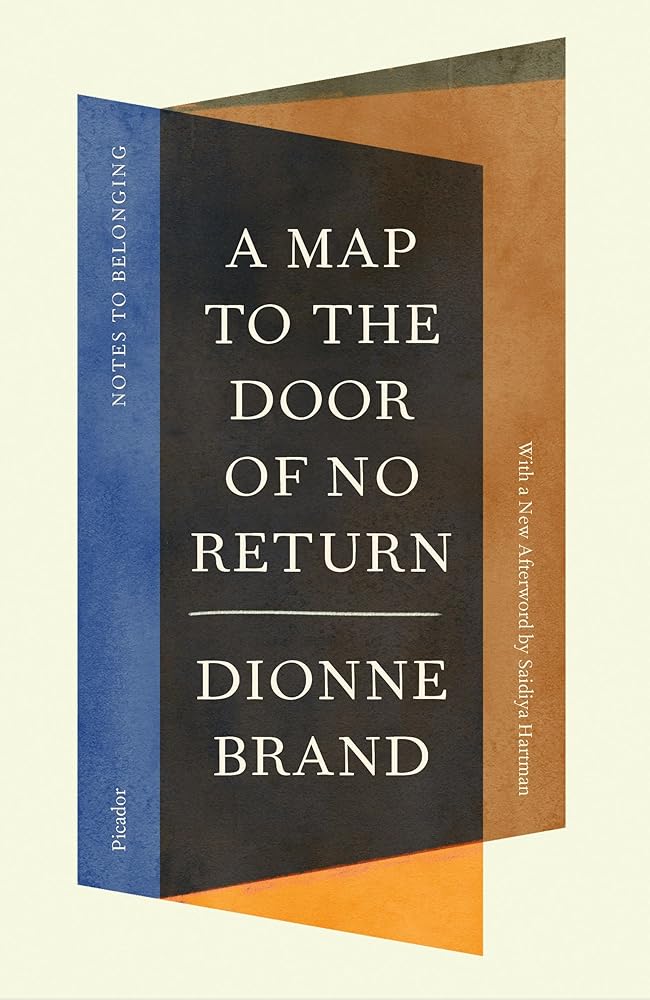
A Map to the Door of No Return: Notes to Belonging
$19.00Now in its first American edition, Dionne Brand's groundbreaking A Map to the Door of No Return has emerged as a modern classic, a highly influential exploration of "being" in the Black Diaspora.
Since its first publication in 2001, Dionne Brand's groundbreaking exploration of being in the Black Diaspora, A Map to the Door of No Return, has emerged as a modern classic. The door, in Brand's iconic schema, represents the point of rupture where the ancestors of the Black Diaspora departed one world for another: the place where all names were forgotten, and all beginnings recast. "This door," writes Brand, "is not mere physicality. It is a spiritual location . . . Since leaving was never voluntary, return was, and still may be, an intention, however deeply buried. There is as it says no way in; no return."
Through shards of history, memoir, lyrical investigation, and the unwritten experience of so many descendants of those who passed through the door, Brand constructs a map of this indelible region, culminating in an enduring expression, both definitive and seeking, of what it is to live, think, and create in the wake of colonization.
With a new preface by the author, and an afterword by Saidiya Hartman.
-
Ordinary Notes
![Ordinary Notes]()
Ordinary Notes
by Christina Sharpe
$23.00The critically acclaimed author of In the Wake, "Christina Sharpe is a brilliant thinker who attends unflinchingly to the brutality of our current arrangements . . . and yet always finds a way to beauty and possibility" (Saidiya Hartman).
A singular achievement, Ordinary Notes explores profound questions about loss and the shapes of Black life that emerge in the wake. In a series of 248 notes that gather meaning as we read them, Christina Sharpe skillfully weaves artifacts from the past—public ones alongside others that are poignantly personal—with present realities and possible futures, intricately constructing an immersive portrait of everyday Black existence. The themes and tones that echo through these pages, sometimes about language, beauty, memory; sometimes about history, art, photography, and literature—always attend, with exquisite care, to the ordinary-extraordinary dimensions of Black life.
At the heart of Ordinary Notes is the indelible presence of the author’s mother, Ida Wright Sharpe. “I learned to see in my mother’s house,” writes Sharpe. “I learned how not to see in my mother’s house . . . My mother gifted me a love of beauty, a love of words.” Using these gifts and other ways of seeing, Sharpe steadily summons a chorus of voices and experiences to the page. She practices an aesthetic of "beauty as a method,” collects entries from a community of thinkers toward a “Dictionary of Untranslatable Blackness,” and rigorously examines sites of memory and memorial. And in the process, she forges a brilliant new literary form, as multivalent as the ways of Black being it traces. -
Radical Poetics: Essays on Literature & Culture (Poets On Poetry)
![Radical Poetics: Essays on Literature & Culture (Poets On Poetry) cover image]()

Radical Poetics: Essays on Literature & Culture (Poets On Poetry)
$29.95Literature has the power to help build a shelter in language for a way of being that holds integrity and love as its root. In the tradition of Audre Lorde, Angela Davis, and many other Black writers and theorists, poet and professor Khadijah Queen observes questions of life and literature, human feeling and behavior, and explores language-based solutions to common cultural conflicts that are often rooted in harmful assumptions.
Instead of operating from a base of unquestioned thought and systemic tradition, Radical Poetics presents more inclusive and accurate ways of contemplating literary work. Building on ideas and theoretical practices from Édouard Glissant, Toni Morrison, bell hooks, Saidiya Hartman, and Kimberlé Crenshaw, Queen reads for where love is present as well as for where it is absent—tracing systems of thought and aesthetic choices to track how characters are portrayed in terms of race, gender, class, and disability. She analyzes short stories, novels, nonfiction narratives, poetry, and a play from authors such as Herman Melville, Kate Chopin, Dionne Brand, Frances Ellen Watkins Harper, Ma-ka-tai-me-she-kia-kiak, Sor Juana Inés de la Cruz, Natasha Trethewey, and Muriel Rukeyser. Queen’s essays offer shifts in thinking about language—beyond calling out the ways language punishes vulnerability, entrenches harm, and suppresses true intercultural communication. Her intuitive approach aims to correct inaccuracies that have served as a foundation for the discriminatory thinking that undergirds American institutions and culture, particularly the continued glorification of violence. Radical Poetics makes a case for the imperative and practical value of understanding poetics beyond artistic and academic spaces and into everyday life.
-
We Are Owed. by Ariana Brown
![We Are Owed. by Ariana Brown]()

We Are Owed. by Ariana Brown
$20.00We Are Owed. is the debut poetry collection of Ariana Brown, exploring Black relationality in Mexican and Mexican American spaces. Through poems about the author's childhood in Texas and a trip to Mexico as an adult, Brown interrogates the accepted origin stories of Mexican identity. We Are Owed asks the reader to develop a Black consciousness by rejecting U.S., Chicano, and Mexican nationalism and confronting anti-Black erasure and empire-building. As Brown searches for other Black kin in the same spaces through which she moves, her experiences of Blackness are placed in conversation with the histories of formerly enslaved Africans in Texas and Mexico. Esteban Dorantes, Gaspar Yanga, and the author's Black family members and friends populate the book as a protective and guiding force, building the "we" evoked in the title and linking Brown to all other African-descended peoples living in what Saidiya Hartman calls "the afterlife of slavery.
-
Arthur Jafa. Live Evil (English): LUMA
![Arthur Jafa. Live Evil (English): LUMA cover image]()

Arthur Jafa. Live Evil (English): LUMA
Flora Katz
$59.95Richly illustrated catalogue of the works of one of the most significant contemporary artists practicing today. In his both powerful and lyrical works, Jafa consistently reflects on the ontology of race and of blackness. Over several decades, Arthur Jafa has constructed a compelling body of work that defies categorization. Both powerful and lyrical, his practice combines a profoundly unsettling blend of images and histories. Bringing together affective memories that touch on the history of the United States of America, violence, repression, modalities of survival, and how these exist in the production and dissemination of images, music, sound, and time-based media, Jafa reflects on the ontology of race and of blackness. The catalogue explores the philosophical, historical, and artistic implications of Jafa’s work, featuring essays and a series of conversations between Jafa and key practitioners working in the fields of cinema, arts, and theory. Text: Norman Ajari, Tina M. Campt, Liam Gillick, Ernest Hardy, Saidiya Hartman, R.A. Judy, Nathaniel Mackey, Fred Moten, Julian Myers, Vassilis Oikonomopoulos, Peter Saville, James A. Snead, Greg Tate, and Peter Watts.
-
The Black Utopians: Searching for Paradise and the Promised Land in America
![Book cover image]()

The Black Utopians: Searching for Paradise and the Promised Land in America
by Aaron Robertson
from $20.00A lyrical meditation on how Black Americans have envisioned utopia―and sought to transform their lives.
How do the disillusioned, the forgotten, and the persecuted not merely hold on to life but expand its possibilities and preserve its beauty? What, in other words, does utopia look like in black?
These questions animate Aaron Robertson’s exploration of Black Americans' efforts to remake the conditions of their lives. Writing in the tradition of Saidiya Hartman and Ta-Nehisi Coates, Robertson makes his way from his ancestral hometown of Promise Land, Tennessee, to Detroit―the city where he was born, and where one of the country’s most remarkable Black utopian experiments got its start. Founded by the brilliant preacher Albert Cleage Jr., the Shrine of the Black Madonna combined Afrocentric Christian practice with radical social projects to transform the self-conception of its members. Central to this endeavor was the Shrine’s chancel mural of a Black Virgin and child, the icon of a nationwide liberation movement that would come to be known as Black Christian Nationalism. The Shrine’s members opened bookstores and co-ops, created a self-defense force, and raised their children communally, eventually working to establish the country’s largest Black-owned farm, where attempts to create an earthly paradise for Black people continues today.
Alongside the Shrine’s story, Robertson reflects on a diverse array of Black utopian visions, from the Reconstruction era through the countercultural fervor of the 1960s and 1970s and into the present day. By doing so, Robertson showcases the enduring quest of collectives and individuals for a world beyond the constraints of systemic racism.
The Black Utopians offers a nuanced portrait of the struggle for spaces―both ideological and physical―where Black dignity, protection, and nourishment are paramount. This book is the story of a movement and of a world still in the making―one that points the way toward radical alternatives for the future.
-
FEBRUARY 2026: NO NAME BOOK CLUB - FEBRUARY 22 @ 1 PM CST
![FEBRUARY 2026: NO NAME BOOK CLUB - FEBRUARY 22 @ 1 PM CST]()

FEBRUARY 2026: NO NAME BOOK CLUB - FEBRUARY 22 @ 1 PM CST
$0.00No Name is a Black-owned worker cooperative connecting community members both inside and outside carceral facilities with radical books. Each month, No Name uplifts two books written by Black, indigenous, and other people of color. No Name believes building community through political education is crucial for our liberation and should be accessible to everyone—which is why all programming is free.
MEETING DEETSWhen: Sunday, FEBRUARY 22 @ 1 PMWhere: Kindred Stories (2310 Elgin St, Houston, TX 77004)How: RSVP to let us know you're coming!
Now in its first American edition, Dionne Brand’s groundbreaking A Map to the Door of No Return has emerged as a modern classic, a highly influential exploration of “being” in the Black diaspora.Since its first publication in 2001, in Canada, Dionne Brand’s groundbreaking exploration of being in the Black diaspora, A Map to the Door of No Return, has emerged as a modern classic. The door, in Brand’s iconic schema, represents the point of rupture where the ancestors of the Black diaspora departed one world for another: the place where all names were forgotten, and all beginnings recast. “This door,” writes Brand, “is not mere physicality. It is a spiritual location . . . Since leaving was never voluntary, return was, and still may be, an intention, however deeply buried. There is as it says no way in; no return.”
Through shards of history, memoir, lyrical investigation, and the unwritten experience of so many descendants of those who passed through the door, Brand constructs a map of this indelible region, culminating in an enduring expression, both definitive and seeking, of what it is to live, think, and create in the wake of colonization.
With a new preface by the author, and an afterword by Saidiya Hartman. -
Scenes of Subjection: Terror, Slavery, and Self-Making in Nineteenth-Century America
![Scenes of Subjection: Terror, Slavery, and Self-Making in Nineteenth-Century America]()
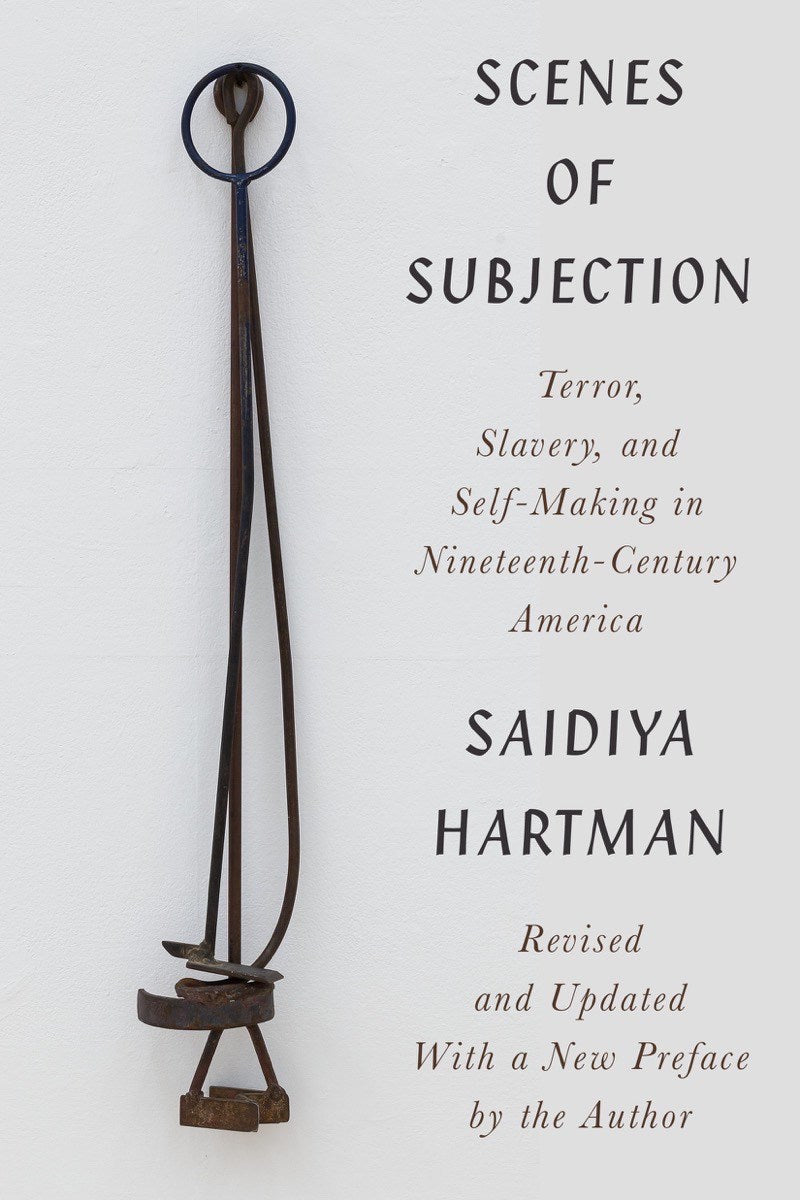
Scenes of Subjection: Terror, Slavery, and Self-Making in Nineteenth-Century America
by Saidiya Hartman
Sold out*ships in 7 - 10 business days*
The groundbreaking debut by the award-winning author of Wayward Lives, Beautiful Experiments, revised and updated.
Saidiya Hartman has been praised as “one of our most brilliant contemporary thinkers” (Claudia Rankine, New York Times Book Review) and “a lodestar for a generation of students and, increasingly, for politically engaged people outside the academy” (Alexis Okeowo, The New Yorker). In Scenes of Subjection—Hartman’s first book, now revised and expanded, with a new foreword, afterword, and illustrations—her singular talents and analytical framework are turned toward the “terrible spectacle” of slavery, illuminating the intertwining of violence, subjugation, and selfhood even in abolitionist depictions of enslavement. Through unmasking the hidden and overlooked at the margins of the historical archive, Hartman radically reshapes our understanding of history, in a work as resonant today as it was on first publication, now for a new generation of readers.
-
Otherworldly Mothering: The Maternal Grammar of Black Women’s Writing, 1970–1990
![Otherworldly Mothering: The Maternal Grammar of Black Women’s Writing, 1970–1990 cover image]()

Otherworldly Mothering: The Maternal Grammar of Black Women’s Writing, 1970–1990
Marika Ceschia
Sold outOtherworldly Mothering argues that literary works by Toni Morrison, Gloria Naylor, Paule Marshall, Audre Lorde, and Toni Cade Bambara reimagine subjectivity in processual and relational terms through a rewriting of maternal praxis, a technique that unveils the historical continuities between antebellum and neoliberal America. By refiguring materials drawn from the tradition of slave narratives, Black women’s literature of the 1970s and 1980s often conjures maternal otherworlds where it is possible to engage alternative modes of being.
In conversation with the work of Hortense Spillers, Sylvia Wynter, and Saidiya Hartman, Marika Ceschia analyzes how Black women writers find in the maternal a means of creatively reenvisioning the figure of the human. Morrison’s Song of Solomon, Naylor’s Linden Hills, Marshall’s Praisesong for the Widow, Lorde’s Zami, and Bambara’s The Salt Eaters each change the strictures that dictate how the human is performed. As these texts show, maternal praxis can have a transformative ontological effect: confronting the toll exerted by centuries of racial violence, these writers reclaim the maternal as a site of subject formation.
Otherworldly Mothering reassesses canonical works of twentieth-century Black women’s literature alongside theoretical debates around the ontology of the human, antiblackness, and Black motherhood. Ceschia proposes a reappraisal of maternal praxis that challenges neoliberal discourse and questions recent critical turns toward Afropessimism and posthumanism.


Stay Informed. We're building a community committed to celebrating Black authors + artisans. Subscribe to keep up with all things Kindred Stories.