
Search results: 214 results for “by Dr. Martin Luther King Jr.”
Not finding what you're looking for? Check out our shop on bookshop.org to order and still support us ♥
214 results
-
Black Studies on 135th Street: The Founding and Future of the Schomburg Collection
![Black Studies on 135th Street: The Founding and Future of the Schomburg Collection cover image]()

Black Studies on 135th Street: The Founding and Future of the Schomburg Collection
$38.00A centennial celebration of the Schomburg Center for Research in Black Culture and its vital role in the development of Black Studies
In 1926, the Afro-Puerto Rican bibliophile Arturo Schomburg's collection of four thousand books, pamphlets, papers, and prints arrived at the 135th Street branch of the New York Public Library. The collection contained works in many languages and formats, offering an unparalleled look into the richness and global reach of Black history. One hundred years later, Schomburg's collection remains a central feature of the Schomburg Center for Research in Black Culture, now the world's premier archive for study of the African diaspora, housing more than 11 million items, and a vibrant site of Black intellectual life.
This volume not only contextualizes the life and work of Schomburg and chronicles the history of the institution that bears his name but also includes a list of books and pamphlets in Schomburg's initial "seed collection," the fruit of a multiyear research effort to reconstruct this early Black Studies archive. Framing this list are essays and reflections written by an interdisciplinary group of scholars on the development of the Black intellectual tradition, both in Schomburg's time and today.
-
Revolutionaries to Race Leaders: Black Power and the Making of African American Politics
![Revolutionaries to Race Leaders: Black Power and the Making of African American Politics cover image]()

Revolutionaries to Race Leaders: Black Power and the Making of African American Politics
$23.00The Black Power movement represented a key turning point in American politics. Disenchanted by the hollow progress of federal desegregation during the 1960s, many black citizens and leaders across the United States demanded meaningful self-determination. The popular movement they created was marked by a vigorous artistic renaissance, militant political action, and fierce ideological debate.
Exploring the major political and intellectual currents from the Black Power era to the present, Cedric Johnson reveals how black political life gradually conformed to liberal democratic capitalism and how the movement’s most radical aims—the rejection of white aesthetic standards, redefinition of black identity, solidarity with the Third World, and anticapitalist revolution—were gradually eclipsed by more moderate aspirations. Although Black Power activists transformed the face of American government, Johnson contends that the evolution of the movement as a form of ethnic politics restricted the struggle for social justice to the world of formal politics.
Johnson offers a compelling and theoretically sophisticated critique of the rhetoric and strategies that emerged in this period. Drawing on extensive archival research, he reinterprets the place of key intellectual figures, such as Harold Cruse and Amiri Baraka, and influential organizations, including the African Liberation Support Committee, the National Black Political Assembly, and the National Black Independent Political Party in postsegregation black politics, while at the same time identifying the contradictions of Black Power radicalism itself.
Documenting the historical retreat from radical, democratic struggle, Revolutionaries to Race Leaders ultimately calls for the renewal of popular struggle and class-conscious politics.
Cedric Johnson is assistant professor of political science at Hobart and William Smith Colleges.
-
PRE-ORDER: I Will Take to the Water: An Anthology of African Americans and the Sea
![I Will Take to the Water: An Anthology of African Americans and the Sea cover image]()

PRE-ORDER: I Will Take to the Water: An Anthology of African Americans and the Sea
$27.50A landmark survey of African American literature about Black experiences of the maritime environment.
The ocean is foundational to the story of Africans in America, beginning with the searing Middle Passage. Initially evoking terror, pain, and death, the ocean also became associated with escape, empowerment, freedom, and home, as over time, African Americans in seaport towns found work, built communities, and gained knowledge from travelers. David R. Anderson shows in this groundbreaking collection of memoir, fiction, poetry, and more that African American maritime literature summons many of the traditional themes―survival in the face of overwhelming natural force, sublimity, demonstration of skill and merit, and self-discovery―but often with an eye on legacies of imperialism, slavery, discrimination, and cultural erasure.
Divided thematically across ten sections that address peril, labor, recreation, and more, the book gathers work by influential writers and intellectuals from the eighteenth century to the present, including: Lucille Clifton, Edwidge Danticat, Frederick Douglass, Alice Dunbar-Nelson, W. E. B. DuBois, Camille T. Dungy, Marcus Garvey, Robert Hayden, Zora Neale Hurston, Major Jackson, Harriet Jacobs, John S. Jacobs, Nella Larsen, Claude McKay, Toni Morrison, Walter Mosley, Natasha Trethewey, Phillis Wheatley, Colson Whitehead, and Kevin Young.
-
No More Police: A Case for Abolition
![No More Police: A Case for Abolition]()

No More Police: A Case for Abolition
by Mariame Kaba & Andrea Ritchie
$18.99A persuasive primer on police abolition from two veteran organizers
“One of the world’s most prominent advocates, organizers and political educators of the [abolitionist] framework.” —NBCNews.com on Mariame Kaba
In this powerful call to action, New York Times bestselling author Mariame Kaba and attorney and organizer Andrea J. Ritchie detail why policing doesn’t stop violence, instead perpetuating widespread harm; outline the many failures of contemporary police reforms; and explore demands to defund police, divest from policing, and invest in community resources to create greater safety through a Black feminist lens.
Centering survivors of state, interpersonal, and community-based violence, and highlighting uprisings, campaigns, and community-based projects, No More Police makes a compelling case for a world where the tools required to prevent, interrupt, and transform violence in all its forms are abundant. Part handbook, part road map, No More Police calls on us to turn away from systems that perpetrate violence in the name of ending it toward a world where violence is the exception, and safe, well-resourced and thriving communities are the rule.
-
Killing the Black Body: Race, Reproduction, and the Meaning of Liberty
![Killing the Black Body: Race, Reproduction, and the Meaning of Liberty]()
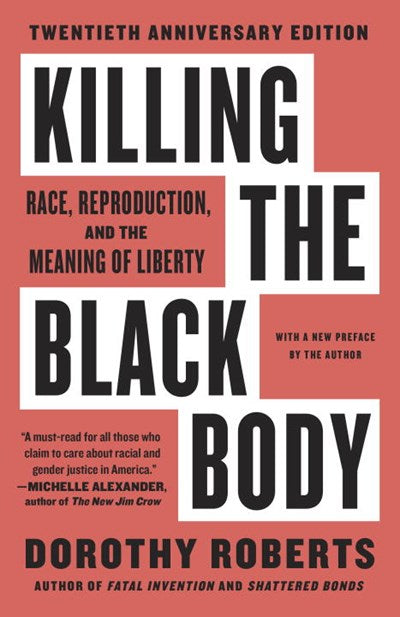
Killing the Black Body: Race, Reproduction, and the Meaning of Liberty
by Dorothy Roberts
$18.00*ships in 7-10 business days*
In 1997, the image of the “Welfare Queen” dominated white America’s perceptions of Black women. Legislation was being proposed to deny benefits to children born to welfare mothers and to require insertion of birth-control implants as a condition of receiving aid. Meanwhile, a booming fertility industry was catering primarily to infertile white couples.
Dorothy Roberts’s landmark book, Killing the Black Body, made a powerful entrance into the national conversation of the era, exposing America’s systemic abuse of Black women’s bodies, from slave masters’ economic stake in bonded women’s fertility to government programs that coerced thousands of poor Black women into being sterilized as late as the 1970s. These abuses point not only to the degradation of Black motherhood, but to the exclusion of Black women’s reproductive needs from the feminist agenda. Killing the Black Body turns twenty next year and is as relevant today as it was upon publication. In our current moment of Black Lives Matter, Between the World and Me, and authors like Chimamanda Ngozi Adichie and Roxane Gay speaking out about feminism and race, Killing the Black Body offers a vision of reproductive freedom that respects each and every American. -
Imagine Freedom: Transforming Pain into Political and Spiritual Power
![Imagine Freedom: Transforming Pain into Political and Spiritual Power cover image]()

Imagine Freedom: Transforming Pain into Political and Spiritual Power
$19.99A social activist, journalist, public theologian, and international speaker who has become a powerful and brilliant voice of her generation offers a bold path to liberation and healing for people of African descent struggling in the shadows of the American Dream.
The United States is at a critical juncture in its history. Not since the 1960s has the nation been so racially divided. White supremacy remains America’s Achilles’ heel—a moral failure that haunts us and holds us back from being the great nation we profess. For centuries, people of African descent have endured unimaginable hatred and discrimination which has manifested in pain and trauma passed from generation to generation. To break free from this historical cycle of suffering and be truly free at last, Black and brown people must reimagine ourselves, our communities, this country, and our relationship to Africa.
Weaving storytelling, socioeconomic analysis, and cultural criticism with the spiritual and political threads of liberation theology and Pan Africanism, Imagine Freedom empowers us to begin the difficult but necessary work of decolonizing our minds and overcoming the lies we have been told about ourselves for centuries. Sobering and inspiring, filled with despair and hope, Rahiel Tesfamariam dares us to see the world through a larger historical and global lens— to understand how our quests for freedom and healing are intrinsically connected to our past, present, and future. By widening our vision, we discover new ways of imagining self, community, nation, and world, and most importantly, a new way to achieve the freedom that has been too long denied.
-
March: Book Two
![March: Book Two]()

March: Book Two
by John Lewis
$19.95*ships in 7 - 10 days*
Ages 13-16
Congressman John Lewis, an American icon and one of the key figures of the civil rights movement, continues his award-winning graphic novel trilogy with co-writer Andrew Aydin and artist Nate Powell, inspired by a 1950s comic book that helped prepare his own generation to join the struggle. Now, March brings the lessons of history to vivid life for a new generation, urgently relevant for today’s world. After the success of the Nashville sit-in campaign, John Lewis is more committed than ever to changing the world through nonviolence - but as he and his fellow Freedom Riders board a bus into the vicious heart of the deep south, they will be tested like never before. Faced with beatings, police brutality, imprisonment, arson, and even murder, the movement’s young activists place their lives on the line while internal conflicts threaten to tear them apart.
But their courage will attract the notice of powerful allies, from Martin Luther King, Jr. to Attorney General Robert F. Kennedy…and once Lewis is elected chairman of the Student Nonviolent Coordinating Committee, this 23-year-old will be thrust into the national spotlight, becoming one of the “Big Six” leaders of the civil rights movement and a central figure in the landmark 1963 March on Washington for Jobs and Freedom. -
AUTHOR TALK: Expecting Inequity with Khiara M. Bridges- October 29 @ 7 PM
![AUTHOR TALK: Expecting Inequity with Khiara M. Bridges- October 29 @ 7 PM]()

AUTHOR TALK: Expecting Inequity with Khiara M. Bridges- October 29 @ 7 PM
from $5.00Celebrate the release of Expecting Inequity with Khiara M. Bridges! The event will feature a moderated conversation, audience Q&A, and book signing, followed by a community art activation led by The Call Me Mother Experience.
EVENT DEETS
When: Thursday, October 29 @ 7PM CST
Where: Kindred Stories (2310 Elgin St, HTX 77004)
How:
- RSVP ONLY to reserve your seat.
- RSVP WITH BOOK to reserve your seat and purchase a copy Expecting Inequity, supporting both the author and our store programming. The book will be available for pickup at the event.
Please Note: Books purchased from other retailers are not permitted in the bookstore and are not eligible for the signing or photo line. To participate in the signing and photo opportunity, you must purchase a copy from Kindred Stories. If you already purchased your book from Kindred Stories, you may select the RSVP Only ticket option and bring your Kindred Stories copy to the event.
If you purchase a ticket and are unable to attend the event, your ticket is non-refundable. If your ticket includes a book, an email will be sent to all attendees before and after the event with instructions on how to receive your book. Books must be claimed within 14 days following the event. If your book is not retrieved it will be returned to the publisher and will not be available for pick up in the future.
ABOUT THE BOOK
An unsettling exploration of the persistence of racism in reproductive healthcare in the US—and why even affluent Black women are imperiled by substandard care.
From a leading expert on race, class, maternal health, and reproductive rights.
Racism in maternal healthcare is not reserved for the poor. An unsparing picture of inequities in prenatal care and childbirth in the United States, Expecting Inequity reveals that not only are black people three to four times more likely to die from a pregnancy-related cause, but racial disparities in maternal mortality persist across income levels. That is, wealthier black people are much more likely to die during pregnancy, childbirth, or the postpartum period than their white counterparts. Focusing on a San Francisco obstetrics clinic that caters to the affluent, Khiara Bridges looks at the choices around prenatal care and childbirth that class-privileged, pregnant black people are making in order to survive what has been called the “black maternal health crisis.”
Bridges, whose previous work exposed how race and racism are embedded in maternal healthcare for the poor, draws on two years of participant-observation to show how wealthier black people try to leverage their class privilege to avoid some of the negative effects of their blackness—only to discover that in a country that has never reckoned with its horrific racial past, there is no escaping racism’s reach. Throughout the book, engaging, heartbreaking, infuriating stories of women’s experiences with pregnancy and prenatal care illustrate how race and racism matter regardless of wealth or status.ABOUT THE AUTHOR
Khiara M. Bridges is the Earl Warren Professor of Public Law at UC Berkeley School of Law.
She is a nationally-recognized expert on the intersection of race, class, and reproductive rights. Her scholarship has appeared in the most influential law reviews in the country, including the flagship law journals at Harvard, Yale, Stanford, and UC Berkeley, among many others. She is also the author of three books: Reproducing Race: An Ethnography of Pregnancy as a Site of Racialization (2011), The Poverty of Privacy Rights (2017), and Critical Race Theory: A Primer (2019, 2026). Her fourth book, Expecting Inequity: How the Maternal Health Crisis Affects Even the Wealthiest Black Americans, was released in March 2026.
Bridges graduated as valedictorian from Spelman College, receiving her degree in three years. She received her J.D. from Columbia Law School and her Ph.D., with distinction, from Columbia University’s Department of Anthropology. She speaks fluent Spanish and basic Arabic, and she is a classically-trained ballet dancer who danced professionally in New York City for twenty years before moving to the Bay Area.
ABOUT THE CONVERSATION PARTNER
Deborah D.E.E.P Mouton is a multi-modal storyteller whose work documents, examines, and celebrates the complexities of Black American life. She has authored Newsworthy (Bloomsday Literary, 2019), Black Chameleon (Henry Holt & Co., 2023), which won the Carr P. Collins award for Best Nonfiction through the Texas Institute of Letters, and Hush Hush Hurricane (Kokila Books, 2027). This three-time TEDx speaker has contributed to Glamour, Texas Monthly, and ESPN's Andscape and written theatrical works that have premiered at Chicago Opera Theater, the Kennedy Center, and National Sawdust. Her upcoming immersive art installation, The Call Me Mother Experience, amplifies the Black Maternal Health crisis.
-
A Little Devil in America : Notes in Praise of Black Performance
![A Little Devil in America : Notes in Praise of Black Performance]()

A Little Devil in America : Notes in Praise of Black Performance
by Hanif Abdurraqib
$27.00Ships in 7-10 business days.
At the March On Washington in 1963, Josephine Baker was 57 years old, well beyond her most prolific days. But in her speech at the march, she was in a mood to consider her life, her legacy, her departure from the country she was now triumphantly returning to. “I was a devil in other countries, and I was a little devil in America, too,” she told the crowd. From those few words, Hanif Abdurraqib has written a profound and lasting reflection on how black performance is inextricably woven into the fabric of American culture. Each moment in every performance he examines—whether it’s the 27 seconds in “Gimme Shelter” where Merry Clayton wails the words “rape, murder,” a schoolyard fistfight, a dance marathon, or the instant in a game of spades right after the cards are dealt—has layers of resonance in black and white culture, the politics of American empire, and Abdurraqib’s own personal history of love, grief, and performance.
-
White Rage: The Unspoken Truth of Our Racial Divide by Carol Anderson
![White Rage: The Unspoken Truth of Our Racial Divide by Carol Anderson]()

White Rage: The Unspoken Truth of Our Racial Divide by Carol Anderson
$17.00*Ships/ready for pick up in 5-8 business days*
From the Civil War to our combustible present, an acclaimed historian reframes our continuing conversation about race, chronicling the powerful forces opposed to black progress in America.
As Ferguson, Missouri, erupted in August 2014, and media commentators across the ideological spectrum referred to the angry response of African Americans as “black rage,” historian Carol Anderson wrote a remarkable op-ed in the Washington Post showing that this was, instead, “white rage at work. With so much attention on the flames,” she writes, “everyone had ignored the kindling.”
Since 1865 and the passage of the Thirteenth Amendment, every time African Americans have made advances towards full participation in our democracy, white reaction has fueled a deliberate rollback of their gains. The end of the Civil War and Reconstruction was greeted with the Black Codes and Jim Crow; the Supreme Court’s landmark 1954 Brown v. Board of Education decision was met with the shutting down of public schools throughout the South while taxpayer dollars financed segregated white private schools.
Carefully linking these and other historical flashpoints when social progress for African Americans was countered by deliberate and cleverly crafted opposition, Anderson pulls back the veil that has long covered actions made in the name of protecting democracy, fiscal responsibility, or protection against fraud, rendering visible the long lineage of white rage. Compelling and dramatic in the unimpeachable history it relates, White Rage will add an important new dimension to the national conversation about race in America.
-
African American Environmental Thought: Foundations (American Political Thought)
![African American Environmental Thought: Foundations (American Political Thought) cover image]()

African American Environmental Thought: Foundations (American Political Thought)
$29.99Choice Outstanding Book
African American intellectual thought has long provided a touchstone for national politics and civil rights, but, as Kimberly Smith reveals, it also has much to say about our relationship to nature. In this first singleauthored book to link African American and environmental studies, Smith uncovers a rich tradition stretching from the abolition movement through the Harlem Renaissance, demonstrating that black Americans have been far from indifferent to environmental concerns.
Beginning with environmental critiques of slave agriculture in the early nineteenth century and evolving through critical engagements with scientific racism, artistic primitivism, pragmatism, and twentiethcentury urban reform, Smith highlights the continuity of twentiethcentury black politics with earlier efforts by slaves and freedmen to possess the land. She examines the works of such canonical figures as Frederick Douglass, Booker T. Washington, W. E. B. Du Bois, and Alain Locke, all of whom wrote forcefully about how slavery and racial oppression affected black Americans' relationship to the environment
Smith's analysis focuses on the importance of freedom in humans' relationship with nature. According to black theorists, the denial of freedom can distort one's relationship to the natural world, impairing stewardship and alienating one from the land. Her pathbreaking study offers the first linkage of the early conservation movement to black history, the first detailed description of black agrarianism, and the first analysis of scientific racism as an environmental theory. It also offers a new way to conceptualize black politics by bringing into view its environmental dimension, as well as a normative environmental theory grounded in pragmatism and aimed at identifying the social conditions for environmental virtue.
Smith's work offers a new approach to established writers and thinkers and shows that they justly deserve a place in the canon of American environmental thought. African American Environmental Thought enriches our understanding of black politics and environmental history, and of environmental theory in general. Because slavery and racism have shaped the meaning of the American landscape, this body of thought offers us fresh conceptual resources by which we can make better sense of our world.
-
Black Capitalists: A Blueprint for What Is Possible
![Black Capitalists: A Blueprint for What Is Possible cover image]()

Black Capitalists: A Blueprint for What Is Possible
Rachel Laryea PhD
$30.00A groundbreaking look at how Black visionaries—from Wall Street to Lagos and beyond—are reimagining capitalism to benefit the needs of Black people and, ultimately, everyone.
“Black Capitalists is a dive into the history of how money is made and our attitudes about wealth. A must read.”—Vanessa Williams, singer, actress, author, producer, and former Miss America
To many, the term “Black Capitalists” is oxymoronic. Black people were the labor force that built the infrastructure of American capitalism through the violent enforcement of legalized slavery, so they cannot, and should not, aspire to be the beneficiaries of it. But Wall Street professional and Yale-educated anthropologist Dr. Rachel Laryea poses a provocative question: What if there was a way to thrive within capitalism without diminishing someone else’s life chances through exploitative practices? There is—and Black Capitalists are showing us how.
Told through Dr. Laryea's own compelling narrative—growing up the child of a single mother who immigrated to the United States from Ghana and rose to the Ivy League and on Wall Street—with original on-the-ground reporting and rigorous historical analysis, Black Capitalists challenges readers to reconsider who gets to be the beneficiary of capitalism and reckons with the responsibility that comes with using the tools of our imperfect economic system to advance social good.
Dr. Laryea reveals in detail how race profoundly shapes the way we participate in capitalism—and how understanding these differences can guide us toward a more inclusive and equitable future. From newly minted undergraduates who find themselves working twenty-hour days to prove their worth on Wall Street to Nigerian startup founders working to build global credit scores, spanning the streets of Accra to the boardrooms of Goldman Sachs, Black Capitalists’ stories and analysis of innovators who are as ambitious as they are altruistic demonstrate the resilience, creativity, and ingenuity of Black people who have long been excluded from the full benefits of the American economic system. At its core, Black Capitalists shows a more productive, and more inclusive, way forward.


Stay Informed. We're building a community committed to celebrating Black authors + artisans. Subscribe to keep up with all things Kindred Stories.