
Search results: 87 results for “Robert”
Not finding what you're looking for? Check out our shop on bookshop.org to order and still support us ♥
87 results
-
The New York Times Cooking Cocktail Deck: 50 Cards for Classic and Creative Drinks
![The New York Times Cooking Cocktail Deck: 50 Cards for Classic and Creative Drinks cover image]()

The New York Times Cooking Cocktail Deck: 50 Cards for Classic and Creative Drinks
$24.99Mix great drinks with this mini bar in a box that gives you fifty recipe cards for boozy cocktails, refreshing aperitifs, and delicious mocktails, curated by the cocktail experts at New York Times Cooking.
Whether you're a seasoned bartender or a casual sipper, the New York Times Cooking Cocktail Deck offers 50 new and quintessential recipes. Pop a few cards in your bag, use them as a shopping list, and then set them on the bar top or counter while you stir or shake.
Unwind at home with Robert Simonson's ultimate Martini or Old-Fashioned. Mix things up with Ali Slagle's Negroni Sbagliato or her spritzy Root Beer Rickey. And welcome guests with Rebekah Peppler's easy-drinking Bicicletta or one of several low-alcohol and nonalcoholic options, like Naz Deravian's Agua Fresca.
Each laminated card features a stunning photograph on the front with recipe instructions on the back. With an essential guide to the necessary glasses, garnishes, tools, and techniques, this recipe deck elevates any at-home bar and is sure to be the star of your next gathering.
-
Black Studies in the University: A Symposium
![Black Studies in the University: A Symposium cover image]()

Black Studies in the University: A Symposium
$22.00A founding document of African American Studies, reissued for today’s students and scholars
In a landmark 1968 conference at Yale University, students, faculty, and community activists helped establish “Afro‑American Studies” as a major, and then a thriving department, at Yale. In these conference proceedings, participants argue for the necessity of Black Studies as a field, start to delineate its central debates, discuss its relationship to the broader community, and plot a course of study. Bristling with implied action and the power of an idea whose time has come, this classic reissue will serve as a resource for new generations of scholars and activists.
Contributors to the proceedings include McGeorge Bundy, Lawrence W. Chisolm, Harold Cruse, David Brion Davis, Nathan Hare, Maulana Ron Karenga, Martin Kilson, Jr., Gerald A. McWorter, Sidney W. Mintz, Boniface Obichere, Alvin Poussaint, Edwin S. Redkey, Charles H. Taylor, Jr., and Robert Farris Thompson.
In a new introduction, Farah Jasmine Griffin reflects on the legacy of this book and the trajectory of the field over the decades; forewords by Ralph C. Dawson and Henry Louis Gates, Jr., recall the pioneering moment at Yale and all that it made possible. -
Collecting Black Studies: The Art of Material Culture at the University of Texas at Austin
![Collecting Black Studies: The Art of Material Culture at the University of Texas at Austin cover image]()

Collecting Black Studies: The Art of Material Culture at the University of Texas at Austin
Lise Ragbir
$50.00What began as an effort to prevent the neglect and potential loss of hundreds of African objects at the University of Texas at Austin has evolved into one of the most significant collections on campus. The art collections at Black Studies were born from the John L. Warfield Center for African and African American Studies’ Art and Archive Initiative, under the leadership of Cherise Smith, Omi L. Jones, and Edmund T. Gordon.
Today Black Studies at the University of Texas boasts approximately 900 objects from sub-Saharan Africa, over 200 contemporary works from African American and Afro-Caribbean artists, and more than 100 pieces jointly held with other collecting entities on campus, adding a diverse richness to the overall collections. Collecting Black Studies gathers and presents these holdings—including costumes, jewelry, paintings, sculptures, works on paper, and photography—and prominently features five Black artists whose work is particularly significant. Scholars and curators examine how John Biggers, Michael Ray Charles, Christina Coleman, Angelbert Metoyer, and Deborah Roberts—artists with deep relationships to Texas—contributed to the Black Studies collections, to art history, and to the culture of our state and beyond.
-
When Black Girls Dream Big
![Book cover image]()

When Black Girls Dream Big
by Tanisia Moore, illustrated by Robert Paul
$19.99You have within you infinite promise. How big will YOU dream? This striking companion to I Am My Ancestors' Wildest Dreams celebrates Black female achievement and is perfect for fans of I Am Enough, Little Leaders, and She Persisted.
"Magnificently compelling....Lets Black girls know each time they turn the page that all of their dreams are possible." ―Angela Bassett, Award-winning Actress and Producer
I AM dope!
My crown shines bright
in all its glory.
When I dream big,
I can do anything!
In this inspiring tribute to Black girl pride and excellence, a young child discovers her place in a radiant heritage. As she meets twelve extraordinary Black women―historic and contemporary heroines who have blazed a trail for her own future success―she internalizes their strength and sets out to change the world in her own way.
Just like them, she can reach her dreams. And readers will discover that they can reach theirs too.
-
Mo' Meta Blues
![Mo' Meta Blues]()
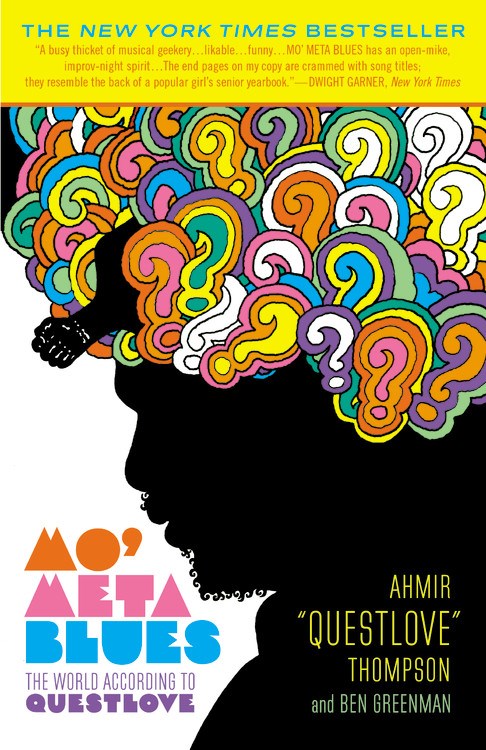
Mo' Meta Blues
by Ahmir "Questlove"Thompson
$17.99"You have to bear in mind that [Questlove] is one of the smartest motherf*****s on the planet. His musical knowledge, for all practical purposes, is limitless." --Robert Christgau
A punch-drunk memoir in which Everyone's Favorite Questlove tells his own story while tackling some of the lates, the greats, the fakes, the philosophers, the heavyweights, and the true originals of the music world. He digs deep into the album cuts of his life and unearths some pivotal moments in black art, hip hop, and pop culture.
Ahmir "Questlove" Thompson is many things: virtuoso drummer, producer, arranger, Late Night with Jimmy Fallon bandleader, DJ, composer, and tireless Tweeter. He is one of our most ubiquitous cultural tastemakers, and in this, his first book, he reveals his own formative experiences--from growing up in 1970s West Philly as the son of a 1950s doo-wop singer, to finding his own way through the music world and ultimately co-founding and rising up with the Roots, a.k.a., the last hip hop band on Earth. Mo' Meta Blues also has some (many) random (or not) musings about the state of hip hop, the state of music criticism, the state of statements, as well as a plethora of run-ins with celebrities, idols, and fellow artists, from Stevie Wonder to KISS to D'Angelo to Jay-Z to Dave Chappelle to...you ever seen Prince roller-skate?!?
But Mo' Meta Blues isn't just a memoir. It's a dialogue about the nature of memory and the idea of a post-modern black man saddled with some post-modern blues. It's a book that questions what a book like Mo' Meta Bluesreally is. It's the side wind of a one-of-a-kind mind.
It's a rare gift that gives as well as takes.
It's a record that keeps going around and around. -
PRE-ORDER: The Northbound Train: A Story of the Great Migration (A Picture Book)
![The Northbound Train: A Story of the Great Migration (A Picture Book) cover image]()

PRE-ORDER: The Northbound Train: A Story of the Great Migration (A Picture Book)
$19.99A unique perspective on the Great Migration, when more than six million Black American families left the South to escape Jim Crow laws and racial violence
Clickety-clack! Don’t look back!
Jane and her parents sit in the segregated train car, traveling from Birmingham, Alabama, to Chicago, Illinois, where her father has found a new job. At the start of the journey, they are forced to sit at the back while white passengers ride at the front.
But when the train crosses the Mason-Dixon line, the conductor announces that passengers may change seats―and for the first time, Jane sees Black and white families sitting side by side.
Based on the author’s family history, The Northbound Train offers a powerful child’s-eye view of the Great Migration and captures what it means to leave home behind in search of something better. Includes recommendations for additional reading and an author’s note about this pivotal moment in American history.
-
Within the Circle: An Anthology of African American Literary Criticism from the Harlem Renaissance to the Present
![Within the Circle: An Anthology of African American Literary Criticism from the Harlem Renaissance to the Present cover image]()

Within the Circle: An Anthology of African American Literary Criticism from the Harlem Renaissance to the Present
Angelyn Mitchell
$39.95Within the Circle is the first anthology to present the entire spectrum of twentieth-century African American literary and cultural criticism. It begins with the Harlem Renaissance, continues through civil rights, the Black Arts Movement, and on into contemporary debates of poststructuralist and black feminist theory. Drawing on a quote from Frederick Douglass for the title of this book, Angelyn Mitchell explains in her introduction the importance for those "within the circle" of African American literature to examine their own works and to engage this critical canon.
The essays in this collection—many of which are not widely available today—either initiated or gave critical definition to specific periods or movements of African American literature. They address issues such as integration, separatism, political action, black nationalism, Afrocentricity, black feminism, as well as the role of art, the artist, the critic, and the audience. With selections from Langston Hughes, Sterling Brown, W. E. B. DuBois, Zora Neale Hurston, Richard Wright, James Baldwin, Toni Morrison, Barbara Smith, Alice Walker, Henry Louis Gates, Jr., and many others, this definitive collection provides a dynamic model of the cultural, ideological, historical, and aesthetic considerations in African American literature and literary criticism.
A major contribution to the study of African American literature, this volume will serve as a foundation for future work by students and scholars. Its importance will be recognized by all those interested in modern literary theory as well as general readers concerned with the African American experience.Selections by (partial list): Houston A. Baker, Jr., James Baldwin, Sterling Brown, Barbara Christian, W. E. B. DuBois, Ralph Ellison, LeRoi Jones, Sarah Webster Fabio, Henry Louis Gates, Jr., W. Lawrence Hogue, Langston Hughes, Zora Neale Hurston, Alain Locke, Deborah E. McDowell, Toni Morrison, J. Saunders Redding, George Schuyler, Barbara Smith, Valerie Smith, Hortense J. Spillers, Robert B. Stepto, Alice Walker, Margaret Walker, Mary Helen Washington, Richard Wright
-
PRE-ORDER: The Jungles: Thelonious Monk and the Lost Cradle of Modern Jazz
![The Jungles: Thelonious Monk and the Lost Cradle of Modern Jazz cover image]()

PRE-ORDER: The Jungles: Thelonious Monk and the Lost Cradle of Modern Jazz
$31.99A hidden history of twentieth-century American modernity that re-examines a mere twelve-block area on Manhattan’s Upper West Side with Thelonious Monk as its guiding star.
The Jungles reclaims the largely forgotten world of San Juan Hill, a predominantly Black neighborhood on Manhattan’s West Side, was one of the most fertile centers of American cultural life in the twentieth century.
At once a biography, an urban history, and a cultural reckoning, Howard W. French’s The Jungles reveals how the neighborhood that would encompass Lincoln Center, previously known as the Jungles, fostered numerous pathbreaking Black artists, among them a young Thelonious Sphere Monk (1917–1982).
The story opens in Cuba in 1898, where we watch as Teddy Roosevelt’s forces triumph on San Juan Hill, with close to one-fifth of the overall invading force consisting of Black soldiers whose valor went largely unrecognized. After returning to the US, these veterans joined a broader wave of Black migrants moving northward, eventually settling in a Manhattan -neighborhood that would take the battle’s name. San Juan Hill became a lively, artistic Black community that preceded the Harlem Renaissance and inspired some of the highest twentieth- century creative triumphs―giving rise to the stride piano style and nurturing the genius of Monk, whose mold-breaking artistry struggled to gain traction in an industry then dominated by white producers.
As Robert Moses began tearing down the neighborhood under the guise of “urban renewal,” Monk became its most famous holdout, staying put in his cramped apartment in the Phipps Houses at 243 West 63rd Street, his upright piano protruding from his bedroom into the kitchen as he continued to make his iconic music.
By the late 1950s, Monk’s genius had finally been recognized, but the erasure already felt irreversible, extending even to the musical West Side Story, which reimagined the neighborhood’s streets as Latino gang territory, whitewashing the predominantly Black and Caribbean community that had actually lived there.
A compelling history from one of our finest American historians, The Jungles ultimately emerges as a new way of telling the history of music, of New York, and of America. The cradle of jazz was not only in New Orleans but also in San Juan Hill, and French’s magnificent recreation of that vanished world, and of the miraculous life of Thelonious Monk, restores to American cultural memory what erasure nearly stole for good.
12 illustrations
-
The Hidden Roots of White Supremacy: and the Path to a Shared American Future
![The Hidden Roots of White Supremacy: and the Path to a Shared American Future]()

The Hidden Roots of White Supremacy: and the Path to a Shared American Future
by Robert P. Jones
$29.99
Taking the story of white supremacy in America back to 1493, and examining contemporary communities in Mississippi, Minnesota, and Oklahoma for models of racial repair, The Hidden Roots of White Supremacy helps chart a new course toward a genuinely pluralistic democracy.
Beginning with contemporary efforts to reckon with the legacy of white supremacy in America, Jones returns to the fateful year when a little-known church doctrine emerged that shaped the way five centuries of European Christians would understand the “discovered” world and the people who populated it. Along the way, he shows us the connections between Emmett Till and the Spanish conquistador Hernando De Soto in the Mississippi Delta, between the lynching of three Black circus workers in Duluth and the mass execution of thirty-eight Dakota men in Mankato, and between the murder of 300 African Americans during the burning of Black Wall Street in Tulsa and the Trail of Tears.
From this vantage point, Jones shows how the enslavement of Africans was not America’s original sin but, rather, the continuation of acts of genocide and dispossession flowing from the first European contact with Native Americans. These deeds were justified by people who embraced the 15th century Doctrine of Discovery: the belief that God had designated all territory not inhabited or controlled by Christians as their new promised land.
This reframing of American origins explains how the founders of the United States could build the philosophical framework for a democratic society on a foundation of mass racial violence—and why this paradox survives today in the form of white Christian nationalism. Through stories of people navigating these contradictions in three communities, Jones illuminates the possibility of a new American future in which we finally fulfill the promise of a pluralistic democracy. -
The Culture: Hip Hop & Contemporary Art in the 21st Century
![The Culture: Hip Hop & Contemporary Art in the 21st Century]()

The Culture: Hip Hop & Contemporary Art in the 21st Century
by Asma Naeem
$55.00A sweeping survey of hip hop’s resounding impact on contemporary art and culture across the past 20-plus years
Accompanying a groundbreaking exhibition originating at the Baltimore Museum of Art, this book captures the extraordinary influence of hip hop, which has driven innovations in music, visual and performing arts, fashion, and technology and grown into a global phenomenon since its emergence in the 1970s. It features approximately 70 objects by both established and emerging artists, design houses, streetwear icons and musicians working in a wide range of mediums to demonstrate hip hop’s proliferation from the street to the runway, the studio to the museum gallery, and countless sites in between. The exhibition also explores how hip hop has and continues to challenge structures of power, dominant cultural narratives, and political and social systems of oppression.
This fully illustrated monograph documents the exhibition and contains texts and interviews from more than 30 artists and scholars
Artists include: Nina Chanel Abney, Dionne Alexander, Maxwell Alexandre, Devin Allen, Alvaro Barrington, Jean-Michel Basquiat, Grace Wales Bonner, Mark Bradford, Jordan Casteel, Willy Chavarria, Caitlin Cherry, Troy Chew II, William Cordova, Carl Jones, Stan Douglas, John Edmonds, Gajin Fujita, Monica Ikegwu, Shabez Jamal, Kahlil Joseph, Nia June, LA II, Deana Lawson, Eric N. Mack, Emmanuel Massillon, Julie Mehretu, Murjoni Merriweather, Jayson Musson, Rashaad Newsome, Yvonne Osei, Zéh Palito, Gordon Parks, Adam Pendleton, Robert Pruitt, Rammellzee, Sheila Rashid, Rozeal, Joyce J. Scott, Tschabalala Self, Tariku Shiferaw, Devan Shimoyama, Hank Willis Thomas, Carrie Mae Weems, Vivienne Westwood and Malcolm McLaren, Abbey Williams, Pharrell Williams and Wilmer Wilson IV.
Authors include: Ebony Haynes, Todd Boyd, Lester Spence, Jordana Moore Saggese, Greg Tate, Misa Hylton, Elena Romero, Ekow Eshun, Devin Allen, Michael Holman, Simone White, Salome Asega, Alphonse Pierre, David A.M. Goldberg and Tahir Hemphill, Jacolby Satterwhite, Wendel Patrick, Simon Reynolds, Seph Rodney, Jesse McCarthy, Danez Smith, Noriko Manabe, Lindsay Knight and Charity Marsh, Shaheem Sanchez, Jeffrey Q. McCune, Jr., Sekou Cooke, Jessica N. Pabón-Colón, Martha Cooper, Skeme, Alex de Mora and Lawrence Burney. -
The Mixed Marriage Project: A Memoir of Love, Race, and Family
![The Mixed Marriage Project: A Memoir of Love, Race, and Family cover image]()

The Mixed Marriage Project: A Memoir of Love, Race, and Family
Sold outFrom Dorothy Roberts, author of Killing the Black Body and a writer who “has brilliantly illuminated the Black experience in America for decades” (Bryan Stevenson), comes a spirited and riveting memoir of growing up in an interracial family in 1960s Chicago and a daughter’s journey to understand her parents’ marriage—and her own identity.
Dorothy Roberts grew up in a deeply segregated Chicago of the 1960s where relationships barely crossed the “colorline.” Yet inside her own home, where her father was white and her mother a Black Jamaican immigrant, interracial marriage wasn’t just a part of her upbringing, it was a shared mission. Her father, an anthropologist, spent her entire childhood working on a book about Black-white marriages—a project he never finished but shaped every aspect of their family life.
As a 21-year-old graduate student, Dorothy’s father dedicated himself to the study of interracial marriage and her mother soon became his full-time partner in that work. Together over the years they interviewed over 500 couples and assembled stunning stories about interracial marriages that took place as early as the 1880s—studying, but also living, championing, and believing in their power to advance social equality.
Decades later, while sorting through her father’s papers, Roberts uncovers a truth that upends everything she thought she knew about her family: her father’s research didn’t begin with her parents’ love story—it came long before it. This discovery forces her to wrestle with her father’s intentions, her own views about interracial relationships, and where she fits in that story. Rather than finish the book her father never published, Roberts immerses herself in their archive of interviews to trace the story of her parents and to better understand her own.
Though grounded in her parents’ research, it’s Roberts’ captivating storytelling that drives this memoir. In following the arc of her parents’ interviews and marriage, The Mixed Marriage Project invites us into the everyday lives of interracial couples in Chicago over four decades. Along the way, Roberts reflects on her own childhood as a Black girl with a white father, and how those experiences shaped her into one of today’s most prominent public thinkers and scholars on race. Blurring the boundaries between the political and the personal, between memoir and history, The Mixed Marriage Project is a deeply moving meditation on family, race, identity, and love.
-
Torn Apart
![Torn Apart]()

Torn Apart
by Dorothy Roberts
Sold out*Ships in 7-10 Business Days*
An award-winning scholar exposes the foundational racism of the child welfare system and calls for radical change
Many believe the child welfare system protects children from abuse. But as Torn Apart uncovers, this system is designed to punish Black families. Drawing on decades of research, legal scholar and sociologist Dorothy Roberts reveals that the child welfare system is better understood as a “family policing system” that collaborates with law enforcement and prisons to oppress Black communities. Child protection investigations ensnare a majority of Black children, putting their families under intense state surveillance and regulation. Black children are disproportionately likely to be torn from their families and placed in foster care, driving many to juvenile detention and imprisonment.
The only way to stop the destruction caused by family policing, Torn Apart argues, is to abolish the child welfare system and liberate Black communities.


Stay Informed. We're building a community committed to celebrating Black authors + artisans. Subscribe to keep up with all things Kindred Stories.