


The iconic, multiplatinum, Grammy Award®–winning performer Brandy brings us a raw, intimate portrait of her life, charting her growth to stardom from Mississippi churches to Hollywood spotlights
Search results: 1000 results for “alain mabanckou, dominic thomas, and librairie artheme fayard”
Not finding what you're looking for? Check out our shop on bookshop.org to order and still support us ♥
1000 results
-
Be the Light : How She Became Angela Davis
![Be the Light : How She Became Angela Davis]()

Be the Light : How She Became Angela Davis
Daria Peoples, Daria Peoples (Illustrated by)
$19.99Acclaimed author-artist Daria Peoples illuminates the life of civil rights icon Angela Davis in this strikingly illustrated picture book biography. This profound exploration of American history, activism, the civil rights movement, and the power of the people is for fans of Maya's Song, Nina and There Was a Party for Langston. Includes backmatter.
Before she was an iconic civil rights activist, before she was one of the FBI’s Most Wanted, before she was a teacher, Angela Davis was a young girl in Birmingham, Alabama. A girl whose parents taught her that freedom lives anywhere and everywhere it pleases. A girl who believed it when her mother told her, “It won’t always be this way.” And a girl who grew up to fight for the world and the future that she imagined could exist—for all people.
In this resonant and timely picture book biography of Angela Davis, acclaimed author-artist Daria Peoples invites young readers to join the fight. Her striking paintings and powerful text pay tribute to Angela Davis’s evolution as an abolitionist and dare readers of all ages to light the way to the future. An inspiring choice for fans of books by Kwame Alexander, Kadir Nelson, Christian Robinson, and Carole Boston Weatherford. Features extensive back matter, including a timeline of Angela Davis’s life, a visual glossary, and an author’s note.
-
PRE-ORDER: The Color of Love
![The Color of Love cover image]()

PRE-ORDER: The Color of Love
$8.99Former CNN News anchor Poppy Harlow and Saturday TODAY's Laura Jarrett celebrate how love comes in many forms—now in board book!
If love were a color, what color would it be?
Everyone in Ms. Clementine's class has a different answer, but Grace doesn't know which color to choose. Love could be blue like her favorite pair of shoes or yellow like the daffodils that grow in her neighborhood. As Grace and her classmates share what love looks like to them, they learn that it comes in many forms.
Former CNN news anchor Poppy Harlow and Saturday TODAY's Laura Jarrett have created a warmhearted tale that encourages young readers to celebrate the many meanings of love.
-
Phases: A Memoir
![Phases: A Memoir]()

Phases: A Memoir
Brandy
$32.50From the moment she first sang at church in McComb, Mississippi, Brandy knew her voice was special. At fourteen she landed her first record deal. At fifteen her album went platinum. At sixteen she was starring in the hit sitcom Moesha and became the first Black actress to play Cinderella on screen alongside fairy godmother, Whitney Houston.
Yet as the accolades piled up, so too did the pressure the maintain a flawless image. To onlookers, she had crafted the blueprint for the teenage “it” girl. But behind closed doors “The Vocal Bible” as she was known, was struggling.
Now, for the first time, Brandy reveals the real story behind her life in the spotlight, the stratospheric highs and the unimaginable lows, the groundbreaking moments and the relatable journey she had to take to discover her authentic self—as a woman, a mother, an artist—as Brandy.
Brandy's debut memoir is a fearless and remarkable story of hope, resilience and the strength it takes to make peace with the past.
-
Belonging : A Culture of Place
![Belonging : A Culture of Place]()

Belonging : A Culture of Place
bell hooks
$40.99What does it mean to call a place home? Who is allowed to become a member of a community? When can we say that we truly belong? These are some of the questions of place and belonging that renowned cultural critic bell hooks examines in her new book, Belonging: A Culture of Place.
What does it mean to call a place home? Who is allowed to become a member of a community? When can we say that we truly belong?
These are some of the questions of place and belonging that renowned cultural critic bell hooks examines in her new book, Belonging: A Culture of Place. Traversing past and present, Belonging charts a cyclical journey in which hooks moves from place to place, from country to city and back again, only to end where she began--her old Kentucky home.
hooks has written provocatively about race, gender, and class; and in this book she turns her attention to focus on issues of land and land ownership. Reflecting on the fact that 90% of all black people lived in the agrarian South before mass migration to northern cities in the early 1900s, she writes about black farmers, about black folks who have been committed both in the past and in the present to local food production, to being organic, and to finding solace in nature. Naturally, it would be impossible to contemplate these issues without thinking about the politics of race and class. Reflecting on the racism that continues to find expression in the world of real estate, she writes about segregation in housing and economic racialized zoning. In these critical essays, hooks finds surprising connections that link of the environment and sustainability to the politics of race and class that reach far beyond Kentucky.
With characteristic insight and honesty, Belonging offers a remarkable vision of a world where all people--wherever they may call home--can live fully and well, where everyone can belong.
-
Capitalism & Slavery
![Capitalism & Slavery cover image]()

Capitalism & Slavery
$28.95Slavery helped finance the Industrial Revolution in England. Plantation owners, shipbuilders, and merchants connected with the slave trade accumulated vast fortunes that established banks and heavy industry in Europe and expanded the reach of capitalism worldwide. Eric Williams advanced these powerful ideas in Capitalism and Slavery, published in 1944. Years ahead of its time, his profound critique became the foundation for studies of imperialism and economic development. Binding an economic view of history with strong moral argument, Williams’s study of the role of slavery in financing the Industrial Revolution refuted traditional ideas of economic and moral progress and firmly established the centrality of the African slave trade in European economic development. He also showed that mature industrial capitalism in turn helped destroy the slave system. Establishing the exploitation of commercial capitalism and its link to racial attitudes, Williams employed a historicist vision that set the tone for future studies.
William A. Darity Jr.’s new foreword highlights Williams’s insights for a new generation of readers, and Colin Palmer’s introduction assesses the lasting impact of Williams’s groundbreaking work and analyzes the heated scholarly debates it generated when it first appeared.
-
Les Portes (CAAPP Book Prize)
![Les Portes (CAAPP Book Prize) cover image]()

Les Portes (CAAPP Book Prize)
$17.95Winner of the 2025 CAAPP Book Prize, selected by Cameron Awkward-Rich, Les Portes traces how harm against women and femmes takes root, recurs, and reshapes itself across generations.
Unfolding in three movements—Le Début, Le Passé, and Le Présent—all of which rupture conventional domestic abuse narratives, and drawing heavily from zuihitsu, ekphrasis, erasure, and found forms to mirror the fractured experience of living through and after harm, these poems serve as radical meditations on the power to reflect as resistance. A queer woman caught in an abusive marriage begins to reimagine justice not as punishment but as something restorative, collective, and deeply non-carceral.
In her debut book, Nnoka poses the question that propels the collection: “Where is the path forward / that ensures no recurrence?” Rather than gesture toward resolution, Les Portes dwells inside this question, and what emerges is not consolation but an immense reckoning.
-
To Save and to Destroy: Writing as an Other (The Charles Eliot Norton Lectures)
![To Save and to Destroy: Writing as an Other (The Charles Eliot Norton Lectures) cover image]()

To Save and to Destroy: Writing as an Other (The Charles Eliot Norton Lectures)
Viet Thanh Nguyen
$26.95From the Pulitzer Prize–winning author of The Sympathizer (now an HBO series) comes a moving and unflinchingly personal meditation on the literary forms of otherness and a bold call for expansive political solidarity.
Born in war-ravaged Vietnam, Viet Nguyen arrived in the United States as a child refugee in 1975. The Nguyen family would soon move to San Jose, California, where the author grew up, attending UC Berkeley in the aftermath of the shocking murder of Vincent Chin, which shaped the political sensibilities of a new generation of Asian Americans.
The essays here, delivered originally as the prestigious Norton Lectures, proffer a new answer to a classic literary question: What does the outsider mean to literary writing? Over the course of six captivating and moving chapters, Nguyen explores the idea of being an outsider through lenses that are, by turns, literary, historical, political, and familial.
Each piece moves between writers who influenced Nguyen’s craft and weaves in the haunting story of his late mother’s mental illness. Nguyen unfolds the novels and nonfiction of Herman Melville, F. Scott Fitzgerald, Ralph Ellison, William Carlos Williams, and Maxine Hong Kingston, until aesthetic theories give way to pressing concerns raised by war and politics. What is a writer’s responsibility in a time of violence? Should we celebrate fiction that gives voice to the voiceless―or do we confront the forces that render millions voiceless in the first place? What are the burdens and pleasures of the “minor” writer in any society? Unsatisfied with the modest inclusion accorded to “model minorities” such as Asian Americans, Nguyen sets the agenda for a more radical and disquieting solidarity with those whose lives have been devastated by imperialism and forever wars.
-
Africanamerican't
![Africanamerican't]()

Africanamerican't
by Ayokunle Falomo
$16.00If the question is America-and by extension, who is and what does it mean to be American? -AFRICANAMERICAN'T offers no answers. The CAN'T in the title suggests impossibility and that is precisely what the book is interested in. Even in the so-called land of opportunity, some things remain impossible for its speaker(s). In a way, AFRICANAMERICAN'T is a document of attempted refusals: assimilation, forgetting, and allegiance to any one country. However valid despair might be as a response to the continued failings of his two countries, Ayokunle Falomo traverses the distance between betrayal and love in an attempt to find poetry-and perhaps, something like hope-in all the places it can't be found.
-
Ours: A Novel
![Book cover image]()

Ours: A Novel
by Phillip B. Williams
$22.00Chosen as a Most Anticipated Book of 2024 by Oprah’s Book Club, Reader's Digest, The Rumpus, Kirkus Reviews, The Millions, Lit Hub, and more. “Fans of The Underground Railroad, The Water Dancer, and Let Us Descend will devour this lyrical and surreal saga.” – Oprah Daily From a writer of singular voice and vision, a mesmerizing epic that reimagines the past to explore the true nature of freedom In this ingenious, sweeping novel, Phillip B. Williams introduces us to an enigmatic woman named Saint, a fearsome conjuror who, in the 1830s, annihilates plantations all over Arkansas to rescue the people enslaved there. She brings those she has freed to a haven of her own creation: a town just north of St. Louis, magically concealed from outsiders, named Ours. It is in this miraculous place that Saint’s grand experiment—a truly secluded community where her people may flourish—takes root. But although Saint does her best to protect the inhabitants of Ours, over time, her conjuring and memories begin to betray her, leaving the town vulnerable to intrusions by newcomers with powers of their own. As the cracks in Saint’s creation are exposed, some begin to wonder whether the community’s safety might be yet another form of bondage. Set over the course of four decades and steeped in a rich tradition of American literature informed by Black surrealism, mythology, and spirituality, Ours is a stunning exploration of the possibilities and limitations of love and freedom by a writer of capacious vision and talent.
-
Never Tell a Black Girl How to Black Girl: Essays
![Never Tell a Black Girl How to Black Girl: Essays cover image]()

Never Tell a Black Girl How to Black Girl: Essays
$30.00An irresistible delight, this hilarious and heartwarming essay collection gathers essential tales about growing up in the South, the pitfalls of date night, and why no one should ever tell a Black girl how to Black Girl.
Black women always find a place to meet: in the natural hair aisle, at Beyoncé concerts, even online in memes and catchphrases. This book is one of those places: a living room where readers can contemplate how a well-picked afro can defy the laws of physics and why boob sweat has to exist in the first place. Here, Black Girl is a verb. Here, Black women can Black Girl in every way we want to.
Amena Brown’s book Never Tell a Black Girl How to Black Girl blends storytelling, humor, and pop culture commentary to traverse the magic and wisdom she's gleaned from being raised by Southern Black women, and supported by the community of Black women who hold her down today. After graduating from the International Black Girl Headquarters (the renowned HBCU Spelman College), Amena has built a career telling stories and celebrating Black womanhood. In her book, she shares stories of dancing in Janelle Monae's "Tightrope" music video and partnering with Tracee Ellis Ross to compose odes to natural hair. She imparts essential life lessons from the Real Housewives of Atlanta, and tells hair tales, including wisdom on the ideal style for her first speaking gig at Essence Fest (box braids, 100 percent).
In the end, Brown shares that Black women are a whole world. A galaxy of customs, language, code, and unspoken understandings, all explored with humor and heart in this unforgettable book.
-
Fearing the Black Body
![Fearing the Black Body]()

Fearing the Black Body
by Sabrina Strings
$33.00Winner, 2020 Body and Embodiment Best Publication Award, given by the American Sociological Association
Honorable Mention, 2020 Sociology of Sex and Gender Distinguished Book Award, given by the American Sociological Association
How the female body has been racialized for over two hundred years
There is an obesity epidemic in this country and poor black women are particularly stigmatized as “diseased” and a burden on the public health care system. This is only the most recent incarnation of the fear of fat black women, which Sabrina Strings shows took root more than two hundred years ago.
Strings weaves together an eye-opening historical narrative ranging from the Renaissance to the current moment, analyzing important works of art, newspaper and magazine articles, and scientific literature and medical journals—where fat bodies were once praised—showing that fat phobia, as it relates to black women, did not originate with medical findings, but with the Enlightenment era belief that fatness was evidence of “savagery” and racial inferiority.
The author argues that the contemporary ideal of slenderness is, at its very core, racialized and racist. Indeed, it was not until the early twentieth century, when racialized attitudes against fatness were already entrenched in the culture, that the medical establishment began its crusade against obesity. An important and original work, Fearing the Black Body argues convincingly that fat phobia isn’t about health at all, but rather a means of using the body to validate race, class, and gender prejudice. -
The Man Who Cried I Am: A Novel
![The Man Who Cried I Am: A Novel]()
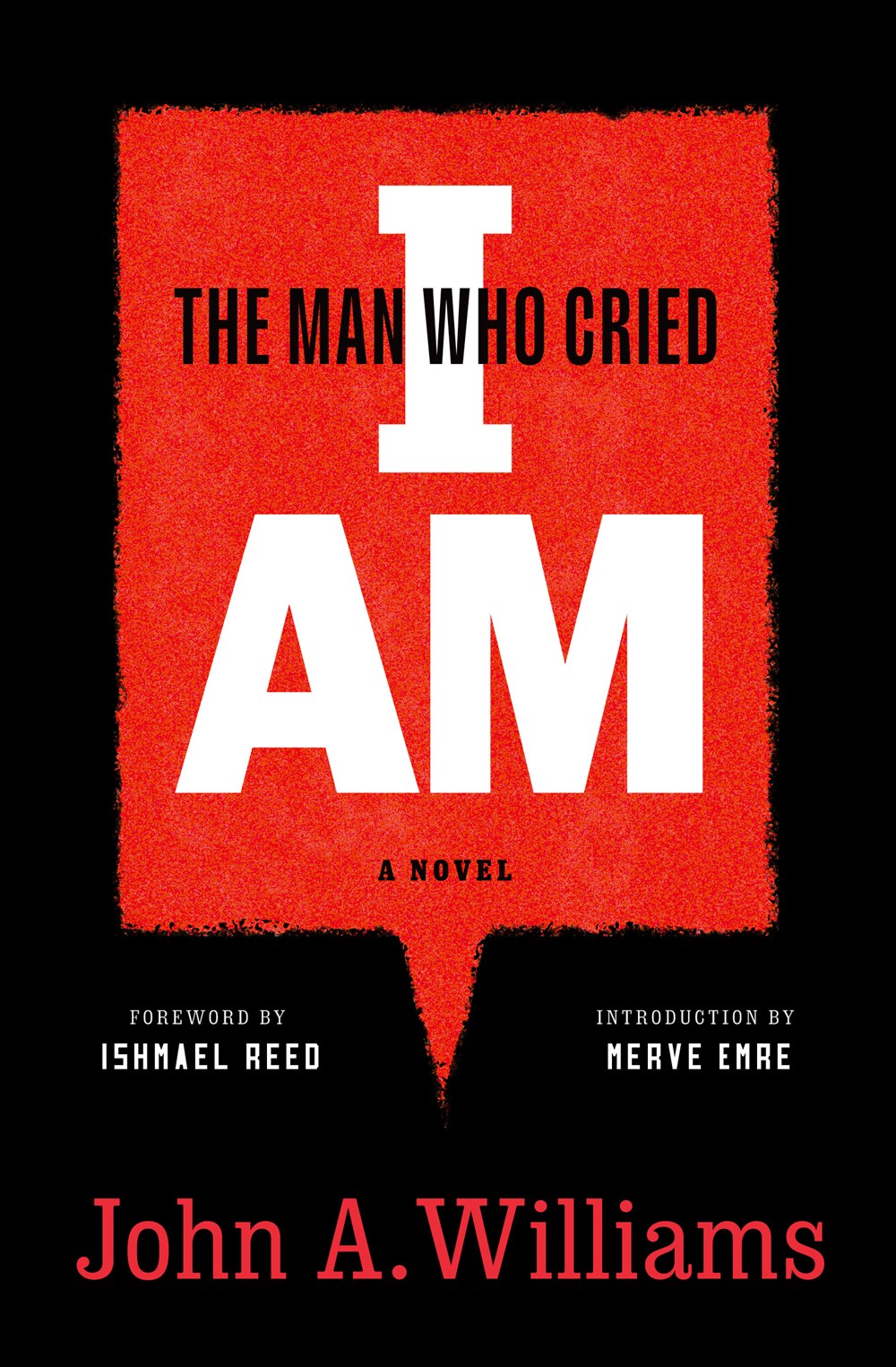
The Man Who Cried I Am: A Novel
by John A. Williams
$19.99Rediscover the sensational 1967 literary thriller that captures the bitter struggles of postwar Black intellectuals and artists
With a foreword by Ishmael Reed and a new introduction by Merve Emre about how this explosive novel laid bare America's racial fault lines
Max Reddick, a novelist, journalist, and presidential speechwriter, has spent his career struggling against the riptide of race in America. Now terminally ill, he has nothing left to lose. An expat for many years, Max returns to Europe one last time to settle an old debt with his estranged Dutch wife, Margrit, and to attend the Paris funeral of his friend, rival, and mentor Harry Ames, a character loosely modelled on Richard Wright.
In Amsterdam, among Harry’s papers, Max uncovers explosive secret government documents outlining “King Alfred,” a plan to be implemented in the event of widespread racial unrest and aiming “to terminate, once and for all, the Minority threat to the whole of the American society.” Realizing that Harry has been assassinated, Max must risk everything to get the documents to the one man who can help.
Greeted as a masterpiece when it was published in 1967, The Man Who Cried I Am stakes out a range of experience rarely seen in American fiction: from the life of a Black GI to the ferment of postcolonial Africa to an insider’s view of Washington politics in the era of segregation and the Civil Rights Movement, including fictionalized portraits of Martin Luther King, Jr., and Malcolm X. John A. Williams and his lost classic are overdue for rediscovery.
Few novels have so deliberately blurred the boundaries between fiction and reality as The Man Who Cried I Am (1967), and many of its early readers assumed the King Alfred plan was real. In her introduction, Merve Emre examines the gonzo marketing plan behind the novel that fueled this confusion and prompted an FBI investigation. This deluxe paperback also includes a new foreword by novelist Ishmael Reed.


Stay Informed. We're building a community committed to celebrating Black authors + artisans. Subscribe to keep up with all things Kindred Stories.