
Search results: 21 results for “edited by henry louis gates, jr.”
Not finding what you're looking for? Check out our shop on bookshop.org to order and still support us ♥
21 results
-
Juneteenth (Revised) (Vintage International)
![Juneteenth (Revised) (Vintage International) cover image]()

Juneteenth (Revised) (Vintage International)
Ralph Ellison
$17.00From the author of the classic novel Invisible Man, Ralph Ellison's Juneteenth is a powerful and brilliantly crafted tale that explores themes of identity, race, and ambition.
"[A] stunning achievement. . . . Ellison sought no less than to create a Book of Blackness, a literary composition of the tradition at its most sublime and fundamental."—Henry Louis Gates, Jr., Time
The story follows Adam Sunraider, a race-baiting senator, whose life takes an unexpected turn when he calls for Alonzo Hickman, an old Black minister, to be by his side as he faces a mortal wound. As the two men intimately share their stories and memories, the true shape and substance of the past begin to emerge.
Here is Ellison, a virtuoso of American vernacular—the preacher’s hyperbole and the politician’s rhetoric, the rhythms of jazz and gospel and ordinary speech—at the height of his powers, telling a moving, evocative tale of a prodigal of the twentieth century.
With an introduction and additional notes by John F. Callahan, who first compiled Juneteenth out of thousands of manuscript pages in 1999, and a preface by National Book Award-winning author Charles R. Johnson.
“Beautifully written and imaginatively conceived, Juneteenth, like Invisible Man, deserves to be read and reread by generations.” —The Atlanta Journal-Constitution
-
Within the Circle: An Anthology of African American Literary Criticism from the Harlem Renaissance to the Present
![Within the Circle: An Anthology of African American Literary Criticism from the Harlem Renaissance to the Present cover image]()

Within the Circle: An Anthology of African American Literary Criticism from the Harlem Renaissance to the Present
Angelyn Mitchell
$39.95Within the Circle is the first anthology to present the entire spectrum of twentieth-century African American literary and cultural criticism. It begins with the Harlem Renaissance, continues through civil rights, the Black Arts Movement, and on into contemporary debates of poststructuralist and black feminist theory. Drawing on a quote from Frederick Douglass for the title of this book, Angelyn Mitchell explains in her introduction the importance for those "within the circle" of African American literature to examine their own works and to engage this critical canon.
The essays in this collection—many of which are not widely available today—either initiated or gave critical definition to specific periods or movements of African American literature. They address issues such as integration, separatism, political action, black nationalism, Afrocentricity, black feminism, as well as the role of art, the artist, the critic, and the audience. With selections from Langston Hughes, Sterling Brown, W. E. B. DuBois, Zora Neale Hurston, Richard Wright, James Baldwin, Toni Morrison, Barbara Smith, Alice Walker, Henry Louis Gates, Jr., and many others, this definitive collection provides a dynamic model of the cultural, ideological, historical, and aesthetic considerations in African American literature and literary criticism.
A major contribution to the study of African American literature, this volume will serve as a foundation for future work by students and scholars. Its importance will be recognized by all those interested in modern literary theory as well as general readers concerned with the African American experience.Selections by (partial list): Houston A. Baker, Jr., James Baldwin, Sterling Brown, Barbara Christian, W. E. B. DuBois, Ralph Ellison, LeRoi Jones, Sarah Webster Fabio, Henry Louis Gates, Jr., W. Lawrence Hogue, Langston Hughes, Zora Neale Hurston, Alain Locke, Deborah E. McDowell, Toni Morrison, J. Saunders Redding, George Schuyler, Barbara Smith, Valerie Smith, Hortense J. Spillers, Robert B. Stepto, Alice Walker, Margaret Walker, Mary Helen Washington, Richard Wright
-
The New Negro: A History in Documents, 1887–1937
![The New Negro: A History in Documents, 1887–1937 cover image]()

The New Negro: A History in Documents, 1887–1937
Martha H. Patterson
$39.95An authoritative anthology tracing the history of one of the most important concepts Black people drew on to challenge the brutal, totalizing system of Jim Crow racism
This book brings together a wealth of readings on the metaphor of the “New Negro,” charting how generations of thinkers debated its meaning and seized on its potency to stake out an astonishingly broad and sometimes contradictory range of ideological positions. It features dozens of newly unearthed pieces by major figures such as W. E. B. Du Bois, Charles S. Johnson, and Drusilla Dunjee Houston as well as writings from Cuba, the US Virgin Islands, Dominica, France, Sierra Leone, South Africa, colonial Zimbabwe, and the United States. Demonstrating how this evocative and supremely protean concept predates its popularization in Alain Locke’s 1925 anthology of the same name, The New Negro takes readers from its beginnings as a response to Henry Grady’s famous “New South” address in 1886 through the Harlem Renaissance and the New Deal.
Opening a fascinating window into a largely unexplored chapter in African American, Afro-Latin American, and African intellectual history, this groundbreaking anthology includes writings by Gwendolyn Bennett, Marita Bonner, John Edward Bruce (“Bruce Grit”), Nannie Helen Burroughs, Charles W. Chesnutt, James Bertram Clarke (“José Clarana,” “Jaime Gil”), Anna Julia Cooper, Alexander Crummell, Countee Cullen, Alice Dunbar-Nelson, Marcus Garvey, Hubert Harrison, Langston Hughes, Zora Neale Hurston, D. Hamilton Jackson, Fenton Johnson, Claude McKay, Oscar Micheaux, Jeanne “Jane” Nardal, Jean Toomer, Gustavo Urrutia, Booker T. Washington, Dorothy West, Ruth Whitehead Whaley, Fannie Barrier Williams, Carter G. Woodson, and a host of others.
-
Putting Myself Together: Writing 1974–
![Putting Myself Together: Writing 1974– cover image]()

Putting Myself Together: Writing 1974–
Jamaica Kincaid
from $20.00My ignorance was on my side. I wasn’t afraid. I didn’t know what to be afraid of. I did one thing, I did another. I did what I now call crashing about. One day I started to write.
This collection of Jamaica Kincaid’s nonfiction writing, including early pieces from publications such as The New Yorker, The Village Voice, and Ms., proves what her admirers have always known: from the start, she has been a consummate stylist, and she has always been herself.
From “Jamaica Kincaid’s New York,” which narrates her move to the city from Antigua at the age of sixteen and a half, to the classic “Biography of a Dress,” her cultural criticism, and her original thinking about the meaning of the garden, Kincaid writes about the world as she finds it, imparting her own quizzical, rapier-sharp response to whatever crosses her path.
Putting Myself Together is a brilliant, trenchant, hilarious self-portrait of the artist and a testament to how this inimitable, self-created mind and spirit, endowed with wit, humor, and fearlessness, has become one of our greatest, most original writers.
-
Mahalia Jackson, Moving On Up a Little Higher: The Story of an American Civil Rights Pioneer
![Mahalia Jackson, Moving On Up a Little Higher: The Story of an American Civil Rights Pioneer cover image]()

Mahalia Jackson, Moving On Up a Little Higher: The Story of an American Civil Rights Pioneer
$28.99“Mahalia Jackson was the greatest gospel singer of her time and an overlooked leader in the Civil Rights Movement. Her voice seemed born of heaven.” ?Henry Louis Gates Jr.
If Americans today still recognize the name Mahalia Jackson, they might recall that she was perhaps the greatest gospel singer who ever lived. But for many people, there is no awareness at all, not even for an entertainer whose “Move On Up a Little Higher” sold eight million copies, who headlined two Newport Jazz Festivals and performed before four United States presidents.
While this rich musical legacy is admired by those in the know, virtually no one recognizes Jackson’s astonishing role in American civil rights history. In this startling new depiction of the renowned gospel singer, New York Times best-selling author Timothy B. Tyson and Mary D. Williams, an acclaimed gospel singer herself, bring Jackson back to soaring life by positioning her as the major civil rights figure she, in fact, was.
Mahlia Jackson, Moving On Up a Little Higher then traces Jackson’s career from abject poverty in New Orleans to global superstardom, revealing how even after meteoric success, Jackson maintained an unwavering devotion to Black freedom. In the 1930s in Chicago, even before the Civil Rights Movement took its modern shape, she used her rapturous voice to support independent Black political power. Her work only intensified in the 1940s and beyond when she campaigned first for Franklin D. Roosevelt, and later for Harry Truman, John F. Kennedy, and Lyndon B. Johnson; headlined in Montgomery for the 1955–56 bus boycott; sang for the Birmingham campaign and on the Selma March; and performed at the iconic 1963 March on Washington, where she urged Martin Luther King Jr. to “Tell ’em about the dream.” In retrospect what becomes historically significant is that Mahalia Jackson was present at so many civil rights events, even singing a divine rendition of “Precious Lord, Take My Hand,” at Dr. King’s funeral in 1968. Weakened and worn, she succumbed to heart failure four years later at the age of sixty.
Weaving together Mahalia Jackson’s inspiring life journey with her soulful music into a transcendent text, this biography ultimately casts Mahalia Jackson as we’ve never seen her before, as a guiding light for the Civil Rights Movement, whose message still speaks to our struggles today.
5 illustrations
-
Little Stories Club: Storytime at Kindred - September 26 @ 11 AM
![Little Stories Club: Storytime at Kindred - September 26 @ 11 AM]()

Little Stories Club: Storytime at Kindred - September 26 @ 11 AM
$0.00Join us for a montly children's storytime at Kindred Stories. Each Story time will celebrate a special book and be read by a wondertful community mementer. IT also includes a story time.
Featured Book: Daisy Helps With The Dress
Featured Reader: Antonia Adams
EVENT DEETS
When: Saturday, September 26 @ 11 AM CST
Where: Kindred Stories (2310 Elgin St. Houston, TX 77004)
How:
-
RSVP ONLY to reserve your spot and let us know you are coming.
ABOUT DAISY HELPS WITH THE DRESS
When Daisy tries to help with her cousin’s wedding, her misguided assists almost ruin the big day, until she finds a way to pull the dress—and her family—together in this charming picture book by award-winning author Olugbemisola Rhuday-Perkovich.
Daisy loves helping her family and she knows the best kind of helpers never wait to be asked. That’s why she doesn’t ask before adding finishing touches to her family’s special reused, re-tried, remixed things, like a leftover broccoli topping for Auntie Fontie’s cakes or a good bath for Nana DJ’s “back-in-the-day, rusty, dusty” vintage albums—much to their chagrin.
But what Daisy wants most is to help give her cousin Simone’s recycled wedding dress a little razzle dazzle. She knows just what the vintage dress needs: a little glitter here, a few stickers there to give the dress some flair.
But Daisy’s cousin Simone and the rest of the family are not so happy with her decorations. Can Daisy make things right and help find Simone a new re-lived, re-loved wedding dress?
-
-
Jean-Michel Basquiat Handbook
![Book cover image]()
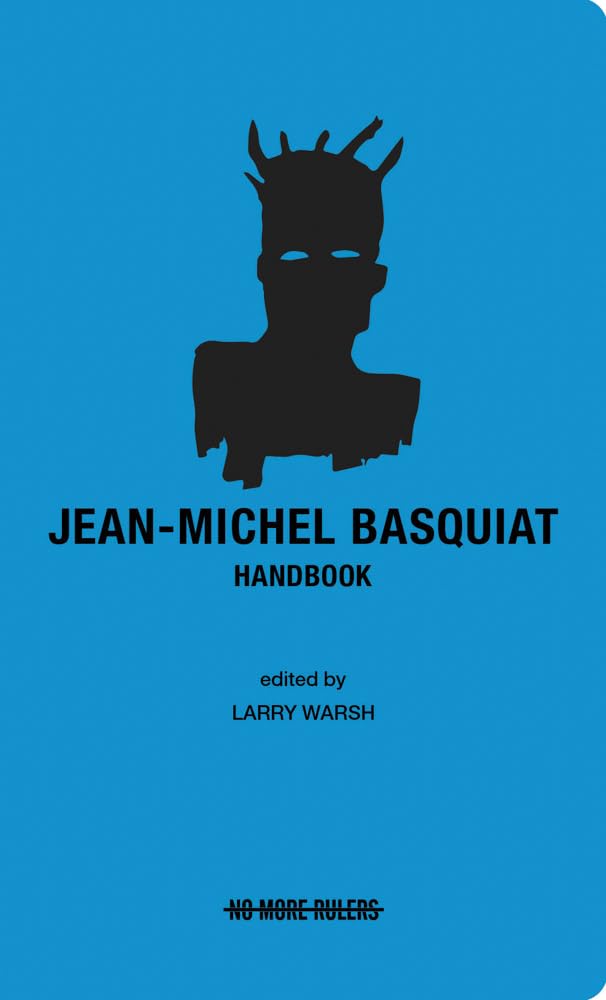
Jean-Michel Basquiat Handbook
Jean-Michel Basquiat
Sold outAn affordable, compact primer on the artist who drastically shifted the course of late 20th-century art
This reader provides a concise introduction to the widely popular yet oft-misunderstood artist Jean-Michel Basquiat. Guided by the steady hand of Basquiat scholar Larry Warsh, it is one of the few books of this kind to be directly approved by the artist’s estate and family: a notable distinction amid all of the buzz.
Jean-Michel Basquiat Handbook begins with a portrait of the young Basquiat, from his years as a precocious child in Brooklyn, to his rebellious teenagedom, to his meteoric rise in fame, to his tragic early death. The book then discusses the development of his groundbreaking style through the recurrent themes of his practice: urban life, the human figure, music and sports, to name just a few. The backend of the book provides a sampling of sketches from Basquiat’s notebooks, a chronology and incisive essays from scholars Henry Geldzahler and Henry Louis Gates Jr.
One of the first African American artists to reach international stature and wealth in the art world, Jean-Michel Basquiat (1960–88) was celebrated for his fusion of multicultural symbols, social commentary and distinctive graphic style. He has been the subject of numerous exhibitions across the globe, and his work is included in the collections of the Museum of Modern Art, New York, the Whitney Museum of American Art and the Broad Contemporary Art Museum, among many others. -
Tenderheaded: A Comb-Bending Collection of Hair Stories (Revised)
![Tenderheaded: A Comb-Bending Collection of Hair Stories (Revised)]()
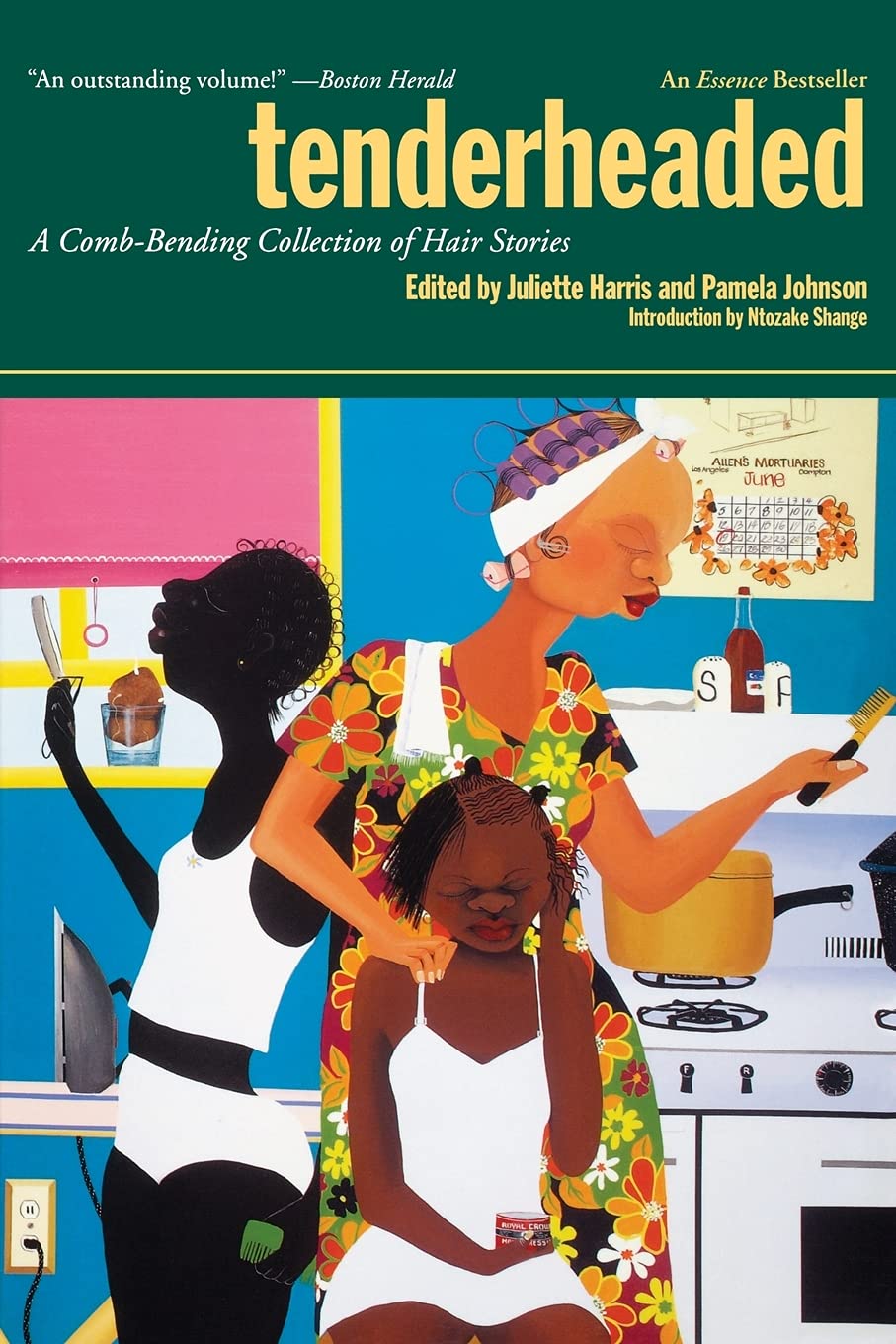
Tenderheaded: A Comb-Bending Collection of Hair Stories (Revised)
edited by Pamela Johnson & Juliette Harris
Sold out*ships in 7 - 10 business days*
In this “outstanding volume” (Boston Herald) that “ought to be at the top of everyone’s must-read list” (Essence), Black women and men evocatively explore what could make a smart woman ignore doctor’s orders; what could get a hardworking employee fired from her job; what could get a black woman in hot water with her white boyfriend? In a word: hair.
In a society where beauty standards can be difficult if not downright unobtainable for many Black women, the issue of hair is a major one. Now, in this evocative and fascinating collection of essays, poems, excerpts, and more, Tenderheaded speaks to the personal, political, and cultural meaning of Black hair.
From A’Leila Perry Bundles, the great-granddaughter of hair care pioneer Madam C.J. Walker celebrating her ancestor’s legacy, to an art historian exploring the moving ways in which Black hair has been used to express Yoruba spirituality, to renowned activist Angela Davis questioning how her message of revolution got reduced to a hairstyle, Tenderheaded is as rich and diverse as the children of the African diaspora.
With works from authors including Toni Morrison, Alice Walker, bell hooks, Henry Louis Gates Jr., and more, this “remarkable array of writings and images” (Publishers Weekly) will stay with you long after you turn the final page. -
Zora Neale Hurston : Folklore, Memoirs, and Other Writings : Mules and Men, Tell My Horse, Dust Tracks on a Road, Selected Articles (The Library of America, 75)
![Zora Neale Hurston : Folklore, Memoirs, and Other Writings : Mules and Men, Tell My Horse, Dust Tracks on a Road, Selected Articles (The Library of America, 75) cover image]()

Zora Neale Hurston : Folklore, Memoirs, and Other Writings : Mules and Men, Tell My Horse, Dust Tracks on a Road, Selected Articles (The Library of America, 75)
Zora Neale Hurston
Sold outThis Library of America volume, with its companion, brings together for the first time all of the best writing of Zora Neale Hurston, one of the most significant twentieth-century American writers, in one authoritative set.
“Folklore is the arts of the people,” Hurston wrote, “before they find out that there is any such thing as art.” A pioneer of African-American ethnography who did graduate study in anthropology with the renowned Franz Boas, Hurston devoted herself to preserving the black folk heritage. In Mules and Men (1935), the first book of African-American folklore written by an African American, she returned to her native Florida and to New Orleans to record stories and sermons, blues and work songs, children’s games, courtship rituals, and formulas of voodoo doctors. This classic work is presented here with the original illustrations by the great Mexican artist Miguel Covarrubias.
Tell My Horse (1938), part ethnography, part travel book, vividly recounts the survival of African religion in Jamaican obeah and Haitian voodoo in the 1930s. Keenly alert to political and intellectual currents, Hurston went beyond superficial exoticism to explore the role of these religious systems in their societies. The text is illustrated by twenty-six photographs, many of them taken by Hurston. Her extensive transcriptions of Creole songs are here accompanied by new translations.
A special feature of this volume is Hurston’s controversial 1942 autobiography, Dust Tracks on a Road. With consultation by Henry Louis Gates, Jr., it is presented here for the first time as she intended, restoring passages omitted by the original because of political controversy, sexual candor, or fear of libel. Included in an appendix are four additional chapters, one never published, which represent earlier stages of Hurston’s conception of the book.
Twenty-two essays, from “The Eatonville Anthology” (1926) to “Court Order Can’t Make Races Mix” (1955), demonstrate the range of Hurston’s concerns as they cover subjects from religion, music, and Harlem slang to Jim Crow and American democracy.
The chronology of Hurston’s life prepared for this edition sheds fresh light on many aspects of her career. In addition, this volume contains detailed notes and a brief essay on the texts.
LIBRARY OF AMERICA is an independent nonprofit cultural organization founded in 1979 to preserve our nation’s literary heritage by publishing, and keeping permanently in print, America’s best and most significant writing. The Library of America series includes more than 300 volumes to date, authoritative editions that average 1,000 pages in length, feature cloth covers, sewn bindings, and ribbon markers, and are printed on premium acid-free paper that will last for centuries.


- ← Previous
- page 1
- page 2
Stay Informed. We're building a community committed to celebrating Black authors + artisans. Subscribe to keep up with all things Kindred Stories.