
Search results: 22 results for “e. hughes”
Not finding what you're looking for? Check out our shop on bookshop.org to order and still support us ♥
22 results
-
The Dark Delight of Being Strange: Black Stories of Freedom
![The Dark Delight of Being Strange: Black Stories of Freedom cover image]()

The Dark Delight of Being Strange: Black Stories of Freedom
James B. Haile III
$26.00Winner, 2025 Hugh J. Silverman Book Prize, Association for Philosophy and Literature
Finalist, 2025 PEN Open Book Award, PEN America
An ambitious genre-crossing exploration of Black speculative imagination, The Dark Delight of Being Strange combines fiction, historical accounts, and philosophical prose to unveil the extraordinary and the surreal in everyday Black life.
In a series of stories and essays, James B. Haile, III, traces how Black speculative fiction responds to enslavement, racism, colonialism, and capitalism and how it reveals a life beyond social and political alienation. He reenvisions Black technologies of freedom through Henry Box Brown’s famed escape from slavery in a wooden crate, fashions an anticolonial “hollow earth theory” from the works of H. G. Wells and Jules Verne, and considers the octopus and its ability to camouflage itself as a model for Black survival strategies, among others. Looking at Black life through the lens of speculative fiction, this book transports readers to alternative worlds and spaces while remaining squarely rooted in present-day struggles. In so doing, it rethinks historical and contemporary Black experiences as well as figures such as Harriet Tubman, Frederick Douglass, Booker T. Washington, W. E. B. Du Bois, Henry Dumas, and Toni Morrison.
Offering new ways to grasp the meanings and implications of Black freedom, The Dark Delight of Being Strange invites us to reimagine history and memory, time and space, our identities and ourselves.
-
The Afro-Latin@ Reader: History and Culture in the United States (a John Hope Franklin Center Book)
![The Afro-Latin@ Reader: History and Culture in the United States (a John Hope Franklin Center Book) cover image]()

The Afro-Latin@ Reader: History and Culture in the United States (a John Hope Franklin Center Book)
Miriam Jiménez Román
$35.95The Afro-Latin@ Reader focuses attention on a large, vibrant, yet oddly invisible community in the United States: people of African descent from Latin America and the Caribbean. The presence of Afro-Latin@s in the United States (and throughout the Americas) belies the notion that Blacks and Latin@s are two distinct categories or cultures. Afro-Latin@s are uniquely situated to bridge the widening social divide between Latin@s and African Americans; at the same time, their experiences reveal pervasive racism among Latin@s and ethnocentrism among African Americans. Offering insight into Afro-Latin@ life and new ways to understand culture, ethnicity, nation, identity, and antiracist politics, The Afro-Latin@ Reader presents a kaleidoscopic view of Black Latin@s in the United States. It addresses history, music, gender, class, and media representations in more than sixty selections, including scholarly essays, memoirs, newspaper and magazine articles, poetry, short stories, and interviews.
While the selections cover centuries of Afro-Latin@ history, since the arrival of Spanish-speaking Africans in North America in the mid-sixteenth-century, most of them focus on the past fifty years. The central question of how Afro-Latin@s relate to and experience U.S. and Latin American racial ideologies is engaged throughout, in first-person accounts of growing up Afro-Latin@, a classic essay by a leader of the Young Lords, and analyses of U.S. census data on race and ethnicity, as well as in pieces on gender and sexuality, major-league baseball, and religion. The contributions that Afro-Latin@s have made to U.S. culture are highlighted in essays on the illustrious Afro-Puerto Rican bibliophile Arturo Alfonso Schomburg and music and dance genres from salsa to mambo, and from boogaloo to hip hop. Taken together, these and many more selections help to bring Afro-Latin@s in the United States into critical view.
Contributors: Afro–Puerto Rican Testimonies Project, Josefina Baéz, Ejima Baker, Luis Barrios, Eduardo Bonilla-Silva, Adrian Burgos Jr., Ginetta E. B. Candelario, Adrián Castro, Jesús Colón, Marta I. Cruz-Janzen, William A. Darity Jr., Milca Esdaille, Sandra María Esteves, María Teresa Fernández (Mariposa), Carlos Flores, Juan Flores, Jack D. Forbes, David F. Garcia, Ruth Glasser, Virginia Meecham Gould, Susan D. Greenbaum, Evelio Grillo, Pablo “Yoruba” Guzmán, Gabriel Haslip-Viera, Tanya K. Hernández, Victor Hernández Cruz, Jesse Hoffnung-Garskof, Lisa Hoppenjans, Vielka Cecilia Hoy, Alan J. Hughes, María Rosario Jackson, James Jennings, Miriam Jiménez Román, Angela Jorge, David Lamb, Aida Lambert, Ana M. Lara, Evelyne Laurent-Perrault, Tato Laviera, John Logan, Antonio López, Felipe Luciano, Louis Pancho McFarland, Ryan Mann-Hamilton, Wayne Marshall, Marianela Medrano, Nancy Raquel Mirabal, Yvette Modestin, Ed Morales, Jairo Moreno, Marta Moreno Vega, Willie Perdomo, Graciela Pérez Gutiérrez, Sofia Quintero, Ted Richardson, Louis Reyes Rivera, Pedro R. Rivera , Raquel Z. Rivera, Yeidy Rivero, Mark Q. Sawyer, Piri Thomas, Silvio Torres-Saillant, Nilaja Sun, Sherezada “Chiqui” Vicioso, Peter H. Wood
-
Within the Circle: An Anthology of African American Literary Criticism from the Harlem Renaissance to the Present
![Within the Circle: An Anthology of African American Literary Criticism from the Harlem Renaissance to the Present cover image]()

Within the Circle: An Anthology of African American Literary Criticism from the Harlem Renaissance to the Present
Angelyn Mitchell
$39.95Within the Circle is the first anthology to present the entire spectrum of twentieth-century African American literary and cultural criticism. It begins with the Harlem Renaissance, continues through civil rights, the Black Arts Movement, and on into contemporary debates of poststructuralist and black feminist theory. Drawing on a quote from Frederick Douglass for the title of this book, Angelyn Mitchell explains in her introduction the importance for those "within the circle" of African American literature to examine their own works and to engage this critical canon.
The essays in this collection—many of which are not widely available today—either initiated or gave critical definition to specific periods or movements of African American literature. They address issues such as integration, separatism, political action, black nationalism, Afrocentricity, black feminism, as well as the role of art, the artist, the critic, and the audience. With selections from Langston Hughes, Sterling Brown, W. E. B. DuBois, Zora Neale Hurston, Richard Wright, James Baldwin, Toni Morrison, Barbara Smith, Alice Walker, Henry Louis Gates, Jr., and many others, this definitive collection provides a dynamic model of the cultural, ideological, historical, and aesthetic considerations in African American literature and literary criticism.
A major contribution to the study of African American literature, this volume will serve as a foundation for future work by students and scholars. Its importance will be recognized by all those interested in modern literary theory as well as general readers concerned with the African American experience.Selections by (partial list): Houston A. Baker, Jr., James Baldwin, Sterling Brown, Barbara Christian, W. E. B. DuBois, Ralph Ellison, LeRoi Jones, Sarah Webster Fabio, Henry Louis Gates, Jr., W. Lawrence Hogue, Langston Hughes, Zora Neale Hurston, Alain Locke, Deborah E. McDowell, Toni Morrison, J. Saunders Redding, George Schuyler, Barbara Smith, Valerie Smith, Hortense J. Spillers, Robert B. Stepto, Alice Walker, Margaret Walker, Mary Helen Washington, Richard Wright
-
A Century of Poetry in The New Yorker: 1925-2025
![A Century of Poetry in The New Yorker: 1925-2025 cover image]()

A Century of Poetry in The New Yorker: 1925-2025
Kevin Young
$50.00Edited by the magazine’s poetry editor, Kevin Young, a celebratory selection from one hundred years of influential, entertaining, and taste-making verse in The New Yorker
Seamus Heaney, Dorothy Parker, Louise Bogan, Louise Glück, Randall Jarrell, Langston Hughes, Derek Walcott, Sylvia Plath, W. S. Merwin, Czesław Miłosz, Tracy K. Smith, Mark Strand, E. E. Cummings, Sharon Olds, Franz Wright, John Ashbery, Sandra Cisneros, Amanda Gorman, Maggie Smith, Kaveh Akbar: these stellar names make up just a fraction of the wonderfulness that is present in this essential anthology.
The book is organized into sections honoring times of day (“Morning Bell,” “Lunch Break,” “After-Work Drinks,” “Night Shift”), allowing poets from different eras to talk back to one another in the same space, intertwined with chronological groupings from the decades as they march by: the frothy 1920s and 1930s (“despite the depression,” Young notes), the more serious ’40s and ’50s (introducing us to the early greats of our contemporary poetry, like Elizabeth Bishop, W. S. Merwin, and Adrienne Rich), the political ’60s and ’70s, the lyrical ’80s and ’90s, and then the 2000s’ with their explosion of greater diversity in the magazine, greater depth and breadth. Inevitably, we see the high points when poems spoke directly into, about, or against the crises of their times—the war poetry of W. H. Auden and Karl Shapiro; the remarkable outpouring of verse after 9/11 (who can forget Adam Zagajewski’s “Try to Praise the Mutilated World”?); and more recently, stunning poems in response to the cataclysmic events of COVID and the murder of George Floyd.
The magazine’s poetic influence resides not just in this historical and cultural relevance but in sheer human connection, exemplified by the passing verses that became what Young calls “refrigerator poems”: the ones you tear out and affix to the fridge to read again and again over months and years. Our love for that singular Billy Collins or Ada Limón poem—or lines by a new writer you’ve never heard of but will hear much more from in the future—is what has made The New Yorker a great organ for poetry, a mouthpiece for our changing culture and way of life, even a mirror of our collective soul.
-
The Weary Blues; Not Without Laughter; The Ways of White Folks (Everyman's Library Contemporary Classics Series)
![The Weary Blues; Not Without Laughter; The Ways of White Folks (Everyman's Library Contemporary Classics Series) cover image]()

The Weary Blues; Not Without Laughter; The Ways of White Folks (Everyman's Library Contemporary Classics Series)
Langston Hughes
Sold outA major hardcover compendium of poetry and fiction by the legendary Black American poet of the Harlem Renaissance
One of the most important writers to emerge from the Harlem Renaissance, Langston Hughes may be best known as a poet, but he was also a brilliant storyteller, blending elements of blues and jazz, speech and song, into a triumphant and wholly original idiom. Perhaps more than any other writer, Langston Hughes made the white America of the 1920s and 1930s aware of the Black culture thriving in its midst. Hughes's poetry and fiction works are messages from that America, sharply etched vignettes of its daily life, cruelly accurate portrayals of Black and white collisions.
This Everyman's Library compendium comprises Hughes's debut poetry collection, The Weary Blues, which catapulted him into literary stardom at just twenty-four years old; his award-winning debut novel, Not Without Laughter, published in 1930 to critical raves; and his 1933 collection of short stories The Ways of White Folks, currently only available in Vintage Classics trade paperback.
Everyman's Library pursues the highest production standards, printing on acid-free paper, with full-cloth cases with two-color foil stamping, decorative endpapers, silk ribbon markers, European-style half-round spines, and a full-color illustrated jacket.
-
Troubled Lands: Stories of Mexico and Cuba as Translated by Langston Hughes
![Troubled Lands: Stories of Mexico and Cuba as Translated by Langston Hughes cover image]()

Troubled Lands: Stories of Mexico and Cuba as Translated by Langston Hughes
Sold outA landmark book—the first complete publication of Langston Hughes’s translations of thirty-three stories by eighteen Mexican and Cuban writers
In late 1934, Langston Hughes, already established as a leading voice of literary Black America, traveled to Mexico City, where he stayed for more than five months and began translating short fiction by prominent Mexican and Cuban writers. These stories, as he wrote to a friend, explore “the revolutions and uprisings, sugar cane, Negroes, Indians, corrupt generals, [and] American imperialists,” and are “mostly all left stories, because practically all the writers down here are left these days.” But when Hughes proposed publishing the stories as a book, to be titled Troubled Lands, his agent discouraged him from further pursuing the project and it remained unpublished, until now, with only a handful of the translations making their way into contemporary magazines. This volume presents Hughes’s translations of these stories together for the first time as he originally envisioned. Edited by Ricardo Wilson, the book also features an introduction and brief biographies of the included writers.
Troubled Lands features thirty-three stories by eighteen writers, including Rafael Felipe Muñoz, Nellie Campobello, Lino Novás Calvo, Luis Felipe Rodríguez, Germán List Arzubide, Pablo de la Torriente-Brau, and Juan de la Cabada. The collection depicts Mexico in the wake of its revolution and Cuba in the years between the brutal regimes of Machado and Batista.
Hughes was a noted translator of poetry, but his commitment to translating fiction is less well known. Troubled Lands provides a window into this important dimension of his work and illuminates his deep interest in Mexico and Cuba.
-
IRL Author Talk: Harlem Rhapsody with Victoria Christopher Murray - February 5 @ 7PM
![IRL Author Talk: Harlem Rhapsody with Victoria Christopher Murray - February 5 @ 7PM]()
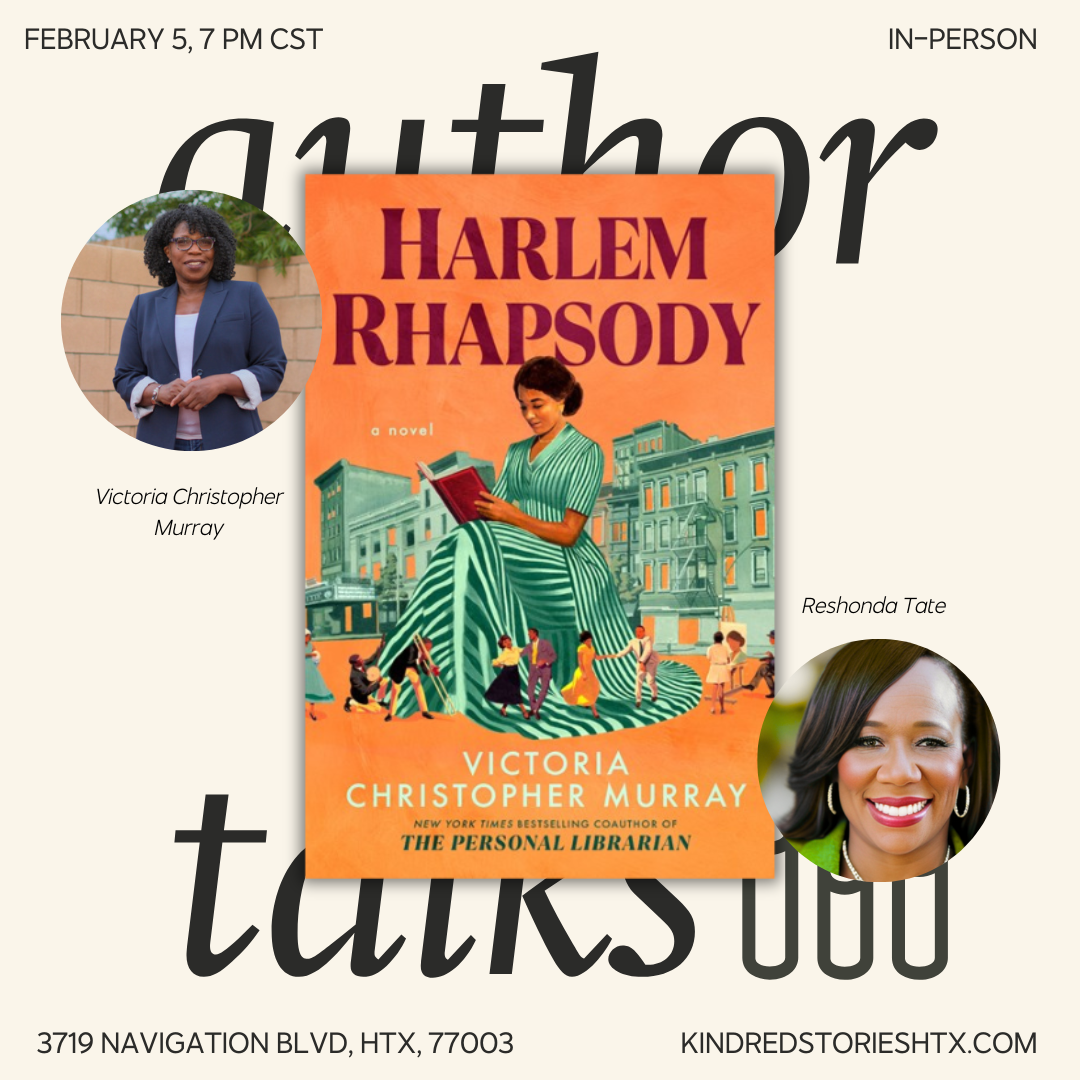
IRL Author Talk: Harlem Rhapsody with Victoria Christopher Murray - February 5 @ 7PM
Sold outCelebrate the release of Harlem Rhapsody with Victoria Christopher Murray!
EVENT DEETS
When: Wednesday, February 5 @ 7PM
Where: Holy Family HTX (3719 Navigation Blvd, HTX, 77003)
How: Get your tickets here!
ABOUT THE BOOK
In 1919, a high school teacher from Washington, D.C arrives in Harlem excited to realize her lifelong dream. Jessie Redmon Fauset has been named the literary editor of The Crisis. The first Black woman to hold this position at a preeminent Negro magazine, Jessie is poised to achieve literary greatness. But she holds a secret that jeopardizes it all.
W. E. B. Du Bois, the founder of The Crisis, is not only Jessie’s boss, he’s her lover. And neither his wife, nor their fourteen-year-age difference can keep the two apart. Amidst rumors of their tumultuous affair, Jessie is determined to prove herself. She attacks the challenge of discovering young writers with fervor, finding sixteen-year-old Countee Cullen, seventeen-year-old Langston Hughes, and Nella Larsen, who becomes one of her best friends. Under Jessie’s leadership, The Crisis thrives…every African American writer in the country wants their work published there.
When her first novel is released to great acclaim, it’s clear that Jessie is at the heart of a renaissance in Black music, theater, and the arts. She has shaped a generation of literary legends, but as she strives to preserve her legacy, she’ll discover the high cost of her unparalleled success.ABOUT THE AUTHOR
Victoria Christopher Murray is one of the country's top Black contemporary authors. Her novels include the Seven Deadly Sins series and Stand Your Ground, a Library Journal Best Book of the Year. She holds an MBA from the NYU Stern School of Business.
ABOUT THE CONVERSATION PARTNER
As a national bestselling author and award-winning journalist, ReShonda Tate has the credentials, and the passion, to bring stories to life. A highly sought-after motivational speaker/poet, ReShonda is a three-time nominee and previous winner of the NAACP Image Award for Outstanding Literature. She has received a plethora of distinguished awards and honors for her journalism, fiction, and poetry writing skills, including an induction into the Arkansas Black Hall of Fame and the Texas Literary Hall of Fame. Two of her novels have been made into television movies.
-
The Big Sea (American Century Series)
![The Big Sea (American Century Series) cover image]()

The Big Sea (American Century Series)
Langston Hughes
Sold out"This book is the chronicle of a bright and lively artistic ear that brought the African-American people full into the twentieth century. It is a wonderful book!” ―Amiri Baraka
In his incisive introduction to The Big Sea, an American classic, Arnold Rampersad writes: "This is American writing at its best--simpler than Hemingway; as simple and direct as that of another Missouri-born writer...Mark Twain."
Langston Hughes, born in 1902, came of age early in the 1920s. In The Big Sea he recounts those memorable years in the two great playgrounds of the decade--Harlem and Paris. In Paris he was a cook and waiter in nightclubs. He knew the musicians and dancers, the drunks and dope fiends. In Harlem he was a rising young poet--at the center of the "Harlem Renaissance."
-
Selected Poems of Langston Hughes
![Selected Poems of Langston Hughes]()

Selected Poems of Langston Hughes
Sold out*Ships in 7-10 Business Days*Langston Hughes electrified readers and launched a renaissance in Black writing in America—the poems in this collection were chosen by Hughes himself shortly before his death and represent stunning work from his entire career.
The poems Hughes wrote celebrated the experience of invisible men and women: of slaves who “rushed the boots of Washington”; of musicians on Lenox Avenue; of the poor and the lovesick; of losers in “the raffle of night.” They conveyed that experience in a voice that blended the spoken with the sung, that turned poetic lines into the phrases of jazz and blues, and that ripped through the curtain separating high from popular culture. They spanned the range from the lyric to the polemic, ringing out “wonder and pain and terror—and the marrow of the bone of life.”
The collection includes “The Negro Speaks of Rivers,” “The Weary Blues,” “Still Here,” “Song for a Dark Girl,” “Montage of a Dream Deferred,” and “Refugee in America.” It gives us a poet of extraordinary range, directness, and stylistic virtuosity. -
Black Poets of the United States: From Paul Laurence Dunbar to Langston Hughes
![Black Poets of the United States: From Paul Laurence Dunbar to Langston Hughes cover image]()

Black Poets of the United States: From Paul Laurence Dunbar to Langston Hughes
Sold outAcclaimed upon its initial American release, Black Poets of the United Statescontinued to spark comment and analysis for years afterward. Jean Wagner's masterpiece delves into the vital union of racial and religious feeling in the Black poets who emerged from 1890 to 1940.
Beginning with an analysis of slavery's impact on the Black psyche and religious feeling, Wagner examines the evolution of Black lyrical expression to the end of the nineteenth century. He then moves into a focused study of Paul Laurence Dunbar and his contemporaries, emphasizing their struggle against prevalent stereotypes that stemmed from minstrelsy, popular song, and southern white writing. His look at the twentieth-century Black Renaissance explores the works, themes, concerns, and experiences of poets Claude McKay, Jean Toomer, Countee Cullen, James Weldon Johnson, Sterling Brown, and Langston Hughes.
Deeply sensitive and remarkably comprehensive Black Poets of the United States combines encyclopedic knowledge with a broad perspective to provide a pioneering examination of major African American poets and their works.


- ← Previous
- page 1
- page 2
Stay Informed. We're building a community committed to celebrating Black authors + artisans. Subscribe to keep up with all things Kindred Stories.