
Search results: 147 results for “by Dr. Martin Luther King, Jr.”
Not finding what you're looking for? Check out our shop on bookshop.org to order and still support us ♥
147 results
-
NOVEMBER 2024: Non Fiction Book Club - November 19 @ 7PM
![NOVEMBER 2024: Non Fiction Book Club - November 19 @ 7PM]()

NOVEMBER 2024: Non Fiction Book Club - November 19 @ 7PM
Sold outBook Club Meeting DEETS
When: Tuesday, November 19 @ 7PM
Where: Kindred Stories (2304 Stuart Street, HTX, 77004)
How: RSVP ONLY to let us know you plan to attend or RSVP WITH BOOK to support Non Fiction Book Club and our other programming.
About We Refuse
Black resistance to white supremacy is often reduced to a simple binary, between Dr. Martin Luther King Jr.’s nonviolence and Malcolm X’s “by any means necessary.” In We Refuse, historian Kellie Carter Jackson urges us to move past this false choice, offering an unflinching examination of the breadth of Black responses to white oppression, particularly those pioneered by Black women.
The dismissal of “Black violence” as an illegitimate form of resistance is itself a manifestation of white supremacy, a distraction from the insidious, unrelenting violence of structural racism. Force—from work stoppages and property destruction to armed revolt—has played a pivotal part in securing freedom and justice for Black people since the days of the American and Haitian Revolutions. But violence is only one tool among many. Carter Jackson examines other, no less vital tactics that have shaped the Black struggle, from the restorative power of finding joy in the face of suffering to the quiet strength of simply walking away.
Clear-eyed, impassioned, and ultimately hopeful, We Refuse offers a fundamental corrective to the historical record, a love letter to Black resilience, and a path toward liberation. -
Medical Bondage: Race, Gender, and the Origins of American Gynecology
![Medical Bondage: Race, Gender, and the Origins of American Gynecology]()
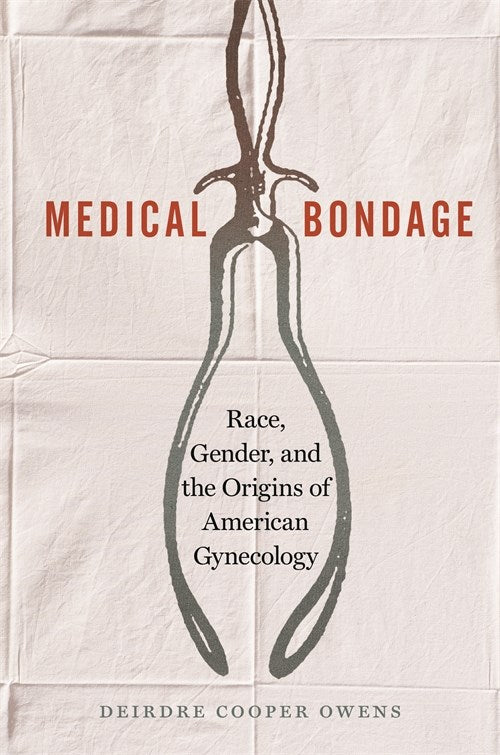
Medical Bondage: Race, Gender, and the Origins of American Gynecology
by Deirdre Cooper Owens
Sold outHow pioneering gynecologists promoted and exploited scientific myths about inferior races and nationalities. The accomplishments of pioneering doctors such as John Peter Mettauer, James Marion Sims, and Nathan Bozeman are well documented. It is also no secret that these nineteenth-century gynecologists performed experimental caesarean sections, ovariotomies, and obstetric fistula repairs primarily on poor and powerless women. Medical Bondage breaks new ground by exploring how and why physicians denied these women their full humanity yet valued them as “medical superbodies” highly suited for medical experimentation.
In Medical Bondage, Cooper Owens examines a wide range of scientific literature and less formal communications in which gynecologists created and disseminated medical fictions about their patients, such as their belief that black enslaved women could withstand pain better than white “ladies.” Even as they were advancing medicine, these doctors were legitimizing, for decades to come, groundless theories related to whiteness and blackness, men and women, and the inferiority of other races or nationalities.
Medical Bondage moves between southern plantations and northern urban centers to reveal how nineteenth-century American ideas about race, health, and status influenced doctor-patient relationships in sites of healing like slave cabins, medical colleges, and hospitals. It also retells the story of black enslaved women and of Irish immigrant women from the perspective of these exploited groups and thus restores for us a picture of their lives. -
The Battle for the Black Mind
![The Battle for the Black Mind cover image]()

The Battle for the Black Mind
Karida L. Brown Ph.D
Sold outFrom a NAACP award-winning historian and Fulbright scholar, a history of education in the United States from the end of the Civil War to the historic ruling of Brown v. Board of Education.
In The Battle for the Black Mind, Dr. Karida Brown explores the struggle to define and control the education of African Americans amid shifting societal attitudes and forms of systemic exclusion. From the perspective of freed slaves seeking empowerment and liberation through education, to the white elites aiming to shape the future of the workforce and consolidate power, The Battle for the Black Mind explores the formation of segregated education systems and the influence of philanthropic organizations, religious institutions, and Black educators themselves in shaping these structures. It also examines the global reach of these education models, particularly their impact on African societies under colonial rule.
Ultimately, Dr. Brown presents a critical investigation of the foundational roots of racial inequality in American education, arguing that it wasn't just about the separation of institutions—but about controlling access to the ideals of American democracy.
-
The Black Consciousness Reader
![The Black Consciousness Reader cover image]()

The Black Consciousness Reader
Sold outThere is a current revival of Black Consciousness, as political and student movements around the world – as well as academics and campaigners working in decolonization – reconfigure the continued struggle for socio-economic revolution. Yet the roots of Black Consciousness and its relation to other movements such as Black Lives Matter have only begun to be explored.
Black Consciousness has deep connections to the struggle against apartheid. The Black Consciousness Reader is an essential collection of history, culture, philosophy and meaning of Black Consciousness by some of the thinkers, artists and activists who developed it in order to finally bring revolution to South Africa. A contribution to the world’s Black cultural archive, it examines how the proper acknowledgement of Blackness brings a greater love, a broader sweep of heroes and a wider understanding of intellectual and political influences.
Although the legendary murdered activist Steve Biko is a strong figure within this history, the book documents many other significant international Black Consciousness personalities and focuses a predominantly African eye on Black Consciousness in politics, land, women, power, art, music and religion. Onkgopotse Tiro, Vuyelwa Mashalaba, Winnie Madikizela-Mandela, Assata Shakur, Marcus Garvey, Neville Alexander, Thomas Sankara, Malcolm X, Don Mattera, Keorapetse Kgositsile, W.E.B. DuBois, Walter Rodney, Mongane Wally Serote, Ready D and Zola are among the many bold minds included in this amalgam of facts, ideas and images.
-
History Teaches Us to Resist: How Progressive Movements Have Succeeded in Challenging Times
![History Teaches Us to Resist: How Progressive Movements Have Succeeded in Challenging Times cover image]()

History Teaches Us to Resist: How Progressive Movements Have Succeeded in Challenging Times
Mary Frances Berry
Sold outHistorian and civil rights activist proves how progressive movements can flourish even in conservative times.
Despair and mourning after the election of an antagonistic or polarizing president, such as Donald Trump, is part of the push-pull of American politics. But in this incisive book, historian Mary Frances Berry shows that resistance to presidential administrations has led to positive change and the defeat of outrageous proposals, even in challenging times. Noting that all presidents, including ones considered progressive, sometimes require massive organization to affect policy decisions, Berry cites Indigenous peoples’ protests against the Dakota pipeline during Barack Obama’s administration as a modern example of successful resistance built on earlier actions.
Beginning with Franklin D. Roosevelt, Berry discusses that president’s refusal to prevent race discrimination in the defense industry during World War II and the subsequent March on Washington movement. She analyzes Lyndon Johnson, the war in Vietnam, and the antiwar movement and then examines Ronald Reagan’s two terms, which offer stories of opposition to reactionary policies, such as ignoring the AIDS crisis and retreating on racial progress, to show how resistance can succeed.
The prochoice protests during the George H. W. Bush administration and the opposition to Bill Clinton’s “Don’t Ask, Don’t Tell” policy, as well as his budget cuts and welfare reform, are also discussed, as are protests against the war in Iraq and the Patriot Act during George W. Bush’s presidency. Throughout these varied examples, Berry underscores that even when resistance doesn’t achieve all the goals of a particular movement, it often plants a seed that comes to fruition later.
Berry also shares experiences from her six decades as an activist in various movements, including protesting the Vietnam War and advocating for the Free South Africa and civil rights movements, which provides an additional layer of insight from someone who was there. And as a result of having served in five presidential administrations, Berry brings an insider’s knowledge of government.
History Teaches Us to Resist is an essential book for our times which attests to the power of resistance. It proves to us through myriad historical examples that protest is an essential ingredient of politics, and that progressive movements can and will flourish, even in perilous times.
-
For Which We Stand: How Our Government Works and Why it Matters
![For Which We Stand: How Our Government Works and Why it Matters cover image]()

For Which We Stand: How Our Government Works and Why it Matters
Sold outDiscover everything you ever wanted to know about how the government really works with this accessible, highly designed and illustrated handbook from Marjory Stoneman Douglas AP government teacher Jeff Foster.
Now more than ever, it's so important for everyone to understand our government: where it came from, how it works, and how we can bring about change. And, after all, in the words of author and government teacher Jeff Foster, "If you don't participate, you can't complain."This book is a comprehensive and entertaining guide that answers questions like: What is the Constitution? What are the branches of the government? What is the Electoral College? What are the political parties? What are the different responsibilities of the city, state, and federal governments?Plus, discover the complete backstory on some of our government's most important moments, like why we wrote the Declaration of Independence, and how people since then have worked with―and protested against―the government to improve the lives of all Americans.Each spread features a mix of black-and-white and full-color art, including infographics, charts, maps, political caricatures, and other engaging visual elements that will be fun and easy for kids to understand.Includes a foreword from Yolanda Renee King, an activist and the granddaughter of Martin Luther King, Jr. and Coretta Scott King, plus lots of amazing back matter about how kids can participate and get involved.
-
Do the Work!: An Antiracist Activity Book By W. Kamau Bell and Kate Schatz
![Do the Work!: An Antiracist Activity Book By W. Kamau Bell and Kate Schatz]()

Do the Work!: An Antiracist Activity Book By W. Kamau Bell and Kate Schatz
Sold outDo the Work! is a hands-on workbook for anyone overwhelmed by racial injustice, who feels shocked by all the American histories they never learned, and who keeps asking the question “what can I DOOOOOO?!” Packed with humorous, thought-provoking activities—all are rooted in history and contemporary social justice concepts—the book helps readers move from "What can I do?" to... you know... actually doing the work.
Revelatory and thought-provoking, this highly illustrated, highly informative interactive workbook gives readers a unique, hands-on understanding of systemic racism—and how we can dismantle it.
Packed with activities, games, illustrations, comics, and eye-opening conversation, Do the Work! challenges readers to think critically and act effectively. Try the “Separate but Not Equal” crossword puzzle. Play “Bootstrapping, the Game” to understand the myth of meritocracy. Test your knowledge of racist laws by playing “Jim Crow or Jim Faux?”
Have hard conversations with your people (scripts and talking points included). Be open to new ideas and diversify your “feed” with a scavenger hunt. Team up with an accountability partner and find hundreds of ideas, resources, and opportunities to DO THE WORK! -
Evolution of Collective African Consciousness: An Integral View of African Development
![Evolution of Collective African Consciousness: An Integral View of African Development cover image]()

Evolution of Collective African Consciousness: An Integral View of African Development
Sold outThere exists, spearheaded by a critical mass of spiritually evolved Africans, the evolving higher consciousness of the African collective, or the Ausarian Self. This Self of higher spiritual consciousness can be fully known when the higher consciousness of one's individual self is known. As the ancients of spiritual culture have taught, knowledge and effectuation of one's higher Self is a supreme undertaking of life. Knowledge and effectuation of the collective Self or Ancestral consciousness is an equally supreme undertaking. The reason this must be so, is that life is a Unity behind its marvelous diversity; thus, one's individual higher Self is one with any collective Self (i.e., national soul) that the Supreme Being is poised in. The status of the whole is always relevant to the status of the individual, and vice versa. Our individual spiritual achievement is not complete if we isolate ourselves from the condition of others or from our ancestral heritage, self-content with our supposed state of Nirvana. We must see the evolving spirit in ourselves and in others of our collective as the same. Ultimately, there is only one Self that expresses through the unity and evolving diversity of life, the Universal Integral Divine One. The higher African Self has given to the World its first great humanity and civilizations; this same evolving higher African Self has a role to play in giving to the world its next higher expression of humanity and civilization. This books outlines evolutionary movements of the African Collective Consciousness. The author lays out educational imperatives for furthering that evolutionary push.
-
Gordon Parks: Stokely Carmichael and Black Power
![Gordon Parks: Stokely Carmichael and Black Power]()
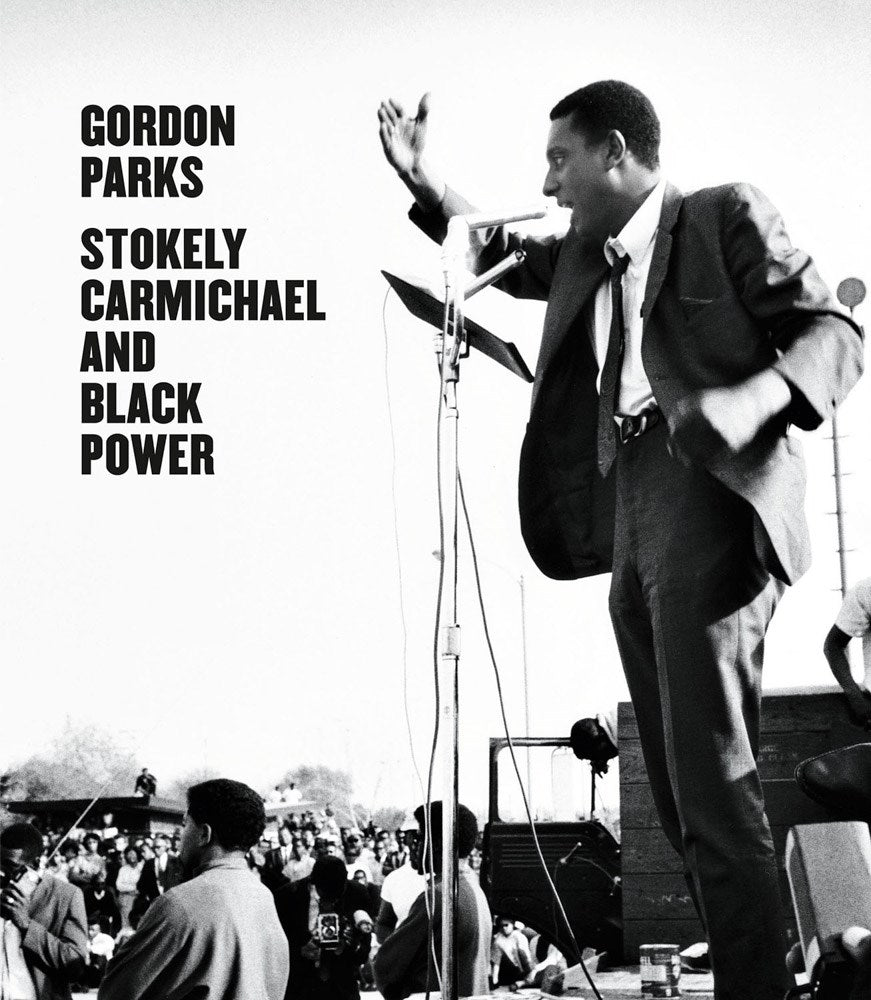
Gordon Parks: Stokely Carmichael and Black Power
Sold outA nuanced profile, in image and text, of the great Black Power leader at the exhilarating moment of the movement’s ascendancy
Gordon Parks’ 1967 Life magazine essay “Whip of Black Power” is a nuanced profile of the young, controversial civil rights leader Stokely Carmichael. As chairman of the Student Nonviolent Coordinating Committee, Carmichael gained national attention and inspired media backlash when he issued the call for Black Power in Greenwood, Mississippi, in June 1966. Parks shadowed him from the fall of 1966 to the spring of 1967, as Carmichael gave speeches, headed meetings and promoted the growing Black Power movement. Parks’ photos and writing addressed Carmichael’s intelligence and humor, presenting the whole man behind the headline-making speeches and revealing his own advocacy of Black Power and its message of self-determination and love.
Stokely Carmichael and Black Power delves into Parks’ groundbreaking presentation of Carmichael, with analysis of his images and accompanying text about the charismatic leader. Lisa Volpe explores Parks’ complex understanding of the movement and its leader, and Cedric Johnson frames Black Power within the heightened political moment of the late 1960s. Carmichael’s own voice is represented through a reprint of his important 1966 essay “What We Want.”
Gordon Parks (1912–2006) was a photographer, filmmaker, musician and author whose 50-year career focused on American culture, social justice, the civil rights movement and the Black American experience. Born into poverty and segregation in Fort Scott, Kansas, Parks was awarded the Julius Rosenwald Fellowship in 1942, which led to a position with the Farm Security Administration. In 1969 he became the first Black American to write and direct a major feature film, The Learning Tree, and his next directorial endeavor, Shaft (1971), helped define a film genre. -
Police Brutality and White Supremacy: The Fight Against American Traditions
![Police Brutality and White Supremacy: The Fight Against American Traditions]()
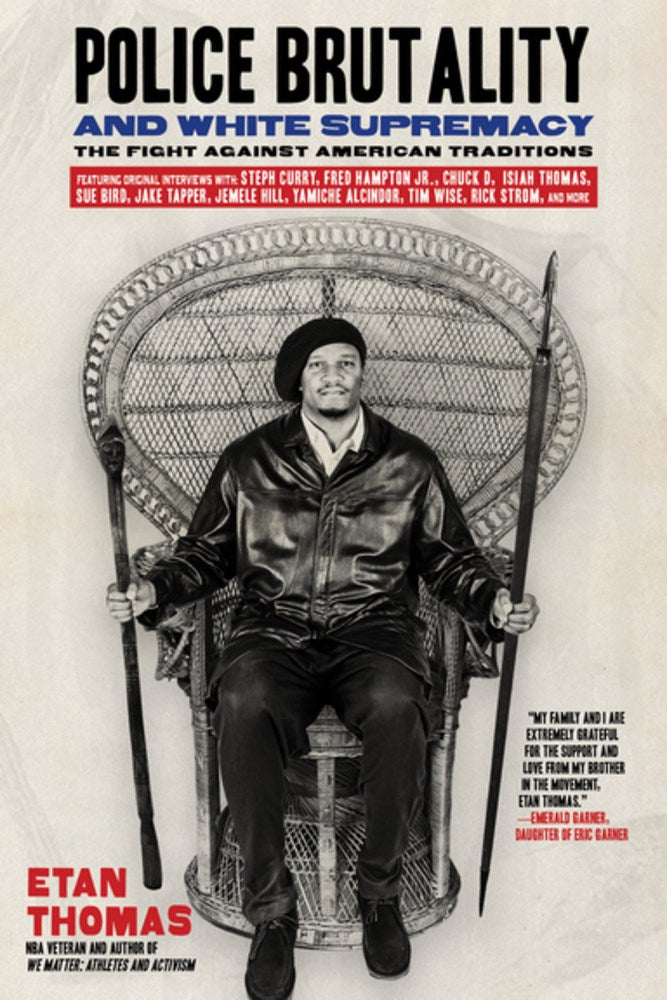
Police Brutality and White Supremacy: The Fight Against American Traditions
by Etan Thomas
Sold out*Ships in 7-10 Business Days*
ETAN THOMAS, an eleven-year NBA veteran and lifelong advocate for social justice, weaves together his personal experiences with police violence and white supremacy with multiple interviews of family members of victims of police brutality like exonerated Central Park Five survivor Raymond Santana and Rodney King’s daughter Lora Dene King; as well as activist athletes and other public figures such as Steph Curry, Chuck D, Isiah Thomas, Sue Bird, Jake Tapper, Jemele Hill, Stan Van Gundy, Kyle Korver, Mark Cuban, Rick Strom, and many more.
Thomas speaks with retired police officers about their efforts to change policing, and white allies about their experiences with privilege and their ability to influence other white people. Thomas also examines the history of racism, white supremacy, and the prevalence of both in the current moment. He looks at the origins of white supremacy in the US, dating back to the country’s inception, and explores how it was interwoven into Christianity--interviewing leading voices both in and outside of the church. Finally, with prominent voices in the media and education, Thomas discusses the continued cultivation of these injustices in American society.
Police Brutality and White Supremacy demands accountability and justice for those responsible for and impacted by police violence and terror. It offers practical solutions to work against the promotion of white supremacy in law enforcement, Christianity, early education, and across the public sphere.
Featuring original interviews with: Steph Curry, Chuck D, Yamiche Alcindor, Isiah Thomas, Jemele Hill, Craig Hodges, Stan Van Gundy, Mark Cuban, Jake Tapper, Mahmoud Abdul-Rauf, Sue Bird, Kyle Korver, Rick Strom, Cenk Uygur, Tim Wise, Chris Broussard, Breanna Stewart, Rex Chapman, Stephen Jackson, Kori Mccoy, Lora Dene King, Chikesia Clemons, Raymond Santana, Alissa Findley, Amber And Ashley Carr, Michelle And Ashley Monterrosa, Chairman Fred Hampton Jr., Abiodun Oyewole, Marc Lamont Hill, Officer Carlton Berkley, Pastor John K. Jenkins Sr., Officer Joe Ested, Captain Sonia Pruitt, and Bishop Talbert Swan.
-
Dr. No: A Novel
![Dr. No: A Novel]()

Dr. No: A Novel
by Percival Everett
Sold outA sly, madcap novel about supervillains and nothing, really, from an American novelist whose star keeps rising
The protagonist of Percival Everett’s puckish new novel is a brilliant professor of mathematics who goes by Wala Kitu. (Wala, he explains, means “nothing” in Tagalog, and Kitu is Swahili for “nothing.”) He is an expert on nothing. That is to say, he is an expert, and his area of study is nothing, and he does nothing about it. This makes him the perfect partner for the aspiring villain John Sill, who wants to break into Fort Knox to steal, well, not gold bars but a shoebox containing nothing. Once he controls nothing he’ll proceed with a dastardly plan to turn a Massachusetts town into nothing. Or so he thinks.
With the help of the brainy and brainwashed astrophysicist-turned-henchwoman Eigen Vector, our professor tries to foil the villain while remaining in his employ. In the process, Wala Kitu learns that Sill’s desire to become a literal Bond villain originated in some real all-American villainy related to the murder of Martin Luther King Jr. As Sill says, “Professor, think of it this way. This country has never given anything to us and it never will. We have given everything to it. I think it’s time we gave nothing back.”
Dr. No is a caper with teeth, a wildly mischievous novel from one of our most inventive, provocative, and productive writers. That it is about nothing isn’t to say that it’s not about anything. In fact, it’s about villains. Bond villains. And that’s not nothing.
-
My Face Is Black Is True by Mary Frances Berry
![My Face Is Black Is True by Mary Frances Berry]()
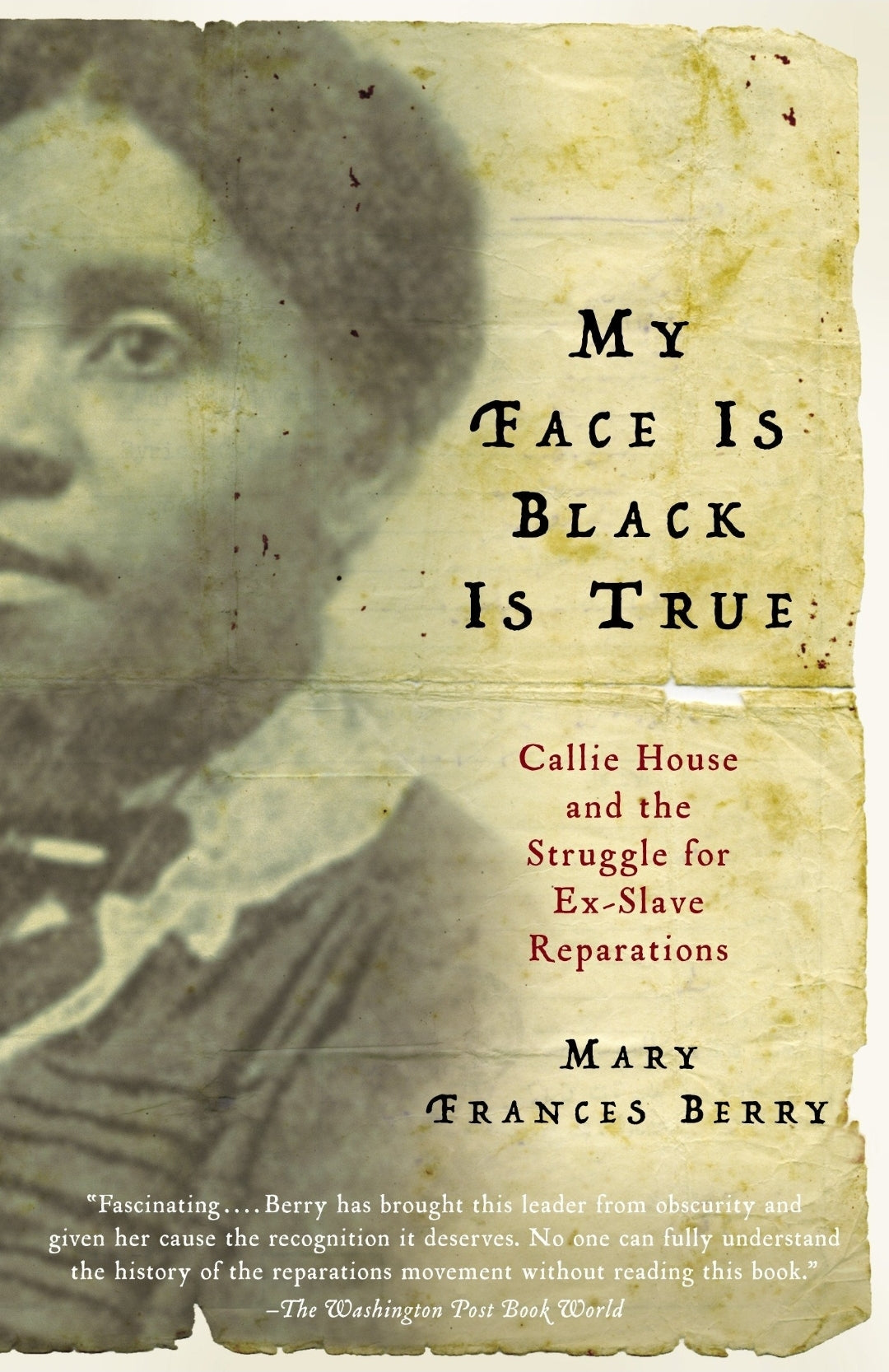
My Face Is Black Is True by Mary Frances Berry
Sold outAcclaimed historian Mary Frances Berry resurrects the remarkable story of ex-slave Callie House who, seventy years before the civil-rights movement, demanded reparations for ex-slaves. A widowed Nashville washerwoman and mother of five, House (1861-1928) went on to fight for African American pensions based on those offered to Union soldiers, brilliantly targeting $68 million in taxes on seized rebel cotton and demanding it as repayment for centuries of unpaid labor. Here is the fascinating story of a forgotten civil rights crusader: a woman who emerges as a courageous pioneering activist, a forerunner of Malcolm X and Martin Luther King, Jr.


Stay Informed. We're building a community committed to celebrating Black authors + artisans. Subscribe to keep up with all things Kindred Stories.