
Search results: 28 results for “frederick douglass”
Not finding what you're looking for? Check out our shop on bookshop.org to order and still support us ♥
28 results
-
The Portable Frederick Douglass (Penguin Classics)
![The Portable Frederick Douglass (Penguin Classics) cover image]()

The Portable Frederick Douglass (Penguin Classics)
Frederick Douglass
$25.00A new collection of the seminal writings and speeches of a legendary writer, orator, and civil rights leader
This compact volume offers a full course on the remarkable, diverse career of Frederick Douglass, letting us hear once more a necessary historical figure whose guiding voice is needed now as urgently as ever. Edited by renowned scholar Henry Louis Gates, Jr., and Pulitzer Prize–nominated historian John Stauffer, The Portable Frederick Douglass includes the full range of Douglass’s works: the complete Narrative of the Life of Frederick Douglass, as well as extracts from My Bondage and My Freedom and Life and Times of Frederick Douglass; The Heroic Slave, one of the first works of African American fiction; the brilliant speeches that launched his political career and that constitute the greatest oratory of the Civil War era; and his journalism, which ranges from cultural and political critique (including his early support for women’s equality) to law, history, philosophy, literature, art, and international affairs, including a never-before-published essay on Haitian revolutionary Toussaint L’Ouverture.
The Portable Frederick Douglass is the latest addition in a series of African American classics curated by Henry Louis Gates, Jr. First published in 2008, the series reflects a selection of great works of fiction, nonfiction, and poetry by African and African American authors introduced and annotated by leading scholars and acclaimed writers in new or updated editions for Penguin Classics. In his series essay, “What Is an African American Classic?” Gates provides a broader view of the canon of classics of African American literature available from Penguin Classics and beyond. Gates writes, “These texts reveal the human universal through the African American particular: all true art, all classics do this; this is what ‘art’ is, a revelation of that which makes each of us sublimely human, rendered in the minute details of the actions and thoughts and feelings of a compelling character embedded in a time and place.”
For more than seventy years, Penguin has been the leading publisher of classic literature in the English-speaking world. With more than 1,700 titles, Penguin Classics represents a global bookshelf of the best works throughout history and across genres and disciplines. Readers trust the series to provide authoritative texts enhanced by introductions and notes by distinguished scholars and contemporary authors, as well as up-to-date translations by award-winning translators. -
Narrative of the Life of Frederick Douglass, an American Slave (Penguin Vitae)
![Narrative of the Life of Frederick Douglass, an American Slave (Penguin Vitae) cover image]()

Narrative of the Life of Frederick Douglass, an American Slave (Penguin Vitae)
Frederick Douglass
$25.00An updated edition of a classic African American autobiography, with new supplementary materials
A Penguin Vitae Edition
The preeminent American slave narrative first published in 1845, Frederick Douglass’s Narrative powerfully details the life of the abolitionist from his birth into slavery in 1818 to his escape to the North in 1838, how he endured the daily physical and spiritual brutalities of his owners and driver, how he learned to read and write, and how he grew into a man who could only live free or die. In addition to Douglass’s classic autobiography, this new edition also includes his most famous speech “What to the Slave Is the Fourth of July?” and his only known work of fiction, The Heroic Slave, which was written, in part, as a response to Harriet Beecher Stowe’s Uncle Tom’s Cabin.
Penguin Classics presents Penguin Vitae, loosely translated as “Penguin of one’s life,” a deluxe hardcover series featuring a dynamic landscape of classic fiction and nonfiction that has shaped the course of our readers' lives. Penguin Vitae invites readers to find themselves in a diverse world of storytellers, with beautifully designed classic editions of personal inspiration, intellectual engagement, and creative originality.
-
PRE-ORDER: The Frederick Douglass Papers: Series Three: Correspondence, Volume 4: 1881-1888
![The Frederick Douglass Papers: Series Three: Correspondence, Volume 4: 1881-1888 cover image]()

PRE-ORDER: The Frederick Douglass Papers: Series Three: Correspondence, Volume 4: 1881-1888
$125.00Douglass’s letters from the 1880s reveal both his unrelenting efforts to protect African American rights and little-known details about his personal life
The fourth volume of the Correspondence Series presents Frederick Douglass as a still-influential public figure but also as a man aware that the gains African Americans made during the Civil War and Reconstruction were not as well secured as he had hoped.
For this volume, the editors selected 247 of the 914 known letters sent to or from Douglass between 1881 and 1888. An active partisan, Douglass corresponded regularly with Republican party leaders from the local to national level about campaign tactics and strategies. Douglass also often received letters from African Americans who detailed the deteriorating state of race relations across the South in the 1880s. Douglass used his correspondence to advance the political stature of Republicans he regarded as most sympathetic to protecting African American rights.
Douglass wrote about his taste in reading; his fondness for carriage riding; his feuds with family members and neighbors; his first wife, Anna Murray; and his remarriage, to Helen Pitts, and the controversy that the interracial marriage generated. Douglass’s correspondence details the seven-month honeymoon the couple took in Europe and Egypt, the reunion with old abolitionist friends in Great Britain, and candid appraisals of places he visited and people he met overseas. -
PRE-ORDER: Until the Last Yoke Is Broken: The Constitutional Vision of Frederick Douglass
![Until the Last Yoke Is Broken: The Constitutional Vision of Frederick Douglass cover image]()

PRE-ORDER: Until the Last Yoke Is Broken: The Constitutional Vision of Frederick Douglass
$29.95A groundbreaking analysis of Frederick Douglass as constitutional theorist, showing how his vision, which prefigured today’s originalism, melded history and natural rights to address the evil of slavery.
In his celebrated address “What to the Slave is the Fourth of July?” Frederick Douglass denounced America’s hypocritical celebration of freedom. But he did not blame the nation’s founding document for enabling the evil of slavery. Rather, he proclaimed that “interpreted as it ought to be interpreted, the Constitution is a Glorious Liberty Document.”
This was no mere rhetorical flourish. Examining Douglass not just as an activist but as a legal and political theorist, Until the Last Yoke Is Broken reveals that his abolitionism was guided by rigorous constitutional interpretation. Reconstructing Douglass’s method from his speeches and writings, Bradley Rebeiro shows that his approach both anticipated and challenged aspects of contemporary originalism. Like today’s originalists, Douglass saw historical meaning as central to constitutional analysis. But unlike today’s originalism, Douglass’s goes beyond simply asking how the Constitution was understood at its ratification. Instead, Douglass insisted that whenever a constitutional provision is ambiguous, the interpreter must adopt whatever meaning best agrees with the natural rights affirmed in the Declaration of Independence.
Rebeiro also shows how Douglass balanced this constitutional vision with pragmatism during Reconstruction. When political tensions pitted the fate of black suffrage against women’s suffrage, Douglass set aside the theoretically pure for the politically possible; as soon as black suffrage was secured, he returned to advocating for universal voting rights. “It was mine to stand for the freedom of people of all colors,” Douglass wrote near the end of his life, “until in our land the last yoke was broken and the last bondsman was set free.”
-
Frederick Douglass: A Novel
![Frederick Douglass: A Novel cover image]()

Frederick Douglass: A Novel
$24.95Frederick Douglass was the most prominent African American of the 19th Century and Sidney Morrison has created a mesmerizing historical novel richly detailing his life and the Civil War Era
Born into slavery, Frederick Douglass did what seemed impossible: he escaped, reinvented himself, and rose to become one of the most powerful voices in American history—a fierce abolitionist, gifted orator, founder of The North Star, and collaborator with Abraham Lincoln, William Lloyd Garrison, John Brown, and Susan B. Anthony in ending slavery and shaping U.S. democracy itself.
But in this singular work of historical fiction, Sidney Morrison is able to move beyond the legend to explore the full complexity of Douglass's interior life: the loves he protected, the choices he made, the costs paid for his greatness. Anna Murray Douglass, the wife instrumental to his escape. Julia Griffith, the British abolitionist whose closeness sparked scandal. Ottilie Assing, the German journalist who died by suicide after Douglass married another woman. Here is Douglass as history has never quite shown him: a towering public figure and a deeply complex private man, whose life was rich in conflict, consequence, and humanity.
-
What to the Slave is the Fourth of July? (Books of American Wisdom)
![What to the Slave is the Fourth of July? (Books of American Wisdom) cover image]()

What to the Slave is the Fourth of July? (Books of American Wisdom)
$12.95One of the most memorable speeches in American history, Frederick Douglass’s What to the Slave is the Fourth of July? is now available in an elegant hardcover edition.
Douglass first delivered the famous speech on July 5, 1852, to the Rochester Ladies' Anti-Slavery Society. After paying respect to the patriotic architects of America’s independence, Douglass exposed the hypocrisy of a nation that enshrined the inalienable rights of man yet enslaved millions. The signing of the Declaration of Independence was meaningless to slaves, Douglass argued, and the annual celebration of a freedom not afforded to them was the worst possible insult.
Throughout the speech, Douglass directly quoted passages from the Declaration of Independence, the U.S. Constitution, and the Bible to support his argument that slavery must be abolished in the United States. Douglass was especially critical of the faith leaders in America that used the church to justify slavery rather than to spearhead positive societal change.
Despite Douglass’s condemnation of the institutions that protected slavery, the speech also emphasized America’s young age and her potential to change for the better. In keeping with this belief in an America that would one day guarantee freedom for all, Douglass delivered “What to the Slave is the Fourth of July?” to audiences nationwide in the decade preceding the Civil War.
Famous figures such as James Earl Jones, Morgan Freeman, and Douglass’s descendants have performed small sections of the hour-long speech. Abridged editions of the speech are also disseminated for educational purposes. Because “What to the Slave Is the Fourth of July?” is an incredibly nuanced speech, it is often misrepresented or shared out of context. Now you can read the speech as it was meant to be experienced, in its entirety.
Frederick Douglass’s most famous speech is as relevant today as when it was first delivered in 1852. A defining document of the United States, What to the Slave Is the Fourth of July? is essential reading for all Americans.
-
The Classic Slave Narratives
![The Classic Slave Narratives]()
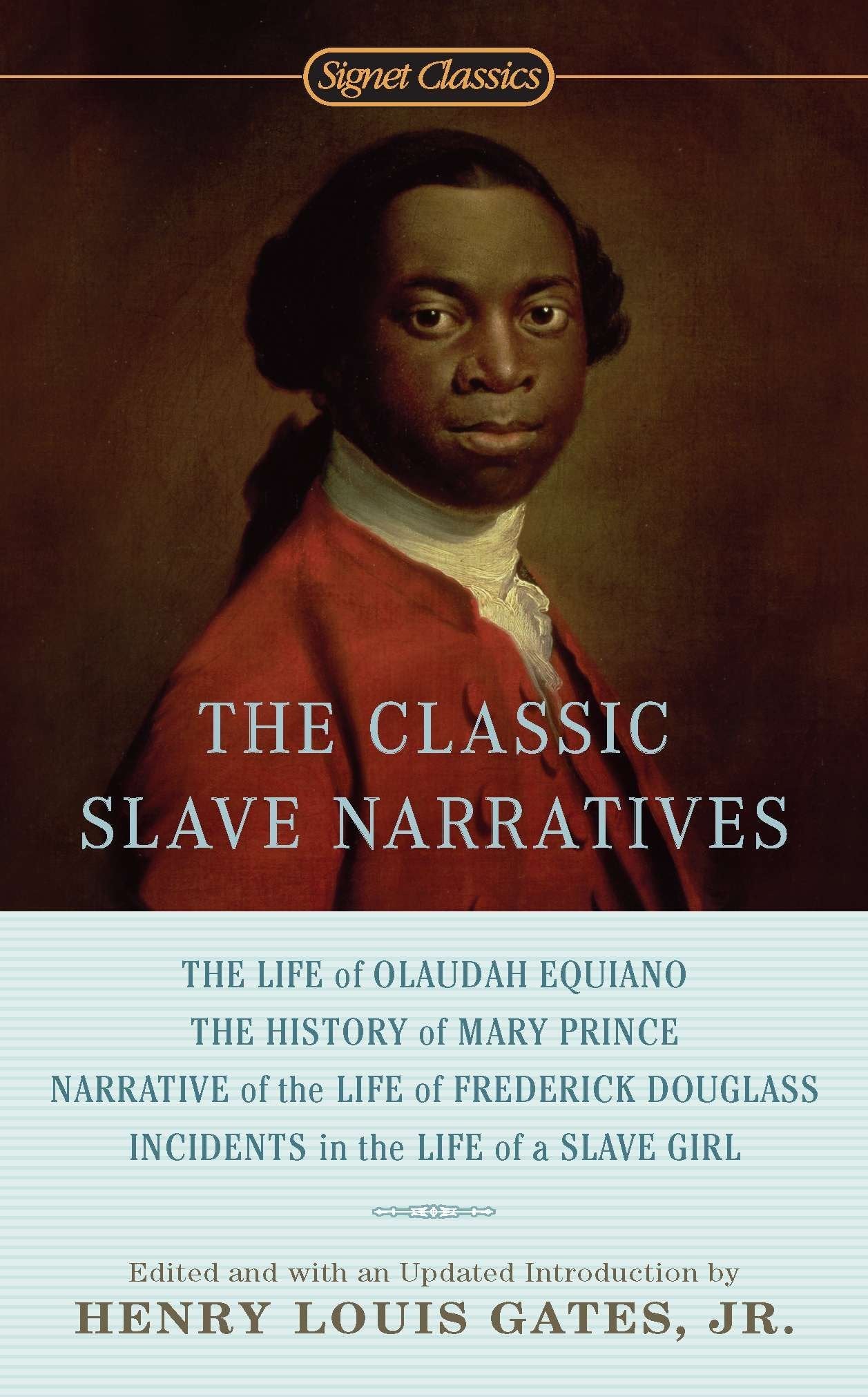
The Classic Slave Narratives
edited by Henry Louis Gates, Jr.
$7.95A seminal volume of four classic slave narratives, including Narrative of the Life of Frederick Douglass, The History of Mary Price: A West Indian Slave, Incident in the Life of a Slave Girl, and The Life of Olaudah Equiano.
Before the end of the Civil War, more than one hundred former slaves had published moving stories of their captivity and escape, joined by a similar number after the war. No group of slaves anywhere, in any other era, has left such prolific testimony to the horror of bondage and servitude.
Henry Louis Gates, Jr., one of America's top experts in African American studies, presents four of these classic narratives that illustrate the real nature of black experience in slavery.
Fascinating and powerful, this collection includes four of the best-known examples: the lives of Frederick Douglass, Harriet Jacobs (alias Linda Brent), Mary Price, and Olaudah Equiano (alias Gustavus Vassa). These amazing stories are not only first-person histories of the highest caliber, they are also a unique literary form that has given birth to the spirit, vitality, and vision of America's modern black writers.
Updated with the ninth edition of The Life of Olaudah Equiano, the last edition he revised and published in his lifetime.
With a Revised and Updated Introduction by Henry Louis Gates, Jr. -
PRE-ORDER: The People's House: The Power and Presence of African Americans in the White House
![The People's House: The Power and Presence of African Americans in the White House cover image]()

PRE-ORDER: The People's House: The Power and Presence of African Americans in the White House
$22.00A new anthology celebrating the African American voices that influenced and shaped the history of the White House
A Penguin Classic
The People’s House is an anthology comprised primarily of first-person accounts, from the eighteenth century to the present, detailing the Black experience in the White House — in turn illustrating how African Americans have influenced the presidency and policy over America’s 250-year history. The collection’s diversity of perspectives — from dressmakers and domestic staff members to abolitionists and civil rights activists, as well as cabinet members, candidates, and elected officials — charts not only a history of African Americans in the most recognizable U.S. institution, but how African Americans have used their power and presence in the White House to urge the nation toward its democratic ideals. Through the words of Frederick Douglass, Ida B. Wells-Barnett, Thurgood Marshall, Shirley Chisholm, Colin M. Powell, Barack Obama, and dozens of other figures, both prominent and lesser-known, this anthology offers an expansive and intimate view of the White House as a key site in the struggle for Black freedom and equal citizenship. Each entry is accompanied by insight from editors Michelle D. Commander and Kathleen M. Kendrick, providing biographical information and historical context to help readers further understand how African Americans have shaped the story and meaning of the People’s House.
Penguin Classics is the leading publisher of classic literature in the English-speaking world, representing a global bookshelf of the best works throughout history and across genres and disciplines. Readers trust the series to provide authoritative texts enhanced by introductions and notes by distinguished scholars and contemporary authors, as well as up-to-date translations by award-winning translators.
-
Read Until You Understand
![Read Until You Understand]()

Read Until You Understand
by Farah Jasmine Griffin
$16.95A brilliant scholar imparts the lessons bequeathed by the Black community and its remarkable artists and thinkers.
Farah Jasmine Griffin has taken to her heart the phrase "read until you understand," a line her father, who died when she was nine, wrote in a note to her. She has made it central to this book about love of the majestic power of words and love of the magnificence of Black life.
Griffin has spent years rooted in the culture of Black genius and the legacy of books that her father left her. A beloved professor, she has devoted herself to passing these works and their wisdom on to generations of students.
Here, she shares a lifetime of discoveries: the ideas that inspired the stunning oratory of Frederick Douglass and Malcolm X, the soulful music of Marvin Gaye and Stevie Wonder, the daring literature of Phillis Wheatley and Toni Morrison, the inventive artistry of Romare Bearden, and many more. Exploring these works through such themes as justice, rage, self-determination, beauty, joy, and mercy allows her to move from her aunt’s love of yellow roses to Gil Scott-Heron’s "Winter in America."
Griffin entwines memoir, history, and art while she keeps her finger on the pulse of the present, asking us to grapple with the continuing struggle for Black freedom and the ongoing project that is American democracy. She challenges us to reckon with our commitment to all the nation’s inhabitants and our responsibilities to all humanity.
-
PRE-ORDER: I Will Take to the Water: An Anthology of African Americans and the Sea
![I Will Take to the Water: An Anthology of African Americans and the Sea cover image]()

PRE-ORDER: I Will Take to the Water: An Anthology of African Americans and the Sea
$27.50A landmark survey of African American literature about Black experiences of the maritime environment.
The ocean is foundational to the story of Africans in America, beginning with the searing Middle Passage. Initially evoking terror, pain, and death, the ocean also became associated with escape, empowerment, freedom, and home, as over time, African Americans in seaport towns found work, built communities, and gained knowledge from travelers. David R. Anderson shows in this groundbreaking collection of memoir, fiction, poetry, and more that African American maritime literature summons many of the traditional themes―survival in the face of overwhelming natural force, sublimity, demonstration of skill and merit, and self-discovery―but often with an eye on legacies of imperialism, slavery, discrimination, and cultural erasure.
Divided thematically across ten sections that address peril, labor, recreation, and more, the book gathers work by influential writers and intellectuals from the eighteenth century to the present, including: Lucille Clifton, Edwidge Danticat, Frederick Douglass, Alice Dunbar-Nelson, W. E. B. DuBois, Camille T. Dungy, Marcus Garvey, Robert Hayden, Zora Neale Hurston, Major Jackson, Harriet Jacobs, John S. Jacobs, Nella Larsen, Claude McKay, Toni Morrison, Walter Mosley, Natasha Trethewey, Phillis Wheatley, Colson Whitehead, and Kevin Young.
-
Superfine: Tailoring Black Style
![Superfine: Tailoring Black Style cover image]()

Superfine: Tailoring Black Style
Tyler Mitchell, Monica L. Miller
$75.00This exploration of Black dandy fashion and its representation in art and literature highlights the vibrant, complicated legacy of a recognizable yet constantly shifting style, from its origins in Enlightenment Europe to the contemporary art and fashion worlds
Superfine: Tailoring Black Style traces the complex and vibrant legacy of menswear across three centuries of Black culture—from today’s hip-hop aesthetic and popular street trends, through its use during the Harlem Renaissance and the civil rights movement as a symbol of creative and political agency, to its surprising origins as an imposed uniform for servants and enslaved people. Organized by key characteristics of dandyism that resonate across time, including presence, distinction, disguise, and respectability, this fresh interpretation of a centuries-old aesthetic draws on prominent Black voices in fashion, literature, and art—among them, Dandy Wellington, Amy Sherald, Iké Udé, and André 3000. Self-described dandies and high-fashion models feature in a stunning photo essay by artist Tyler Mitchell, who also contributes evocative new photography of garments by contemporary designers such as Virgil Abloh, Pharrell Williams, and Grace Wales Bonner. These works are shown alongside historical attire worn by Black luminaries including Frederick Douglass, Alexandre Dumas père, Muhammad Ali, and André Leon Talley. Scholar Monica L. Miller contextualizes these objects in her text and shows how the evolution of dandy style inspired new visions of Black masculinity that use the power of clothing and dress as a means of self-expression.
Published by The Metropolitan Museum of Art/Distributed by Yale University Press
Exhibition Schedule:
The Metropolitan Museum of Art, New York
(May 10–October 26, 2025)Catalogue design by Pacific (Elizabeth Karp-Evans and Adam Turnbull)
-
American Dark Age: Racial Feudalism and the Rise of Black Liberalism
![Book cover image]()

American Dark Age: Racial Feudalism and the Rise of Black Liberalism
Keidrick Roy
$35.00How medieval-inspired racial feudalism reigned in early America and was challenged by Black liberal thinkers
Though the United States has been heralded as a beacon of democracy, many nineteenth-century Americans viewed their nation through the prism of the Old World. What they saw was a racially stratified country that reflected not the ideals of a modern republic but rather the remnants of feudalism. American Dark Age reveals how defenders of racial hierarchy embraced America’s resemblance to medieval Europe and tells the stories of the abolitionists who exposed it as a glaring blemish on the national conscience.
Against those seeking to maintain what Frederick Douglass called an “aristocracy of the skin,” Keidrick Roy shows how a group of Black thinkers, including Frances Ellen Watkins Harper, Hosea Easton, and Harriet Jacobs, challenged the medievalism in their midst—and transformed the nation’s founding liberal tradition. He demonstrates how they drew on spiritual insight, Enlightenment thought, and a homegrown political philosophy that gave expression to their experiences at the bottom of the American social order. Roy sheds new light on how Black abolitionist writers and activists worked to eradicate the pernicious ideology of racial feudalism from American liberalism and renew the country’s commitment to values such as individual liberty, social progress, and egalitarianism.
American Dark Age reveals how the antebellum Black liberal tradition holds vital lessons for us today as hate groups continue to align themselves with fantasies of a medieval past and openly call for a return of all-powerful monarchs, aristocrats, and nobles who rule by virtue of their race.


Stay Informed. We're building a community committed to celebrating Black authors + artisans. Subscribe to keep up with all things Kindred Stories.