
Search results: 20 results for “Frantz Fanon”
Not finding what you're looking for? Check out our shop on bookshop.org to order and still support us ♥
20 results
-
The Wretched of the Earth
![The Wretched of the Earth]()

The Wretched of the Earth
by Frantz Fanon
$18.00First published in 1961, Frantz Fanon’s The Wretched of the Earth is a masterful and timeless interrogation of race, colonialism, psychological trauma, and revolutionary struggle. In 2020, it found a new readership in the wake of the Black Lives Matter protests and the centering of narratives interrogating race by Black writers. Bearing singular insight into the rage and frustration of colonized peoples, and the role of violence in spurring historical change, the book incisively attacks the twin perils of post-independence colonial politics: the disenfranchisement of the masses by the elites on the one hand, and intertribal and interfaith animosities on the other. A landmark text for revolutionaries and activists, The Wretched of the Earth is an eternal touchstone for civil rights, anti-colonialism, psychiatric studies, and Black consciousness movements around the world. Translated by Richard Philcox, and featuring now-classic critical essays by Jean-Paul Sartre and Homi K. Bhabha, as well as a new essay, this sixtieth anniversary edition of Fanon’s most famous text stands proudly alongside such pillars of anti-colonialism and anti-racism as Edward Said’s Orientalism and The Autobiography of Malcolm X.
-
Toward the African Revolution
![Book cover image]()

Toward the African Revolution
Frantz Fanon
$17.00This powerful collection of articles, essays, and letters spans the period between Black Skin, White Masks (1952) and The Wretched of the Earth (1961), Fanon’s landmark manifesto on the psychology of the colonized and the means of empowerment necessary for their liberation. These pieces display the genesis of some of Fanon’s greatest ideas ideas that became so vital to the leaders of the American civil rights movement.
-
Fanon
![Fanon cover image]()

Fanon
John Edgar Wideman
$16.95A philosopher, psychiatrist, and political activist, Frantz Fanon was a fierce, acute critic of racism and oppression. Born of African descent in Martinique in 1925, Fanon fought in defense of France during World War II but later against France in Algeria’s war for independence. His last book, The Wretched of the Earth, published in 1961, inspired leaders of diverse liberation movements: Steve Biko in South Africa, Che Guevara in Latin America, the Black Panthers in the States. Wideman’s novel is disguised as the project of a contemporary African American novelist,Thomas, who undertakes writing a life of Fanon. The result is an electrifying mix of perspectives, traveling from Manhattan to Paris to Algeria to Pittsburgh. Part whodunit, part screenplay, part love story, Fanon introduces the French film director Jean-Luc Godard to the ailing Mrs. Wideman in Homewood and chases the meaning of Fanon’s legacy through our violent, post-9/11 world, which seems determined to perpetuate the evils Fanon sought to rectify.
-
Postcolonial Melancholia (The Wellek Library Lectures)
![Postcolonial Melancholia (The Wellek Library Lectures) cover image]()

Postcolonial Melancholia (The Wellek Library Lectures)
$24.95In an effort to deny the ongoing effect of colonialism and imperialism on contemporary political life, the death knell for a multicultural society has been sounded from all sides. That's the provocative argument Paul Gilroy makes in this unorthodox defense of the multiculture. Gilroy's searing analyses of race, politics, and culture have always remained attentive to the material conditions of black people and the ways in which blacks have defaced the "clean edifice of white supremacy." In Postcolonial Melancholia, he continues the conversation he began in the landmark study of race and nation 'There Ain't No Black in the Union Jack' by once again departing from conventional wisdom to examine―and defend―multiculturalism within the context of the post-9/11 "politics of security."
This book adapts the concept of melancholia from its Freudian origins and applies it not to individual grief but to the social pathology of neoimperialist politics. The melancholic reactions that have obstructed the process of working through the legacy of colonialism are implicated not only in hostility and violence directed at blacks, immigrants, and aliens but in an inability to value the ordinary, unruly multiculture that has evolved organically and unnoticed in urban centers. Drawing on the seminal discussions of race begun by Frantz Fanon, W. E. B. DuBois, and George Orwell, Gilroy crafts a nuanced argument with far-reaching implications. Ultimately, Postcolonial Melancholia goes beyond the idea of mere tolerance to propose that it is possible to celebrate the multiculture and live with otherness without becoming anxious, fearful, or violent.
-
The Black Antifascist Tradition: Fighting Back from Anti-Lynching to Abolition
![The Black Antifascist Tradition: Fighting Back from Anti-Lynching to Abolition cover image]()

The Black Antifascist Tradition: Fighting Back from Anti-Lynching to Abolition
$24.95The story of the fight against fascism across the African diaspora, revealing that Black antifascism has always been vital to global freedom struggles.
At once a history for understanding fascism and a handbook for organizing against, The Black Antifascist Tradition is an essential book for understanding our present moment and the challenges ahead.
From London to the Caribbean, from Ethiopia to Harlem, from Black Lives Matter to abolition, Black radicals and writers have long understood fascism as a threat to the survival of Black people around the world―and to everyone.
In The Black Antifascist Tradition, scholar-activists Jeanelle K. Hope and Bill Mullen show how generations of Black activists and intellectuals―from Ida B. Wells in the fight against lynching, to Angela Y. Davis in the fight against the prison-industrial complex―have stood within a tradition of Black Antifascism.
As Davis once observed, pointing to the importance of anti-Black racism in the development of facism as an ideology, Black people have been “the first and most deeply injured victims of fascism.” Indeed, the experience of living under and resisting racial capitalism has often made Black radicals aware of the potential for fascism to take hold long before others understood this danger.
The book explores the powerful ideas and activism of Paul Robeson, Mary McLeod Bethune, Claudia Jones, W. E. B. Du Bois, Walter Rodney, Frantz Fanon, Aime Cesaire, and Walter Rodney, as well as that of the Civil Rights Congress, the Black Liberation Army, and the We Charge Genocide movement, among others.
In shining a light on fascism and anti-Blackness, Hope and Mullen argue, the writers and organizers featured in this book have also developed urgent tools and strategies for overcoming it.
-
Misbehaving at the Crossroads: Essays & Writings
![Misbehaving at the Crossroads: Essays & Writings cover image]()

Misbehaving at the Crossroads: Essays & Writings
Honoree Fanonne Jeffers
$19.99The New York Times-bestselling, National Book Award-nominated author of The Love Songs of W.E.B. Du Bois and The Age of Phillis makes her nonfiction debut with this personal and thought-provoking work that explores the journeys and possibilities of Black women throughout American history and in contemporary times.
Honorée Fanonne Jeffers is at a crossroads.
Traditional African/Black American cultures present the crossroads as a place of simultaneous difficulty and possibility. In contemporary times, Kimberlé Crenshaw coined the phrase “intersectionality” to explain the unique position of Black women in America. In many ways, they are at a third crossroads: attempting to fit into notions of femininity and respectability primarily assigned to White women, while inventing improvisational strategies to combat oppression.
In Misbehaving at the Crossroads, Jeffers explores the emotional and historical tensions in Black women’s public lives and her own private life. She charts voyages of Black girlhood to womanhood and the currents buffeting these journeys, including the difficulties of racially gendered oppression, the challenges of documenting Black women’s ancestry; the adultification of Black girls; the irony of Black female respectability politics; the origins of Womanism/Black feminism; and resistance to White supremacy and patriarchy. As Jeffers shows with empathy and wisdom, naming difficult historical truths represents both Blues and transcendence, a crossroads that speaks.
Necessary and sharply observed, provocative and humane, and full of the insight and brilliance that has characterized her poetry and fiction, Misbehaving at the Crossroads illustrates the life of one extraordinary Black woman—and her extraordinary foremothers.
-
Stigma and Culture: Last-Place Anxiety in Black America (Lewis Henry Morgan Lecture Series)
![Book cover image]()

Stigma and Culture: Last-Place Anxiety in Black America (Lewis Henry Morgan Lecture Series)
J. Lorand Matory and Thomas P. Gibson
$32.00In Stigma and Culture, J. Lorand Matory provocatively shows how ethnic identification in the United States—and around the globe—is a competitive and hierarchical process in which populations, especially of historically stigmatized races, seek status and income by dishonoring other stigmatized populations. And there is no better place to see this than among the African American elite in academia, where he explores the emergent ethnic identities of African and Caribbean immigrants and transmigrants, Gullah/Geechees, Louisiana Creoles, and even Native Americans of partly African ancestry.
Matory describes the competitive process that hierarchically structures their self-definition as ethnic groups and the similar process by which middle-class African Americans seek distinction from their impoverished compatriots. Drawing on research at universities such as Howard, Harvard, and Duke and among their alumni networks, he details how university life—while facilitating individual upward mobility, touting human equality, and regaling cultural diversity—also perpetuates the cultural standards that historically justified the dominance of some groups over others. Combining his ethnographic findings with classic theoretical insights from Frantz Fanon, Fredrik Barth, Erving Goffman, Pierre Bourdieu and others—alongside stories from his own life in academia—Matory sketches the university as an institution that, particularly through the anthropological vocabulary of culture, encourages the stigmatized to stratify their own. -
Testimony Therapy: Decolonizing Mental Health for Black Therapists and Clients
![Testimony Therapy: Decolonizing Mental Health for Black Therapists and Clients cover image]()

Testimony Therapy: Decolonizing Mental Health for Black Therapists and Clients
$28.99Centering Black culture and community for liberating, anti-racist therapeutic practice.
This innovative book lays out the journey of family therapist Makungu Akinyela in developing testimony therapy―a healing practice rooted in Black cultural traditions of testifying and storytelling. This book argues that traditional Eurocentric approaches to therapy often perpetuate colonial oppression in the lives of Black clients, and that decolonizing mental health requires centering African American cultural knowledge, history, and community.
Drawing from thinkers from the Black radical critical tradition like Frantz Fanon and W. E. B. Du Bois, Dr. Akinyela frames testimony therapy as a narrative practice grounded in Ubuntu (the African communal self) and the oral traditions of African diasporic peoples. Testimony Therapy maps out theory, practices, and supervision approaches that help therapists support clients in resisting internalized racism, reclaiming self-definition, and nurturing liberated Black identities. Ultimately, this work is a call for Black therapists and clients to engage therapy as cultural resistance―a pathway to repair our souls and build collective freedom beyond Eurocentric limitations.
-
Afropessimism
![Afropessimism]()
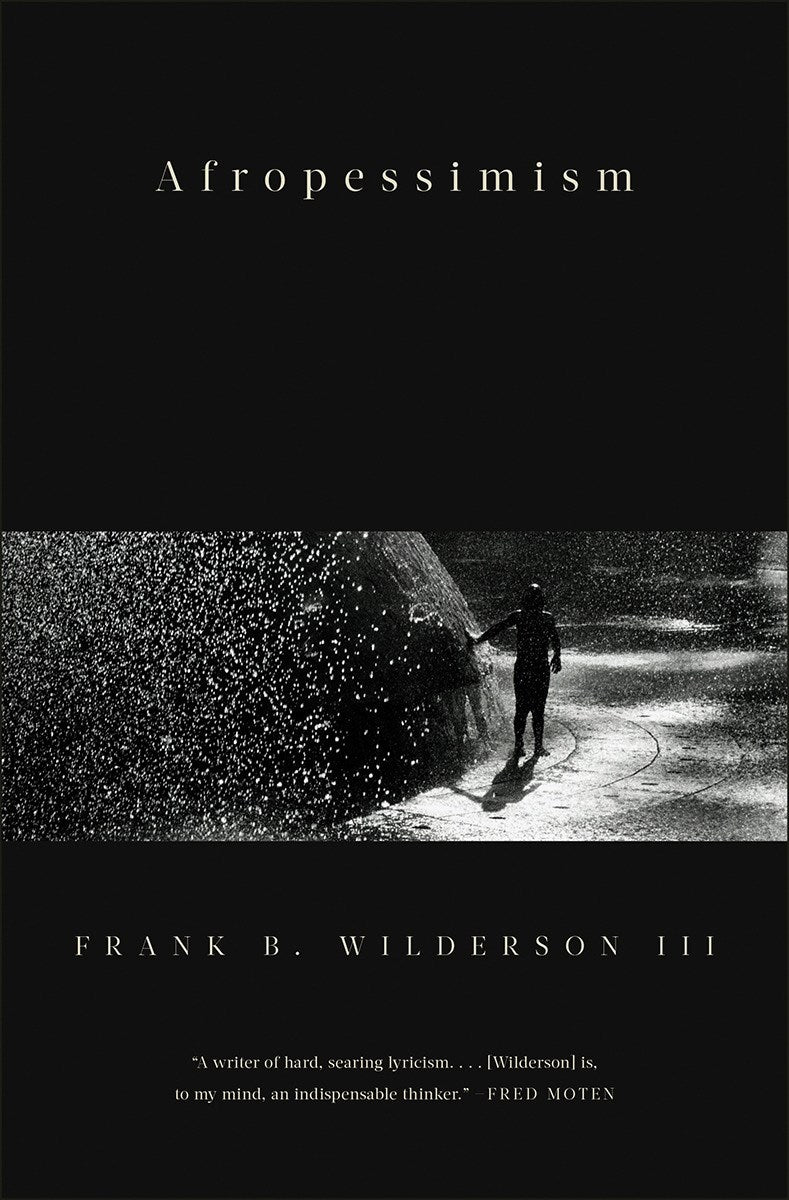
Afropessimism
by Frank B Wilderson III
from $18.95*ships in 7-10 business days
Longlisted • National Book Award (Nonfiction)
Combining trenchant philosophy with lyrical memoir, Afropessimism is an unparalleled account of Blackness.Why does race seem to color almost every feature of our moral and political universe? Why does a perpetual cycle of slavery—in all its political, intellectual, and cultural forms—continue to define the Black experience? And why is anti-Black violence such a predominant feature not only in the United States but around the world? These are just some of the compelling questions that animate Afropessimism, Frank B. Wilderson III’s seminal work on the philosophy of Blackness.
Combining precise philosophy with a torrent of memories, Wilderson presents the tenets of an increasingly prominent intellectual movement that sees Blackness through the lens of perpetual slavery. Drawing on works of philosophy, literature, film, and critical theory, he shows that the social construct of slavery, as seen through pervasive anti-Black subjugation and violence, is hardly a relic of the past but the very engine that powers our civilization, and that without this master-slave dynamic, the calculus bolstering world civilization would collapse. Unlike any other disenfranchised group, Wilderson argues, Blacks alone will remain essentially slaves in the larger Human world, where they can never be truly regarded as Human beings, where, “at every scale of abstraction, violence saturates Black life.”
And while Afropessimism delivers a formidable philosophical account of being Black, it is also interwoven with dramatic set pieces, autobiographical stories that juxtapose Wilderson’s seemingly idyllic upbringing in mid-century Minneapolis with the abject racism he later encounters—whether in late 1960s Berkeley or in apartheid South Africa, where he joins forces with the African National Congress. Afropessimism provides no restorative solution to the hatred that abounds; rather, Wilderson believes that acknowledging these historical and social conditions will result in personal enlightenment about the reality of our inherently racialized existence.
Radical in conception, remarkably poignant, and with soaring flights of lyrical prose, Afropessimism reverberates with wisdom and painful clarity in the fractured world we inhabit. It positions Wilderson as a paradigmatic thinker and as a twenty-first-century inheritor of many of the African American literary traditions established in centuries past.
-
The Second Emancipation: Nkrumah, Pan-Africanism, and Global Blackness at High Tide
![The Second Emancipation: Nkrumah, Pan-Africanism, and Global Blackness at High Tide cover image]()

The Second Emancipation: Nkrumah, Pan-Africanism, and Global Blackness at High Tide
Howard W. French
from $22.99*Paperback Release Date - 10/6/2026*
Named one of the Most Anticipated Books of 2025 by Foreign Policy
“Howard French’s The Second Emancipation stands the second half of the last century on its geopolitical head.” ―David Levering Lewis, winner of the Pulitzer Prize
From the acclaimed author of Born in Blackness comes an extraordinary account of Africa’s liberation from colonial oppression, a work that fundamentally reshapes our understanding of modern history.
A work of epic dimension that recasts the liberation of twentieth-century Africa through the lens of revolutionary leader Kwame Nkrumah.
The Second Emancipation, the second work in a trilogy from best-selling author Howard W. French about Africa’s pivotal role in shaping world history, underscores Adam Hochschild’s contention that French is a “modern-day Copernicus.” The title―referring to a brief period beginning in 1957 when dozens of African colonies gained their freedom―positions this liberation at the center of a “movement of global Blackness,” with one charismatic leader, Kwame Nkrumah (1909–1972), at its head.
That so few people today know about Nkrumah is an omission that French demonstrates is “typical of our deliberate neglect of Africa’s enormous role in the birth of the modern world.” Determined to re-create Nkrumah’s life as “an epic twentieth-century story,” The Second Emancipation begins with his impoverished, unheralded birth in the far-western region of Ghana’s Gold Coast. But blessed with a deep curiosity, a young Nkrumah pursued an overseas education in the United States. Nowhere is French’s consummate style more vivid than in Nkrumah’s early years in Depression-era America, especially in his mesmerizing portrait of a culturally effervescent Harlem that Nkrumah encountered in 1935 before heading to college. During his student years in Pennsylvania and later as an activist in London, Nkrumah became steeped in a renowned international Black intellectual milieu―including Du Bois, Garvey, Fanon, Padmore, and C.L.R. James, who called him “one of the greatest political leaders of our century”―and formed an ideology that readied him for an extraordinarily swift and peaceful rise to power upon his return to Ghana in 1947.
Four years later, in a political landslide he engineered while imprisoned, Nkrumah stunned Britain by winning the first general election under universal franchise in Africa, becoming Ghana’s first independent prime minister in 1957. As leader of a sovereign nation, Nkrumah wielded his influence to promote the liberation of the entire continent, pushing unity as the only pathway to recover from the damages of enslavement and subjugation. By the time national military and police forces, aided by the CIA, overthrew him in 1966, Nkrumah’s radical belief in pan-African liberation had both galvanized dozens of nascent African states and fired a global agenda of Black power.
In its dramatic recasting of the American civil rights story and in its tragic depiction of a continent that once exuded all the promise of a newly won freedom, The Second Emancipation becomes a generational work that positions Africa at the forefront of modern-day history.
16 pages of illustrations; 3 maps
-
Read Until You Understand
![Read Until You Understand]()

Read Until You Understand
by Farah Jasmine Griffin
$16.95A brilliant scholar imparts the lessons bequeathed by the Black community and its remarkable artists and thinkers.
Farah Jasmine Griffin has taken to her heart the phrase "read until you understand," a line her father, who died when she was nine, wrote in a note to her. She has made it central to this book about love of the majestic power of words and love of the magnificence of Black life.
Griffin has spent years rooted in the culture of Black genius and the legacy of books that her father left her. A beloved professor, she has devoted herself to passing these works and their wisdom on to generations of students.
Here, she shares a lifetime of discoveries: the ideas that inspired the stunning oratory of Frederick Douglass and Malcolm X, the soulful music of Marvin Gaye and Stevie Wonder, the daring literature of Phillis Wheatley and Toni Morrison, the inventive artistry of Romare Bearden, and many more. Exploring these works through such themes as justice, rage, self-determination, beauty, joy, and mercy allows her to move from her aunt’s love of yellow roses to Gil Scott-Heron’s "Winter in America."
Griffin entwines memoir, history, and art while she keeps her finger on the pulse of the present, asking us to grapple with the continuing struggle for Black freedom and the ongoing project that is American democracy. She challenges us to reckon with our commitment to all the nation’s inhabitants and our responsibilities to all humanity.
-
Freedom Is a Constant Struggle: Ferguson, Palestine, and the Foundations of a Movement
![Freedom Is a Constant Struggle: Ferguson, Palestine, and the Foundations of a Movement]()
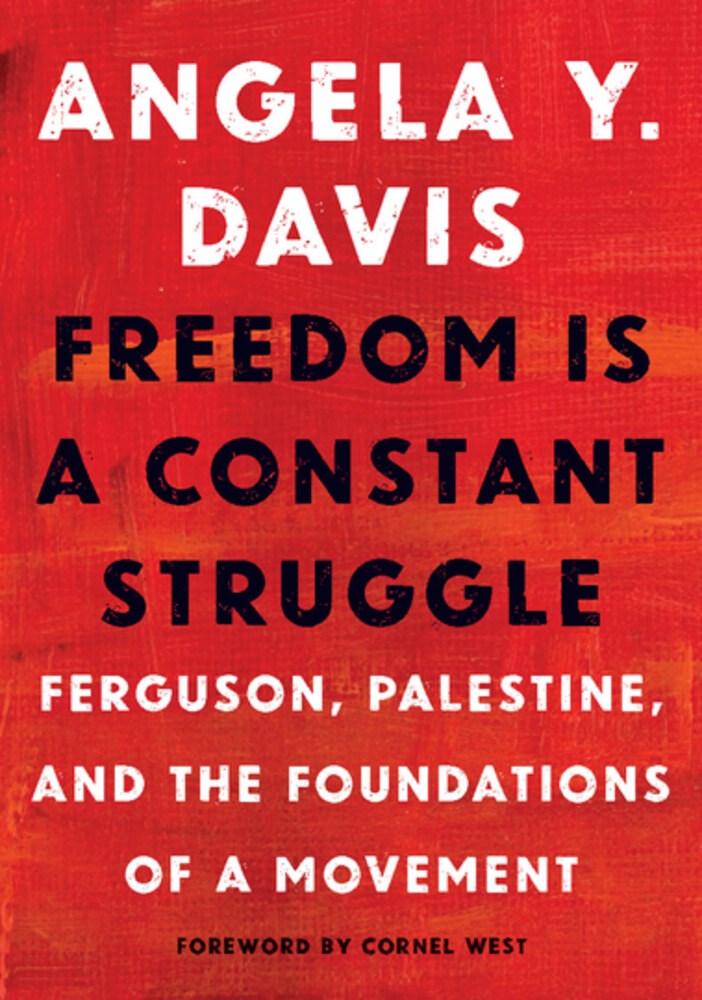
Freedom Is a Constant Struggle: Ferguson, Palestine, and the Foundations of a Movement
by Angela Y. Davis
$15.95Activist, teacher, author and icon of the Black Power movement Angela Davis talks Ferguson, Palestine, and prison abolition.
In these newly collected essays, interviews, and speeches, world-renowned activist and scholar Angela Y. Davis illuminates the connections between struggles against state violence and oppression throughout history and around the world.
Reflecting on the importance of black feminism, intersectionality, and prison abolitionism for today's struggles, Davis discusses the legacies of previous liberation struggles, from the Black Freedom Movement to the South African anti-Apartheid movement. She highlights connections and analyzes today's struggles against state terror, from Ferguson to Palestine.
Facing a world of outrageous injustice, Davis challenges us to imagine and build the movement for human liberation. And in doing so, she reminds us that "Freedom is a constant struggle."


Stay Informed. We're building a community committed to celebrating Black authors + artisans. Subscribe to keep up with all things Kindred Stories.