
Rice University: ENGL 370 001/SWGS 370 001: African American Lit
- Some of Them Will Carry Me
![Some of Them Will Carry Me]()
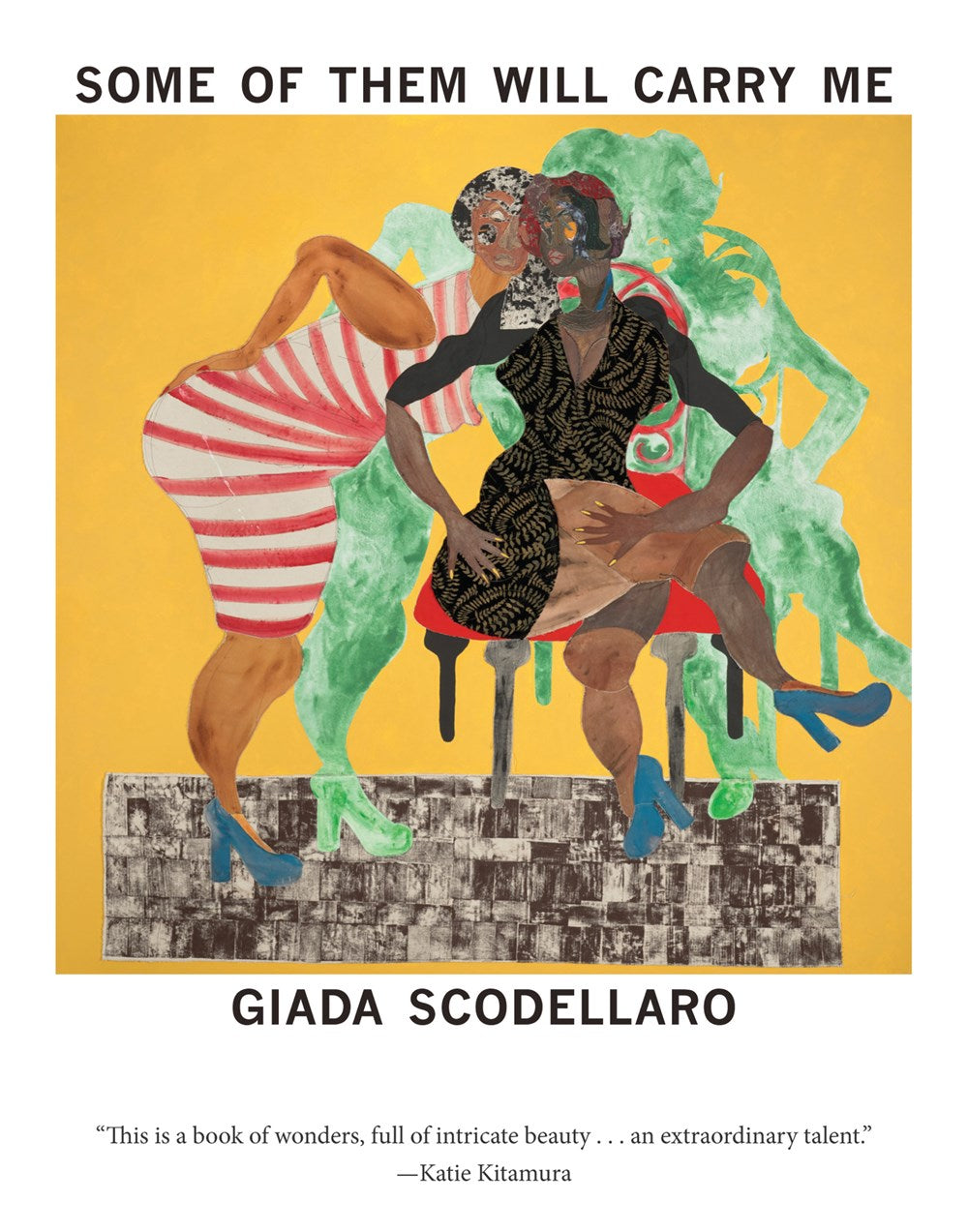
Some of Them Will Carry Me
$18.00A fiercely original debut collection centers Black women in moments of imminent change.
Giada Scodellaro’s stories range in length, style, and tone—a collage of social commentary, surrealism, recipes, folklore, and art.
What brings them together is a focus on experiences of Black women in moments of dislocation, and a cinematic prose style saturated with detail: a child’s legs bent upon the small bosom of their mother, three-piece suits floating in a river, a man holding a rotting banana during sex, wet cardboard, a woman walking naked through a traffic tunnel.
In language that is lyrical, minimal, and often absurd, the diverse stories in Some of Them Will Carry Me deconstruct contemporary life while building a surprising new reality of language, intimacy, and loss. - Interlocutor Goddess (CAAPP Book Prize)
![Interlocutor Goddess (CAAPP Book Prize) cover image]()

Interlocutor Goddess (CAAPP Book Prize)
$17.95“Jasmine Reid writes a shapeful, theoretical work involved in the rigorous attending to emergent selves and the languages made in calling them into being.” —aracelis girmay
Interlocutor Goddess explores the creation of a trans language for selfhood within an exilic state of "ecstatic grief."
Reid's experimental work challenges societal norms, particularly the family as a political construct while reflecting on the trans experiences of a queer Black woman. The poems grapple with oppressive systems of separation and colonial legacies, rejecting extractive, empire-driven paradigms, and gender essentialism. Within her collection, Reid envisions alternative, ethical ways of being, rooted in unity and wholeness and finds kinship with the rhythms and lifeways of the natural world—soil, stars, and water.
Her poetry employs a trans-lyricism, weaving together dual meanings through homonyms, homophones, and portmanteaus to create a layered, fugitive language that resists rigid classifications. At its core, Interlocutor Goddess is an act of transfiguration, a celebration of girlhood, and a reclamation of wholeness for all who exist beyond imposed boundaries.
- Letters to the Future: Black Women/Radical Writing
![Letters to the Future: Black Women/Radical Writing cover image]()

Letters to the Future: Black Women/Radical Writing
Sold outPoetry. African & African American Studies. LGBTQIA Studies. Women's Studies. Art. Edited by Erica Hunt and Dawn Lundy Martin. A collection of poems, essays, elder conversations, and visual works, LETTERS TO THE FUTURE: BLACK WOMEN / RADICAL WRITING, celebrates temporal, spatial, formal, and linguistically innovative literature. The anthology collects late-modern and contemporary work by Black women from the United States, England, Canada, and the Caribbean--work that challenges readers to participate in meaning making. Because one contextual framework for the collection is "art as a form of epistemology," the writing in the anthology is the kind of work driven by the writer's desire to radically present, uncovering what she knows and does not know, as well as critically addressing the future.
Erica Hunt, in her introduction to the collection, says, "The future is a slippery project. What can it hold? We asked writers to write about it, imagining the future as the present conjugated--conjoining the past, the present with some other time...One dimension that drew our curiosity was to know how this particular group of Black women writers would respond to the question of tomorrow. The Black women in this edition were writers we'd known or been introduced to who had been insistent makers of poems and prose that set up radical encounters between language, person, community and the political. We discussed these letters as we received them, marveling at the range of strategies to refract, forecast or expand the penumbra of the present into the shifting and dim lit future."
In Dawn Lundy Martin's introduction, she says, "It has always been difficult for me to conceptualize what we call blackness in relation to human bodies, particularly myself as an indicator of the thing I don't quite understand. It's a strange predicament, and a worrying one...On the one hand, the claim of blackness need not be a claim. A black person in the world experiences themselves as black given the perception by others as to what black is. It is a (mis)recognition, always legible, often very slight in the adjustment of the face, a minor tick, a momentary widening of the eyes, almost imperceptible in its speechless announcement, 'a black is in the room.'"
List of contributors includes Betsy Fagin, Ruth Ellen Kocher, Robin Coste Lewis, Lillian Yvonne Bertram, LaTasha N. Nevada Diggs, r. erica doyle, Adjua Gargi Nzinga Greaves, Duriel E. Harris, Harryette Mullen, giovanni singleton, Evie Shockley, Khadijah Queen, Wendy S. Walters, Adrian Piper, Yona Harvey, Harmony Holiday, Tracie Morris, Claudia Rankine, Deborah Richards, Metta Sáma, Kara Walker, Renee Gladman, Tonya Foster, Julie Patton, Akilah Oliver, Simone White, M. NourbeSe Philip, Lucille Clifton and Sonia Sanchez in conversation, Wanda Coleman interview, Jayne Cortez and Sekou Siundiata with Tracie Morris, Erica Hunt, Dawn Lundy Martin, and Tisa Bryant.


Stay Informed. We're building a community committed to celebrating Black authors + artisans. Subscribe to keep up with all things Kindred Stories.